Colombia is set to grow faster than Brazil and Mexico next year, but the World Bank says the economy will lose momentum as fiscal strains and sticky inflation keep a lid on activity.
Colombia 2026 GDP forecast at 2.3% on fiscal risks

The bank kept its 2026 gross domestic product forecast for Colombia at 2.3%, which would put the country ahead of Brazil and Argentina at 2.1% each, Mexico at 1.4%, Uruguay at 1.2% and Chile at 0.8%. That still leaves Colombia behind Paraguay, Peru and Ecuador in a regional ranking that underscores how uneven Latin America’s recovery remains.
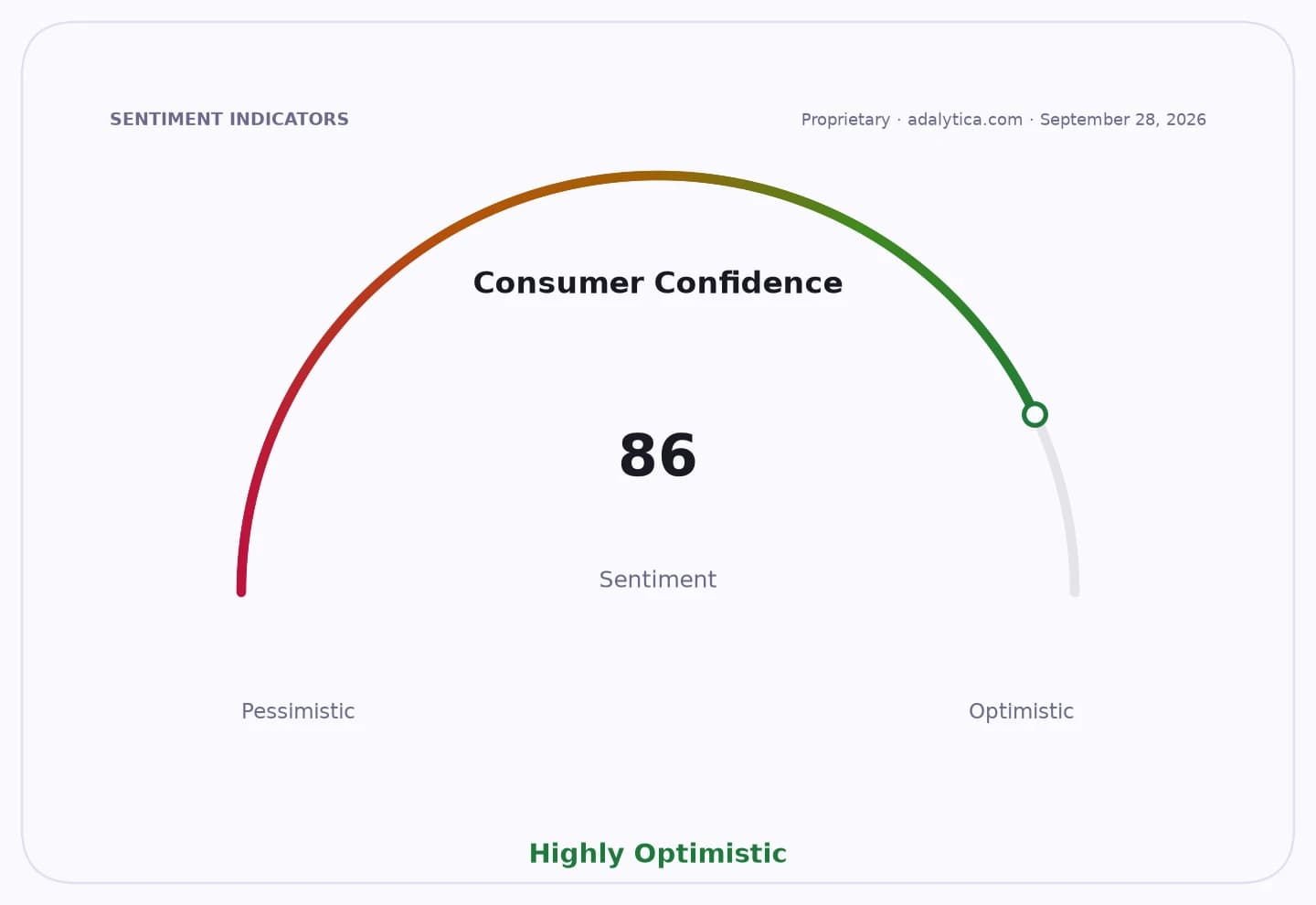
Sentiment IndicatorsⓘProprietary · adalytica.com · October 8, 2026
This is a snapshot — live sentiment, awareness and momentum for 130+ markets update continuously in the dashboard.Open AlphaPulse
For investors, the message is mixed: Colombia is not the region’s standout performer, but it is projected to avoid the deeper slowdown hitting larger peers. The World Bank also said Colombia’s growth would decelerate from 2.6% in 2025 and remain above the 0.8% and 1.5% pace posted in 2023 and 2024, suggesting the economy is still expanding, just not quickly enough to escape structural constraints.
Domestic demand is doing the heavy lifting. The report says household spending continues to support activity, even as inflation and public finances weigh on the outlook. Colombia’s annual inflation was 6.24% in August, and private-sector forecasts cited in the report pointed to 6.33% for September and 6.91% by the end of 2026, well above the central bank’s 3% target and above its 2% to 4% tolerance band.
That matters because persistent price pressure keeps interest rates elevated and squeezes consumer purchasing power. It also limits policy room for the central bank at a time when the government is already under pressure to finance emergency and recovery spending after the earthquake highlighted in the report.
Fiscal risks are becoming part of the growth story. Colombia’s autonomous fiscal rule committee said in September that net debt could reach 67.3% of GDP in 2027, close to the 71% ceiling, and warned that earthquake-related costs were not fully reflected in its calculations. The World Bank’s warning that budget pressures will limit growth reflects that backdrop.
The broader regional picture is hardly supportive. The World Bank sees Latin America and the Caribbean expanding 2.2% in 2026, down from 2.4% in 2025, as investment remains weak and high borrowing costs curb business spending. A worsening El Niño risk adds another layer of uncertainty by threatening hydroelectric output and potentially lifting energy costs across the region.
For markets, the outlook points to a Colombia economy that can keep growing, but only modestly, with consumption as the main support and fiscal credibility as the key risk. The next tests will be inflation prints, policy signals from the central bank and any new estimates of the fiscal cost tied to disaster recovery.
| Entity | Gains | Losses |
|---|---|---|
| Colombia consumers | ▲Still support growth | ▼Real purchasing power eroded by inflation |
| Colombian exporters | ▲Relative growth outpaces Mexico and Brazil | ▼Weak global demand and regional slowdown |
| Colombia government | ▲Economy keeps expanding | ▼Higher debt and tighter fiscal space |
| Fixed-income investors | ▲Potential yield carry in a high-rate setting | ▼Fiscal and inflation risk remain elevated |