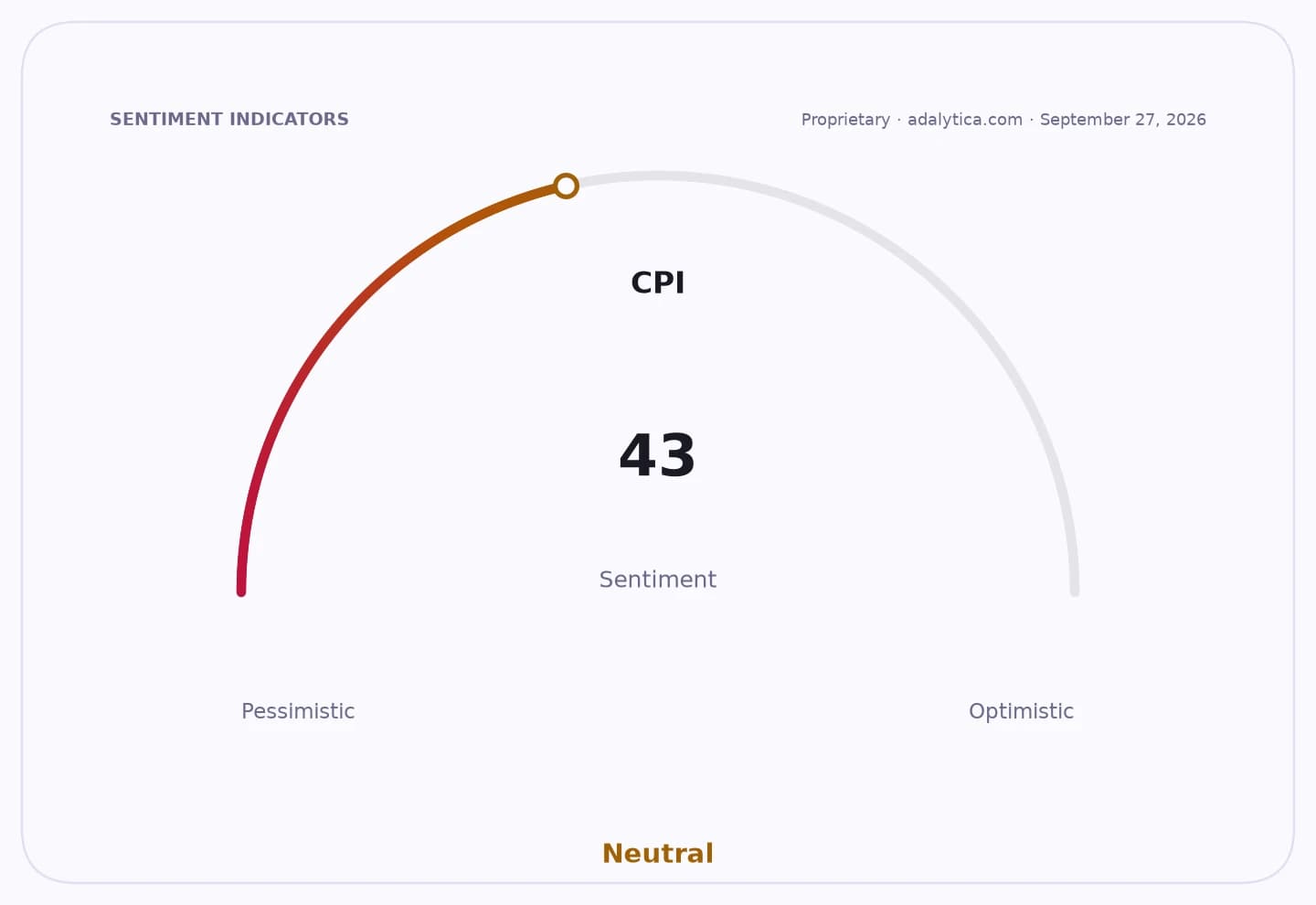
Mexico’s private-sector economists turned a little more optimistic on growth, but the bigger market message is that they still see a long stretch of tight monetary conditions keeping the recovery muted.
Mexico GDP Forecast Raised as Banxico Hold Seen
Citi’s latest Mexico survey lifted the 2026 GDP forecast to 1.4% from 1.3%, with analysts pointing to a consumption-led rebound after a weak first quarter and a stronger-than-expected 2.1% expansion in the second quarter. The improvement matters because it suggests Mexico is avoiding a sharper slowdown even as private investment remains soft, borrowing costs stay high and manufacturing and construction continue to lag.
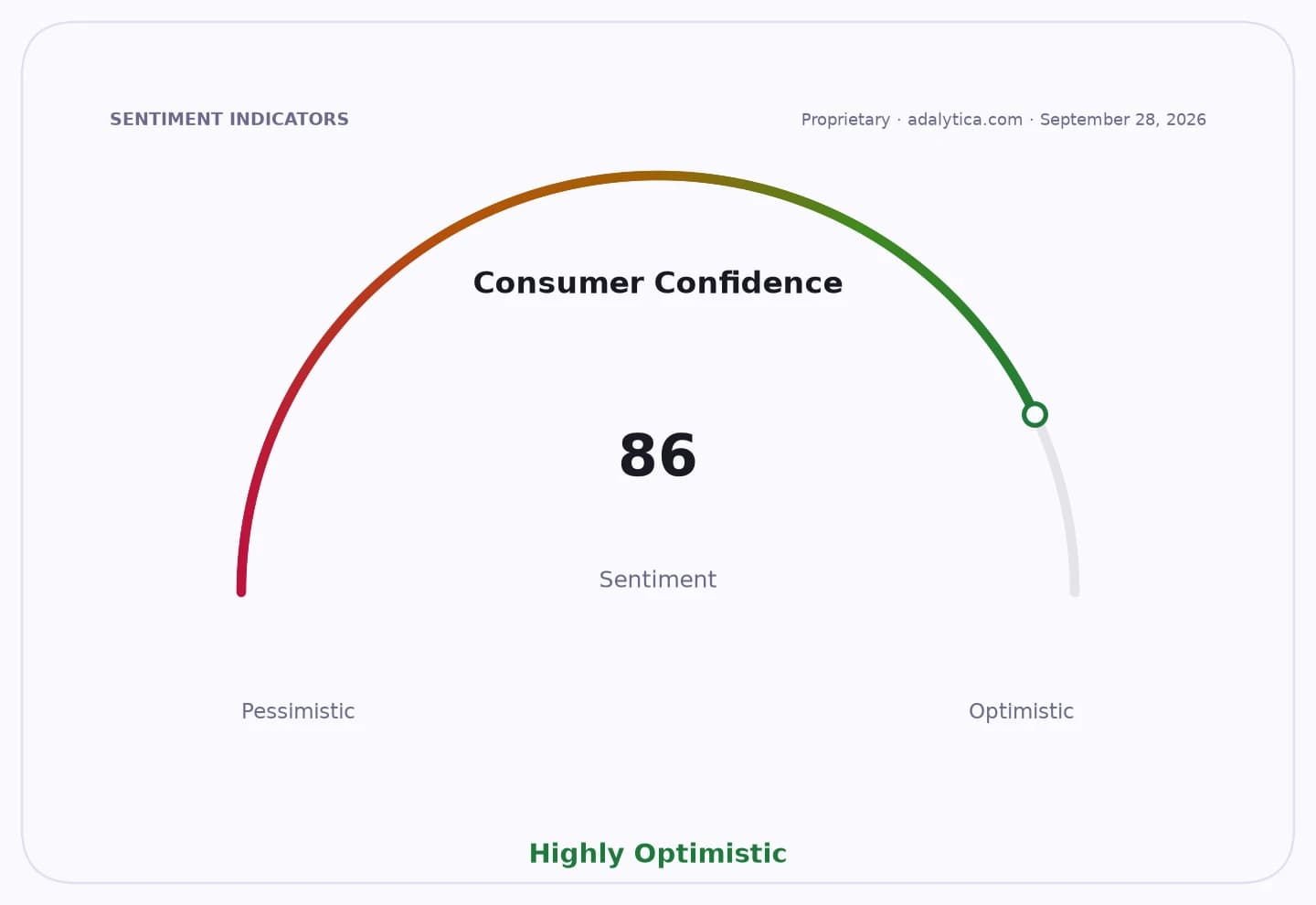
Sentiment IndicatorsⓘProprietary · adalytica.com · September 28, 2026
This is a snapshot — live sentiment, awareness and momentum for 130+ markets update continuously in the dashboard.Open AlphaPulse
The revised outlook is modest rather than transformative. Forecasts for 2027 were unchanged at 1.8%, implying analysts expect a gradual acceleration, not a broad-based surge. That view remains well below the government’s 2.3% estimate and only slightly above earlier private-sector calls, underscoring how much the economy still depends on household spending rather than fixed investment.
The central bank outlook is arguably the more important part of the survey for investors. Of 36 groups polled, 25 expect Banxico to leave the benchmark rate at 6.50% on Thursday, and most do not see another move until late 2027. That would extend an unusually long pause after a cumulative 475 basis points of cuts across 15 meetings. For companies and households, it means financing conditions are likely to stay restrictive even as growth improves only slowly.
That combination — firmer consumption, weak capital spending and elevated rates — captures the basic tension in Mexico’s economy heading into 2027. Lower inflation expectations give Banxico room to wait, with analysts now seeing headline inflation ending 2026 at 3.93%, down from 4.00% in the previous survey. Core inflation is projected at 3.92% for next year, also easing from earlier estimates. But inflation is still expected to sit above the 3% midpoint, and the gap between current readings and year-end forecasts suggests pressure may re-emerge later in the year.
For markets, the survey supports the view that Mexico is not headed into a policy easing cycle any time soon. A prolonged hold tends to support the peso through the rate differential with the United States, but it also keeps credit expensive for corporates that need funding for expansion. That helps explain why gross fixed investment has remained weak despite a better growth backdrop. The economy can still expand on household demand and government transfers, but it is harder to get a durable productivity-led rebound without stronger private capital formation.
The broader picture is one of resilience with constraints. The second-quarter GDP bounce has reassured forecasters enough to lift estimates, and the OECD’s more upbeat tone adds to the case that Mexico can outperform some peers in the near term. Yet the survey also makes clear that the main headwinds — cautious investment, policy tightness and uncertainty around trade and the USMCA review — have not gone away. For investors, that leaves Mexico looking steadier, but not obviously on the verge of a sustained growth re-rating.
| Entity | Gains | Losses |
|---|---|---|
| Mexico households | ▲Support from consumption | ▼Higher borrowing costs |
| Banxico | ▲Inflation credibility | ▼Room to ease policy |
| Mexican corporates | ▲Some demand recovery | ▼Costly financing |
| Peso bulls | ▲Rate support | ▼Slower investment growth |