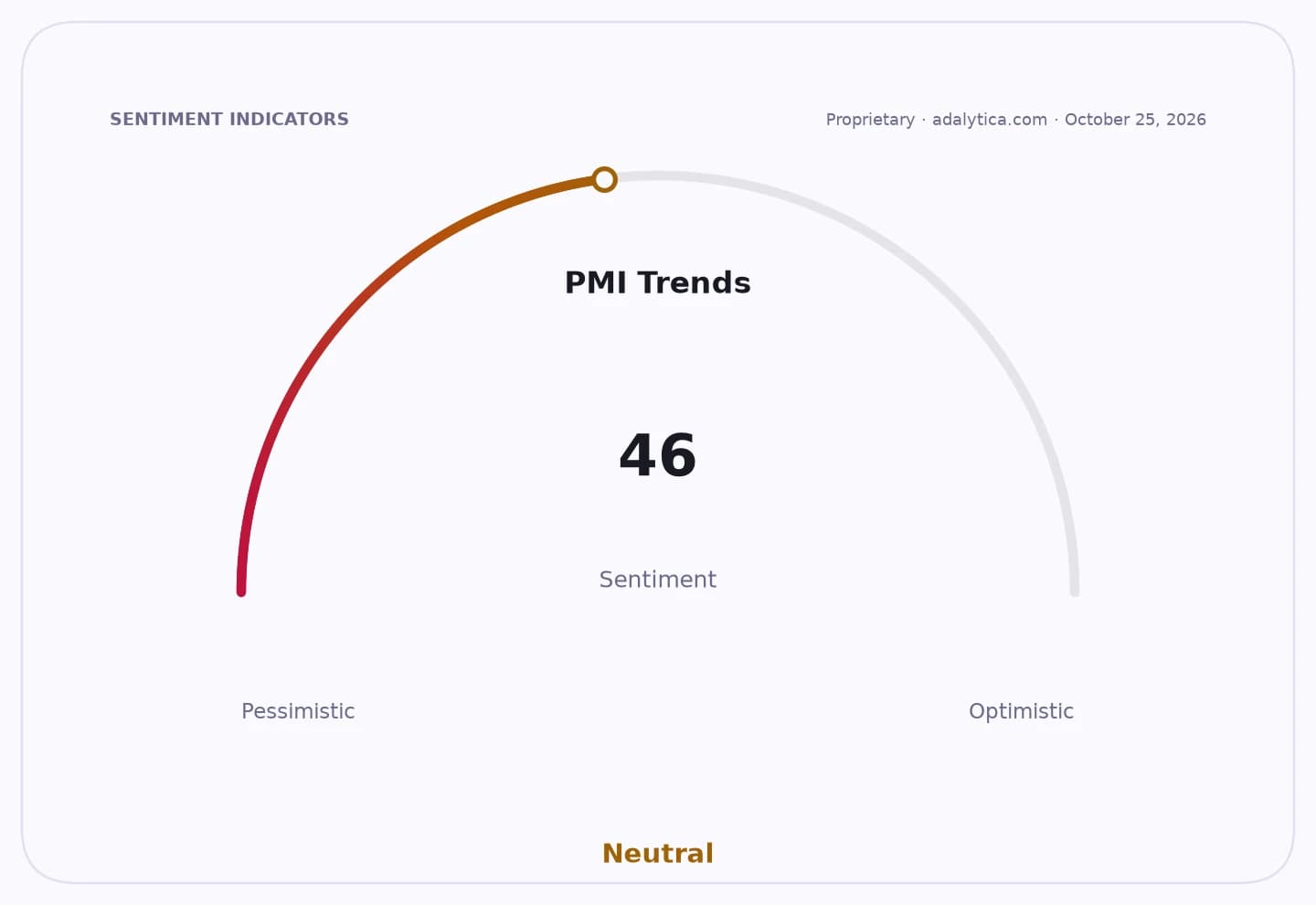
The DAX was little changed after a decline in German economic sentiment underscored how fragile the country’s recovery remains, even as traders kept one eye on stronger euro positioning and another on a still-unsettled U.S. equity backdrop.
DAX Flat as German Sentiment Weakens

That matters because Germany remains the anchor of Europe’s industrial economy, and when business confidence softens, it usually hits autos, machinery and exporters first. The DAX’s muted reaction suggests investors are not yet pricing in a full-blown growth scare, but neither are they willing to chase German equities higher without clearer evidence that domestic demand, factory orders and corporate earnings can keep improving.
Sentiment Indicators

Technically, the index has been struggling to regain momentum after slipping below its 50-day moving average, with the latest close at 43.55 versus a 50-day average around 45.39 and a 200-day average near 44.65. That leaves the benchmark in a vulnerable spot: the move off recent lows has not yet repaired the broader downtrend, and the relative strength index near 46 points to a market that is neither washed out nor convincingly bullish. In other words, the DAX is trying to stabilize, not break out.
The macro backdrop is equally mixed. Adalytica’s euro trade signals show extreme greed, with sentiment at 94, suggesting the common currency has become crowded on the long side. That can be supportive for European assets in the short run, but it also raises the bar for German exporters, who are already facing a currency that may not be doing them any favors if it keeps firming. By contrast, sentiment on the S&P 500 has fallen into extreme fear, a reminder that global investors are still rotating defensively and are likely to favor markets with visible earnings support and less macro strain.
For investors, the message is not to dismiss Germany, but to be selective. A flat DAX in the face of weaker sentiment means the market is waiting for confirmation, not conviction. That creates opportunity in the companies with pricing power, overseas exposure and balance-sheet strength, while keeping pressure on domestically sensitive names tied to cyclical demand. If German data firms, the market can re-rate quickly; if it doesn’t, the DAX may continue to lag until earnings revisions catch up with the mood.
The next catalyst is whether the soft patch in sentiment turns into a broader cut in growth expectations or simply another false start in Europe’s slow recovery. Until then, the trade is patience: own quality exporters and industrial winners, but don’t pay up for the whole index.
| Entity | Gains | Losses |
|---|---|---|
| Quality DAX exporters | ▲Relative resilience | ▼Currency pressure |
| Domestic cyclicals | ▲None | ▼Softer confidence |
| Euro bulls | ▲Momentum support | ▼Crowded positioning risk |
| DAX index buyers | ▲Stability if data improves | ▼Limited upside without growth proof |