The dollar is holding near a 1.5-year high as renewed inflation fears keep the U.S. currency in demand and push up dollar-priced commodities, with Brent crude above $101 and gold trading under pressure.
Dollar near 1.5-year high as oil tops $101
That matters because the move is not just a currency story: it is a tightening across the global pricing chain. A firmer dollar makes imports more expensive for countries that peg to or trade heavily in the greenback, while higher oil feeds through to transport, utilities and broader consumer inflation. For Gulf economies such as Oman, the combination can lift the local-currency cost of fuel-linked goods even when domestic demand is soft.
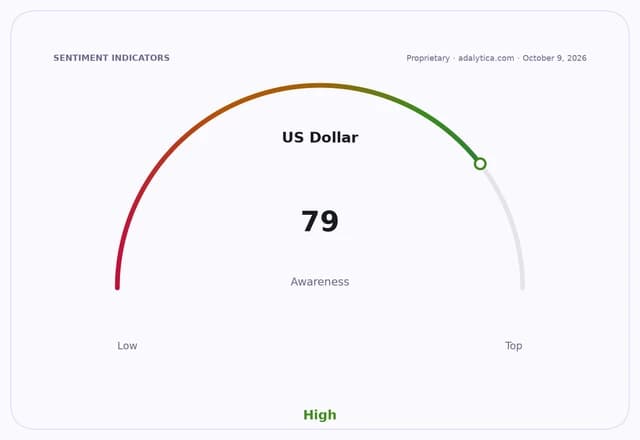
Sentiment IndicatorsⓘProprietary · adalytica.com · October 9, 2026
This is a snapshot — live sentiment, awareness and momentum for 130+ markets update continuously in the dashboard.Open AlphaPulse

The Bloomberg dollar index proxy, UUP, closed at 29.06 on Oct. 9, its highest level in the data series shown and well above the 50-day moving average of 28.32 and the 200-day average of 27.79. The fund’s relative strength index stood at 75, a level that typically signals the dollar has been extended but still firmly bid. The move has coincided with a sharp rise in market anxiety around inflation: Adalytica’s gauge of confidence in the Federal Reserve’s 2% target jumped to 100, while its long-term inflation expectations reading also hit 100, underscoring how quickly investors have repriced the policy backdrop.
Oil is reinforcing that macro tone. USO, a U.S. oil ETF, closed at 147.46 on Oct. 9, after a turbulent climb that has left crude far above its 200-day average of 117.12. Brent’s move above $101 in the seed headline points to the same dynamic: supply concerns in the Middle East are feeding a risk premium into energy markets at a moment when inflation expectations are already elevated. That combination is especially sensitive for importers, central banks and equity markets that have spent much of the year betting on easier financial conditions.
DCOILWTICO — macro contextadalytica.com
Explore this data interactively — full history, time series and cross-market comparisons.Open AlphaPulse
Gold is giving a different read on the same forces. GLD rose to 384.24 on Oct. 9, but it remains below its 50-day moving average of 397.02 and 200-day average of 415.65, suggesting bullion has not yet broken into a sustained bullish trend. In local Gulf markets, the stronger dollar has kept pressure on retail pricing even when the metal itself is volatile. The seed reference to 24-karat gold above 52 riyals in Oman reflects that currency effect more than a purely domestic demand story: when the dollar strengthens, local buyers often face higher riyal-denominated prices even if international gold is not making fresh highs.
For investors, the key question is whether this is a temporary geopolitical bid for the dollar or the start of a broader inflation reacceleration trade. Bulls on the dollar point to sticky U.S. prices, safe-haven demand and oil’s upside risk. Bears argue that the dollar is already overbought on short-term technical measures and that any easing in energy tensions could unwind part of the rally. But with inflation gauges flashing hot and commodities moving in tandem, the market is treating the dollar’s strength less as a standalone FX trade and more as the pricing center of a wider macro shock.
| Entity | Gains | Losses |
|---|---|---|
| U.S. dollar | ▲Safe-haven demand | ▼Emerging-market importers |
| Oil producers | ▲Higher Brent prices | ▼Fuel consumers |
| Gold buyers in Oman | ▲— | ▼Higher riyal prices |
| Inflation hedges | ▲Renewed demand | ▼Rate-sensitive assets |