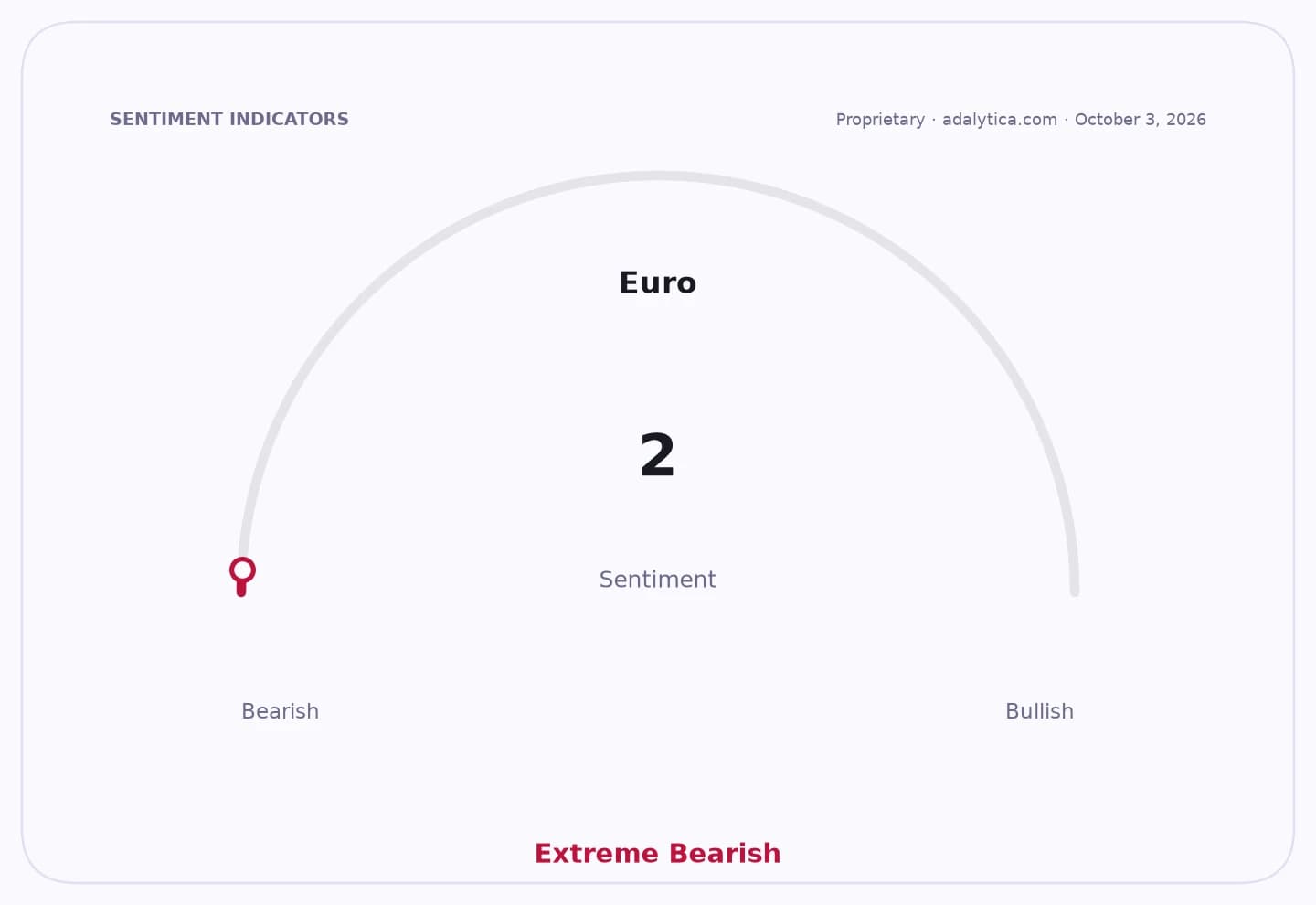
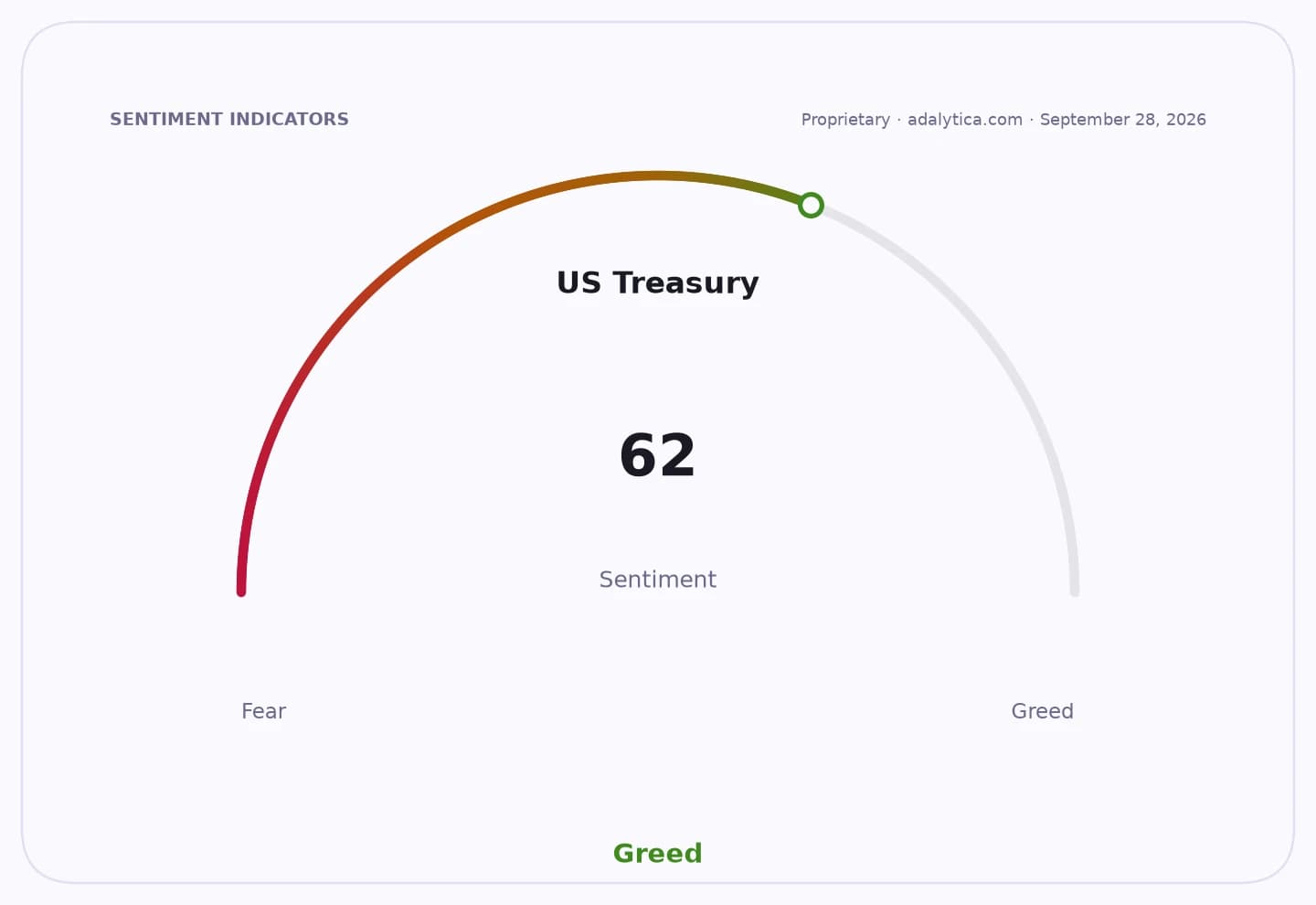
The clearest trade in global FX right now is a stronger dollar — and it is showing up most cleanly against the euro, the Australian dollar and the New Zealand dollar, while still favoring the dollar versus the Canadian dollar and the Swiss franc.
Dollar Strength Pressures EUR/USD, AUD/USD, NZD/USD

That matters because currency moves are increasingly being driven by rate differentials, growth divergence and capital preservation rather than short-lived headline noise. With EUR/USD sitting at 1.12, AUD/USD at 0.69 and NZD/USD at 0.56, the major commodity and European pairs are all trading below key trend levels, a sign that sellers still control the tape. At the same time, USDCAD near 1.45 and USD/CHF around 0.80 remain constructive for the greenback, reinforcing a broad dollar bid rather than a one-off move in a single pair.
Sentiment IndicatorsⓘProprietary · adalytica.com · October 8, 2026
This is a snapshot — live sentiment, awareness and momentum for 130+ markets update continuously in the dashboard.Open AlphaPulse
The technical picture is hard to ignore. EUR/USD is below both its 50-day and 200-day moving averages, with an RSI reading near 12, a level that reflects sustained downside momentum rather than a routine pullback. AUD/USD is also below its 50-day average and sitting with RSI around 22, while NZD/USD has dropped to 0.56 with RSI near 24. Those are the sort of readings that usually appear when a currency is being repriced lower because the market sees fewer reasons to own it.
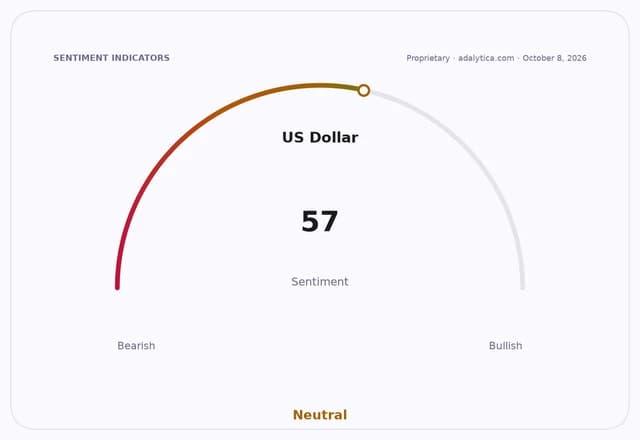
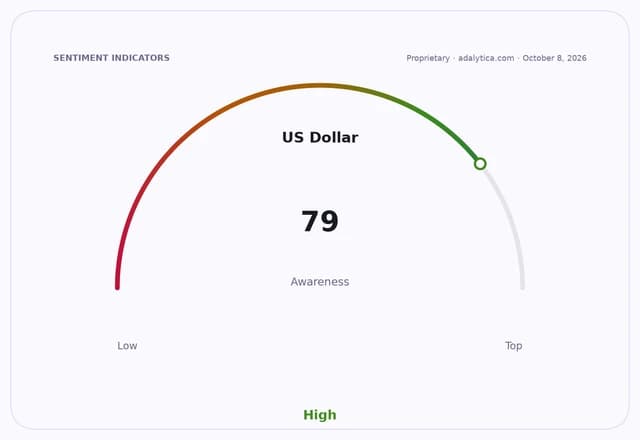
The macro narrative is straightforward: the market is rewarding the dollar as the most liquid shelter in a landscape still shaped by uneven growth, cautious central banks and periodic risk aversion. Adalytica’s U.S. dollar trade signals show neutral sentiment but elevated awareness, which is consistent with investors watching a trend that is not yet fully crowded. FX volatility signals remain subdued in sentiment terms but sit in an “extreme fear” awareness zone, a combination that often means traders are positioned for more two-way movement but still respect the underlying dollar bias.
US Dollar — 30-day sentimentadalytica.com
Explore this data interactively — full history, time series and cross-market comparisons.Open AlphaPulse
For investors, the message is less about the spot FX charts and more about what a firmer dollar does to the rest of the market. A stronger greenback tightens financial conditions globally, pressures exporters, crimps overseas earnings translated back into dollars and can weigh on commodity prices and risk assets. That is especially relevant for Australia and New Zealand, where the currencies are closely tied to global growth expectations and commodity demand. It also matters for Europe, where a weaker euro can cushion exporters but highlights the region’s relative policy and growth weakness.
The opportunity here is in staying aligned with the dollar’s leadership and avoiding the temptation to fade it too early. Until EUR/USD can reclaim its moving averages and AUD/USD and NZD/USD stabilize above their recent support zones, the path of least resistance remains lower for those pairs. The better setup is to treat dollar strength as a macro theme with second-order winners and losers: dollar bulls, U.S.-based multinationals with domestic revenue, and hedged exporters may fare better, while foreign revenue earners, commodity-linked currencies and unhedged global risk assets remain exposed.
If this trend extends, the next catalyst will likely come from U.S. data or central-bank repricing that widens yield support for the dollar again. For now, the highest-conviction stance is simple: stay constructive on the dollar, and remain cautious on EUR/USD, AUD/USD and NZD/USD until the technical damage is repaired.
| Entity | Gains | Losses |
|---|---|---|
| U.S. dollar | ▲Safe-haven demand | ▼— |
| EUR/USD | ▲— | ▼Bearish trend |
| AUD/USD & NZD/USD | ▲— | ▼Growth-linked currencies weaken |
| U.S.-based exporters with domestic revenue | ▲Translation benefit | ▼Foreign competitors |