Christine Lagarde says the recent surge in bond yields is already making it more expensive for governments and companies to borrow, and that tighter financing conditions are now a risk to eurozone growth and inflation.
ECB Lagarde says higher yields raise borrowing costs

The European Central Bank president said at the IMF and World Bank annual meetings in Bangkok that long-term rates have risen sharply since the ECB’s last policy meeting, pushing up credit costs across the currency bloc. She warned that the move will slow activity and could make it harder for companies to pass through higher input costs, such as fuel tied to the Iran war, to consumers.
Sentiment IndicatorsⓘProprietary · adalytica.com · October 21, 2026
This is a snapshot — live sentiment, awareness and momentum for 130+ markets update continuously in the dashboard.Open AlphaPulse

The warning lands as global sovereign borrowing costs jump on concerns about heavy debt loads, persistent inflation and massive capital spending on artificial intelligence. In the US, the 10-year Treasury yield is around 5.08% and the two-year is near 4.74%, levels that keep pressure on rate-sensitive assets and raise the bar for refinancing, even as the market prices in a more restrictive policy stance from central banks.
For the eurozone, the message is that tighter financial conditions are doing part of the ECB’s job before policymakers act again. Markets expect the ECB to raise rates in December to 2.75%, a level officials generally view as restrictive, while Bundesbank President Joachim Nagel said more tightening may still be needed and Finnish central bank chief Olli Rehn warned against second-round inflation effects.
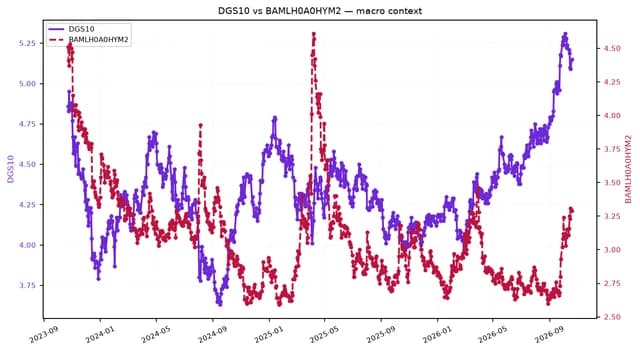
Investors are likely to read the comments as another signal that the borrowing-cost shock is spreading from sovereign debt into corporate funding, credit spreads and growth-sensitive equities. Higher yields tend to pressure bond prices, weigh on leveraged borrowers and increase the risk that weaker companies will struggle to roll debt, especially if the slowdown feeds through to earnings.
The reaction in currency and bond markets reflects that tension: the euro has been under pressure, while Treasury-bond positioning shows elevated caution even after recent volatility. The next catalyst is the ECB’s December decision and incoming inflation data, which will determine whether policymakers lean harder against price pressures or start to worry more openly about the growth hit from elevated financing costs.
| Entity | Gains | Losses |
|---|---|---|
| Lenders | ▲Higher yields on new lending | ▼Lower loan demand if growth slows |
| Governments | ▲None | ▼Higher debt-service costs |
| Companies | ▲Firms with strong pricing power | ▼Highly leveraged borrowers |
| Bond investors | ▲Existing holders of high-coupon debt | ▼Holders of longer-duration bonds |