Egypt’s push to settle more trade with BRICS partners in local currencies has moved from theory to practice, but the real economic payoff will depend on whether Cairo can lift exports fast enough to offset its still-wide trade deficit.
Egypt BRICS local-currency trade still faces deficit
That is the central conclusion from new data showing Egypt’s trade with BRICS countries rose to $53.5 billion in 2025 from $45 billion a year earlier, while exports climbed 45.7% to $13.772 billion. Imports, however, still reached $39.679 billion, leaving a gap of about $25.907 billion that limits how far Egypt can reduce its need for hard currency.
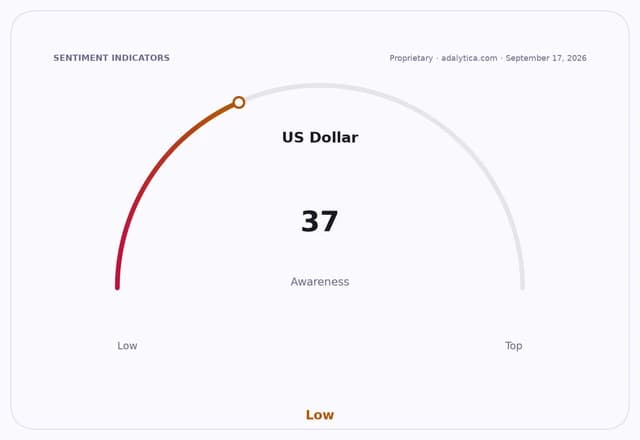
Sentiment IndicatorsⓘProprietary · adalytica.com · September 17, 2026
This is a snapshot — live sentiment, awareness and momentum for 130+ markets update continuously in the dashboard.Open AlphaPulse
The shift matters because it gives Egypt a way to cut transaction costs and reduce its reliance on a third currency in part of its trade with China and India, two of its largest BRICS partners. The central bank has renewed a yuan swap line with the People’s Bank of China at 30 billion yuan, equal to about $4.4 billion, and the rupee settlement account between Bank of India and Banque Misr has begun operating. Together, those mechanisms create a practical channel for bilateral trade settlement outside the dollar.
But local-currency trade is not the same as eliminating foreign-currency demand. As Egyptian economist Abdullah Abu Samra argued, swapping the invoice currency from dollars to yuan or rupees changes the settlement route, not the underlying need for external funding when imports outstrip exports. In other words, Egypt can reduce the number of times the dollar is used, but it cannot remove the need for foreign exchange unless it narrows the trade gap.
That distinction is critical for investors and policymakers because the best-case scenario for Egypt is not a symbolic “BRICS without dollars” narrative, but a measurable improvement in balance-of-payments resilience. If a larger share of imports from BRICS can be matched by Egyptian exports, local-currency clearing could ease pressure on reserves, reduce conversion costs and lower exposure to dollar funding volatility. If not, the benefit is largely logistical.
The export side is therefore the swing factor. Egypt’s shipments to BRICS members rose much faster than imports, suggesting there is some room to expand bilateral settlement. A stronger export base would let Egypt recycle pounds, yuan or rupees through trade rather than relying on dollar intermediation. That would also make swap lines and rupee accounts more useful, because counterparties would accumulate balances they can spend on Egyptian goods or channel into investment.
China remains the most important test case. The enlarged yuan swap line gives Egypt more flexibility in settling trade and investment flows with its biggest Asian partner, but the scale of Egypt’s import bill means only a portion can realistically be netted out. India offers a similar opportunity through the rupee account, especially if bilateral trade rises toward Cairo’s stated goal of $12 billion over five years. Russia is also relevant, though the absence of a formal settlement mechanism comparable to China and India means the commercial relationship is still less advanced on the payments side.
The broader BRICS story is not just about trade settlement. The New Development Bank has said it wants local-currency lending to reach 30% of total financing, and it already stands near 22%, mainly through yuan-denominated loans. For Egypt, that matters because financing in local currencies can reduce exchange-rate risk on projects and diversify funding sources beyond dollar debt.
For investors, the practical implication is that Egypt is trying to build a partial shield against dollar dependence rather than a full break from it. That could support sentiment around external-financing risk, especially if more BRICS trade can be settled without drawing on scarce hard currency. But the upside for the economy and the pound will remain constrained unless Egypt converts that trade platform into higher industrial output, stronger exports and more foreign direct investment.
| Entity | Gains | Losses |
|---|---|---|
| Egypt exporters | ▲Bigger BRICS market access | ▼Pressure to upgrade capacity |
| Egyptian importers | ▲Lower conversion costs | ▼Less benefit if deficits persist |
| BRICS settlement system | ▲More local-currency use | ▼Dollar intermediation |
| Dollar-dependent financers | ▲Less volume in some flows | ▼Reduced dominance in bilateral trade |