Emerging market credit faces a fresh test from higher developed-market yields and a more hawkish US Federal Reserve, with Fitch Ratings warning that tighter global financing conditions could expose weaker balance sheets and foreign-currency borrowers.
Emerging Market Credit Faces Higher Yield Pressure

The rating agency said emerging-market issuers held up in the third quarter, with upgrades outnumbering downgrades for a second straight quarter despite uncertainty around the US-Iran war. But it argued that resilience will be harder to sustain if US rates stay elevated and sovereign borrowing costs in the developed world remain high, because those conditions can slow capital flows, widen bond spreads and tighten refinancing windows for lower-rated sovereigns and companies.
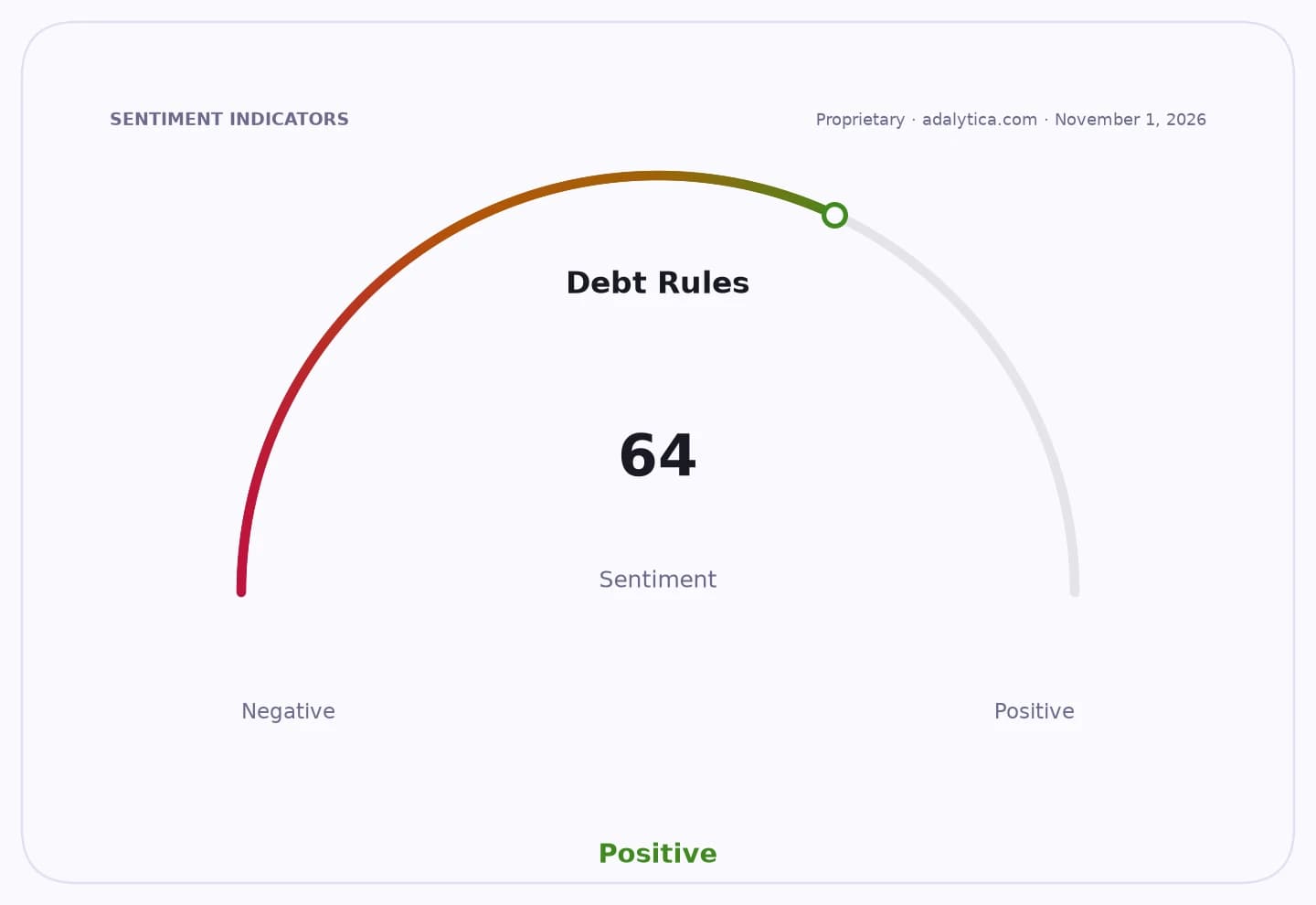
Sentiment Indicators
US Dollar
That matters because emerging markets have spent much of 2026 benefiting from relatively stable access to funding, even as policy divergence has widened between the US and other major economies. Fitch said its base case remains that funding conditions should become more benign in 2027 as global inflation eases and central banks grow less concerned about price pressure. But it cautioned that the path is fragile, and that domestic market depth and dependence on foreign-currency debt could become key differentiators if capital starts leaving emerging markets instead of returning.
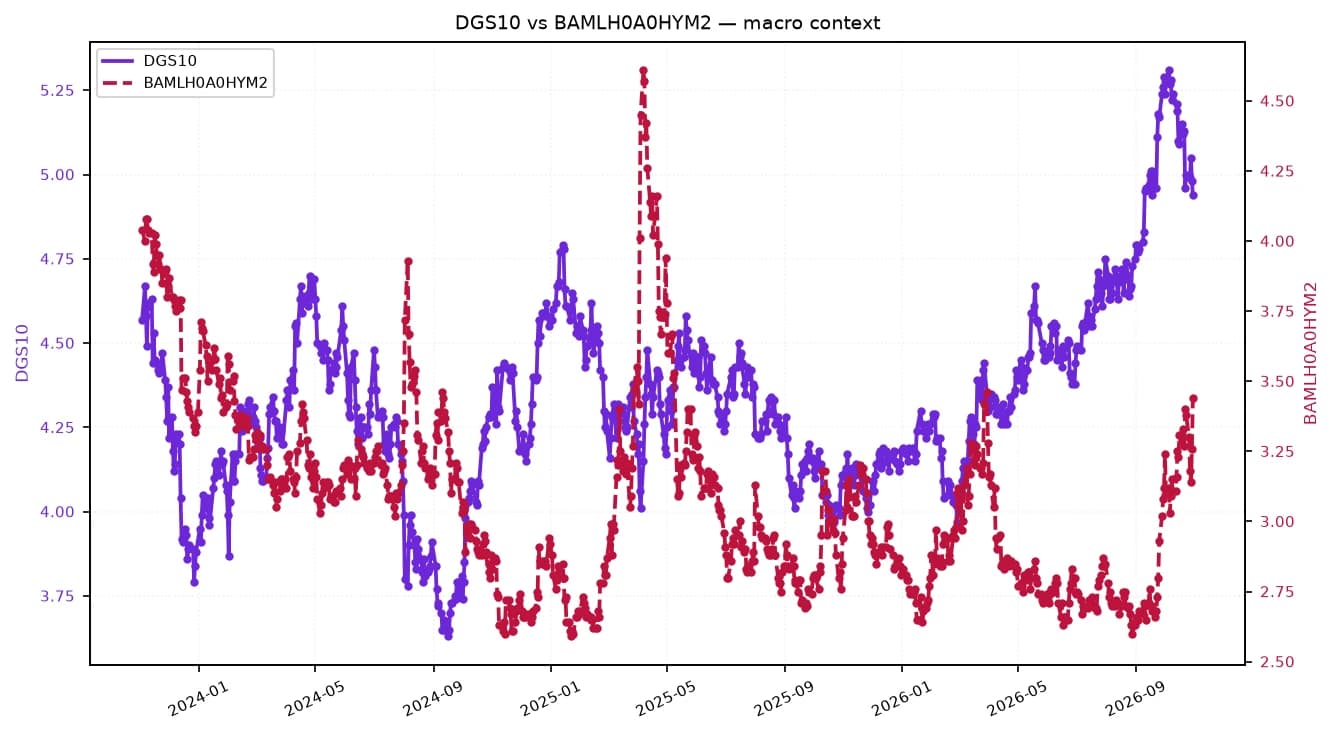
The warning lands as Treasury yields remain elevated by recent standards. The US 10-year yield was around 4.89% in the latest reading, while the two-year yield stood near 4.53%, levels that keep global borrowing costs high even after some recent moderation. For emerging-market sovereigns and corporates, that translates into a costlier backdrop for new issuance, more pressure on debt-service ratios and greater sensitivity to shifts in US monetary expectations.
DGS10 vs DGS2 — macro contextadalytica.com
Explore this data interactively — full history, time series and cross-market comparisons.
Investors have already been rewarding and punishing emerging-market assets unevenly. The iShares MSCI Emerging Markets ETF, EEM, closed at 61.10 on the latest session, still above its 200-day moving average of 63.75 earlier in the month but with the relative strength index near 31, a level that suggests stretched downside momentum. The iShares JPMorgan USD Emerging Markets Bond ETF, EMB, was at 91.52, slightly below its 200-day average of 93.17, underscoring the market’s caution around hard-currency debt. The broader VWO ETF was also weak, closing at 55.34 versus a 200-day average of 58.20.
The key economic distinction, Fitch said, is between countries and issuers that can fund themselves domestically and those that still rely heavily on external borrowing. Those with deeper local capital markets, stronger reform credibility and stable macro policy should be better placed to absorb a shift in global liquidity. Others could see spreads widen quickly if investors become more selective.
Fitch’s forecasts still point to emerging-market growth ex-China of 3.3% next year, down from an upwardly revised 3.6% in 2026, with several 2027 forecasts trimmed slightly. It said Asia-Pacific exporters are still being supported by AI-related shipments, while China’s exports are cushioning its slowdown. But it also warned that an AI-related market correction, combined with tighter financing conditions, could shave as much as 0.8 percentage point from emerging-market growth versus its 2027 baseline.
For investors, the message is that the next phase of emerging-market performance may hinge less on growth alone and more on funding resilience. Countries with credible policy frameworks and a larger local investor base may continue to attract capital, while weaker credits could be forced to pay up, cut spending or delay refinancing if the global rate backdrop stays restrictive longer than expected.
| Entity | Gains | Losses |
|---|---|---|
| Higher-quality emerging-market issuers | ▲More selective investor demand | ▼Risk of broader spread widening |
| Domestic-funded EM economies | ▲Better refinancing resilience | ▼Less benefit from global liquidity |
| Foreign-currency borrowers | ▲Near-term access if markets stay open | ▼Higher rollover and FX pressure |
| EM bondholders/ETF investors | ▲Higher carry potential in strong credits | ▼Mark-to-market losses if yields rise |