The European Central Bank is warning that stretched AI valuations, volatile bond markets and the rise of shadow banking are among the main risks to financial stability, a signal that policymakers are increasingly uneasy about the combination of expensive risk assets and tighter monetary conditions.
ECB Warns on AI Valuations and Bond Risks

For investors, the message matters because it points to a market that is still carrying a lot of optimism even as funding costs remain high and liquidity is more fragile than it was during the era of near-zero rates. The ECB vice president’s comments land at a moment when the 10-year U.S. Treasury yield is still near 4.9%, a level that keeps pressure on asset pricing, while high-yield credit spreads have widened to about 3.4 percentage points, suggesting lenders are demanding more compensation for risk.
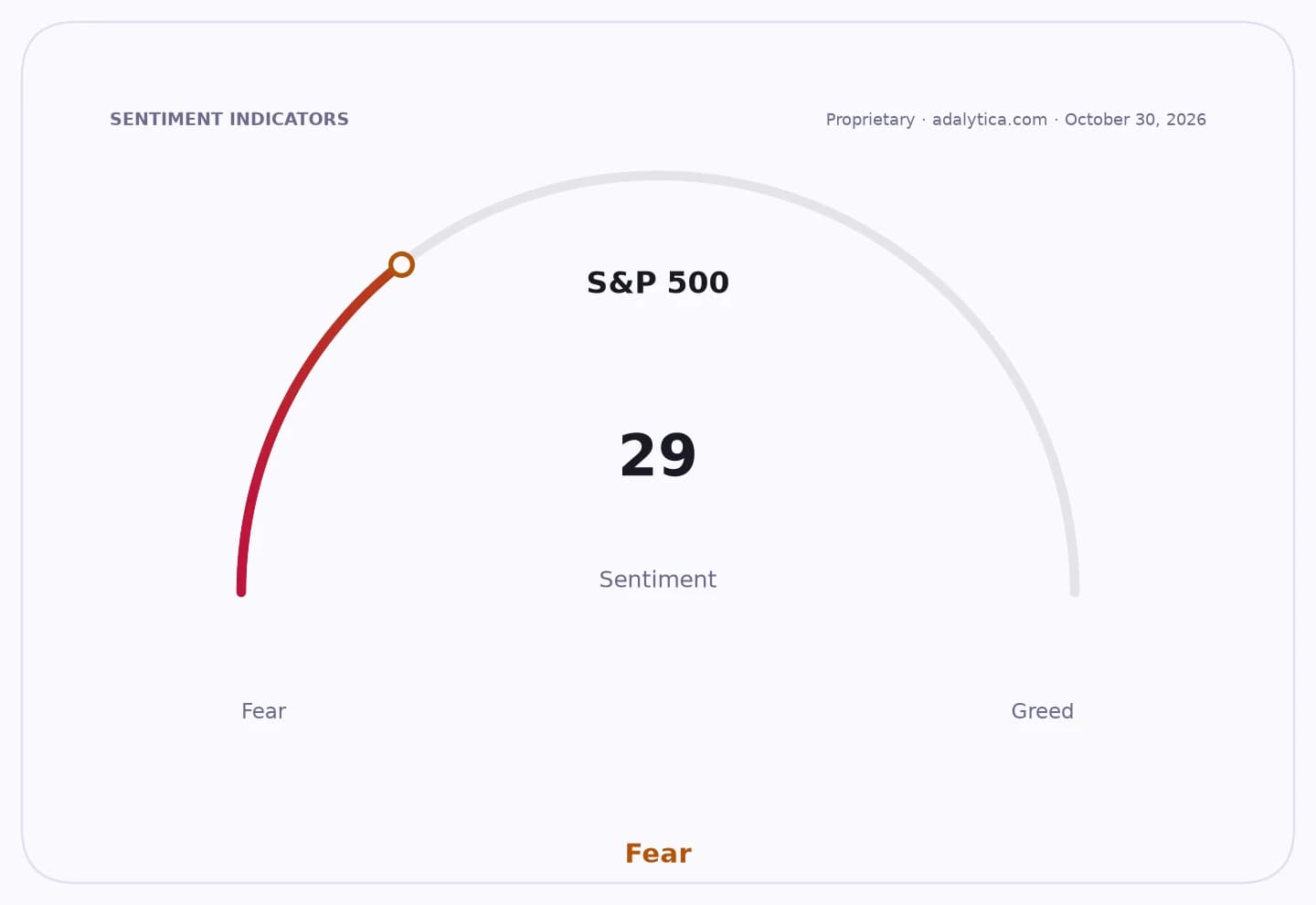
Sentiment Indicators
That combination leaves little room for error in the parts of the market that have been most dependent on easy money and momentum. AI-linked shares remain the clearest example. Nvidia has fallen to about $202, down sharply from its summer highs, with its relative strength index sinking to 26.9, a reading that typically indicates the stock is oversold. Microsoft has also slipped to around $507, below its 50-day moving average, while Alphabet is trading near $279, far under both its 50-day and 200-day averages and with its RSI at 13.1. The selloff suggests investors are reassessing whether the spending boom behind artificial intelligence can keep justifying the sector’s valuations.
The ECB’s warning also reflects a broader concern that risk is migrating outside the traditional banking system, where shadow lenders can be more exposed to market shocks and less constrained by capital rules. That matters economically because these firms have become major providers of credit just as borrowers face higher financing costs and bond markets remain vulnerable to abrupt repricing. If stress builds, the spillover would not be confined to private credit funds or leveraged investors; it could ripple into mainstream markets through forced selling, tighter funding and weaker demand for new debt.
The backdrop is one of uneasy stability rather than outright distress. Adalytica’s Global Stability Sentiment gauge is at 100, described as extreme greed, while the S&P 500 sentiment reading is neutral but still showing elevated awareness. That combination usually implies confidence is high even when positioning is crowded, a dynamic that can amplify swings if growth disappoints or financing conditions tighten further.
For policymakers, the concern is not just that prices are rich, but that markets may be underpricing the second-order effects of higher rates on debt service, leverage and liquidity. For investors, the warning is that the next phase of the cycle may be driven less by earnings growth than by balance-sheet discipline and funding resilience. If bond yields stay near current levels and credit spreads continue to widen, the market’s most crowded AI and growth trades could remain vulnerable even without a full recession.
| Entity | Gains | Losses |
|---|---|---|
| Cash-rich, low-leverage firms | ▲Stronger funding position | ▼Less benefit from risk rally |
| Bond investors | ▲Better carry at higher yields | ▼More mark-to-market volatility |
| Shadow lenders | ▲Expanded role in credit supply | ▼Greater scrutiny and refinancing risk |
| AI growth stocks | ▲Long-term innovation premium | ▼Valuation compression and momentum selloff |