Estonia’s debate over rising public debt is being distorted by the failure to distinguish between nominal borrowing and the size of the economy that supports it, according to economist Raul Eamets.
Estonia Debt Debate Over Public Borrowing

That matters because the country’s fiscal argument is no longer about whether the debt ratio rises in isolation, but whether higher borrowing would still leave Estonia with one of the lightest balance sheets in the European Union and enough room to finance current spending without choking growth.
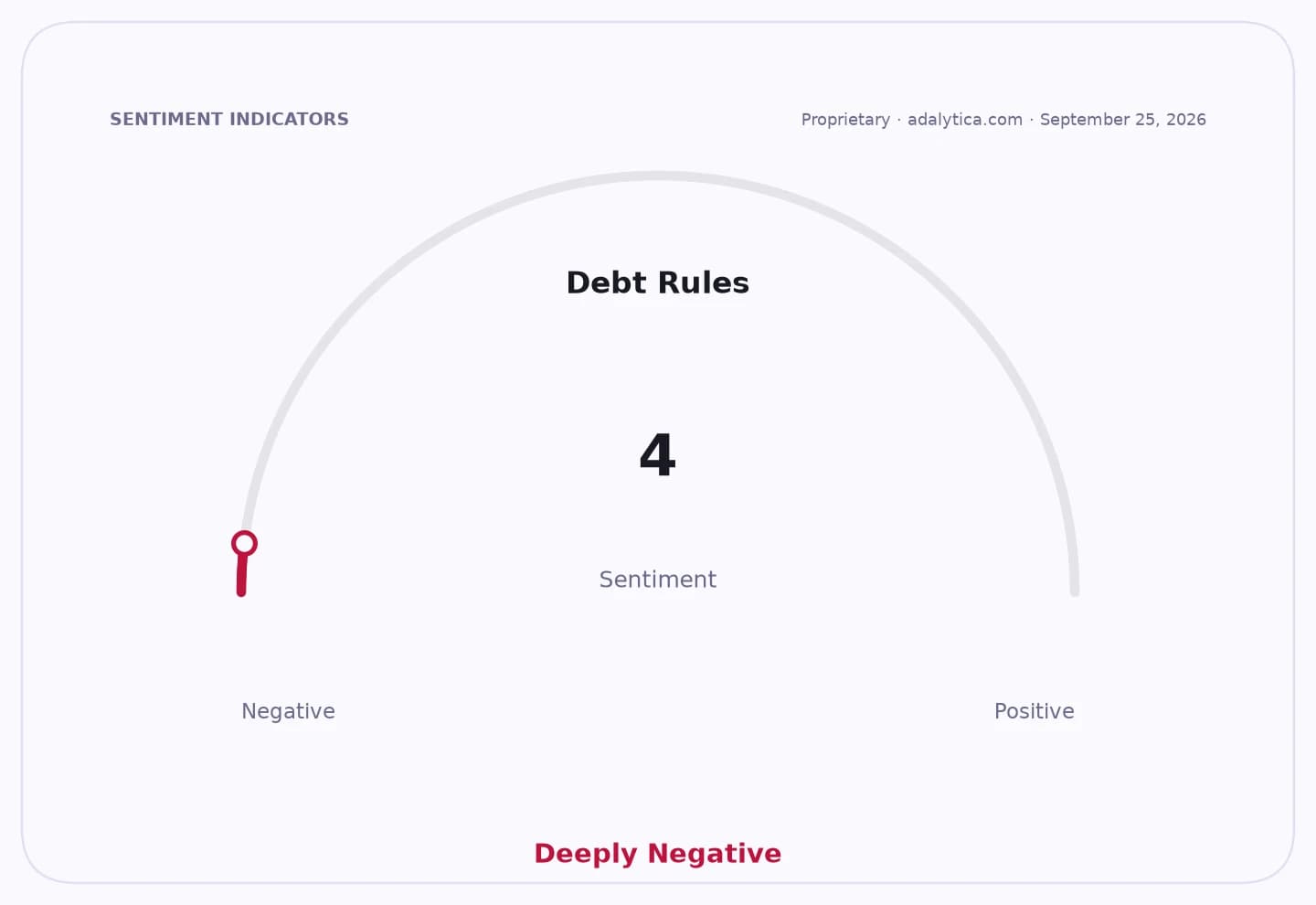
Sentiment IndicatorsⓘProprietary · adalytica.com · October 13, 2026
This is a snapshot — live sentiment, awareness and momentum for 130+ markets update continuously in the dashboard.Open AlphaPulse

Eamets argues the “debt-burden specter” has been overstated by critics who focus on headline ratios and future interest bills while ignoring two forces that shrink debt over time: economic expansion and inflation. Under current plans, Estonia’s public debt is expected to rise from about 26% of GDP to 38.6% by 2030, while annual interest costs increase from €205 million to €650 million.
On paper, that sounds like a sharp deterioration. In context, Eamets says, it does not. Even at 38.6% of GDP, Estonia would still rank near the bottom of the EU debt league, far below the bloc’s 60% reference level and well under the euro-area average of about 90%. He notes that Finland, with a far heavier debt load, continues to borrow normally in bond markets.

The more important issue, he says, is whether borrowing is being used to fund current consumption or investment. Financing indexed social spending and other routine expenses with debt is, in his view, poor fiscal practice. But borrowing for infrastructure, education, healthcare and other forms of human-capital investment can be justified because those outlays lift future output and tax revenues.
That distinction is central for investors and policymakers because it frames Estonia’s fiscal trajectory as a sustainability question, not a solvency one. If nominal GDP continues to rise through real growth and inflation, the debt ratio can stabilize or even decline even with moderate deficits. Eamets points to the euro area’s own fiscal architecture — a 3% deficit ceiling, 60% debt limit and 2% inflation target — to argue that balanced budgets are not the only route to debt stability.
His point cuts against election-season messaging in Tallinn, where the budget has become a political battleground and many of the announced savings appear temporary or symbolic. The government’s decision to extend a cap on senior officials’ wage growth to 2031, for example, has limited fiscal effect but offers a visible signal to voters.
For markets, the key takeaway is that Estonia is not approaching a funding cliff. Rather, the debate is about fiscal composition, political credibility and the long-term cost of delayed consolidation. The real risk is not that borrowing automatically becomes unsustainable at 39% of GDP, but that short-term political fixes keep shifting costs into later years, when higher interest payments will weigh more heavily on the budget.
If growth holds and inflation remains positive, Estonia can absorb more debt than critics suggest. If growth disappoints or the state keeps borrowing to fund consumption instead of investment, the arithmetic becomes less forgiving.
| Entity | Gains | Losses |
|---|---|---|
| Estonian government | ▲More fiscal flexibility | ▼Pressure for immediate austerity |
| Taxpayers and households | ▲Potentially preserved public services | ▼Higher future interest costs |
| Bond investors | ▲Stable sovereign credit profile | ▼Fear trade on Estonia debt risk |
| Fiscal hawks | ▲Stronger case for spending restraint | ▼Argument that debt is “dangerous” |