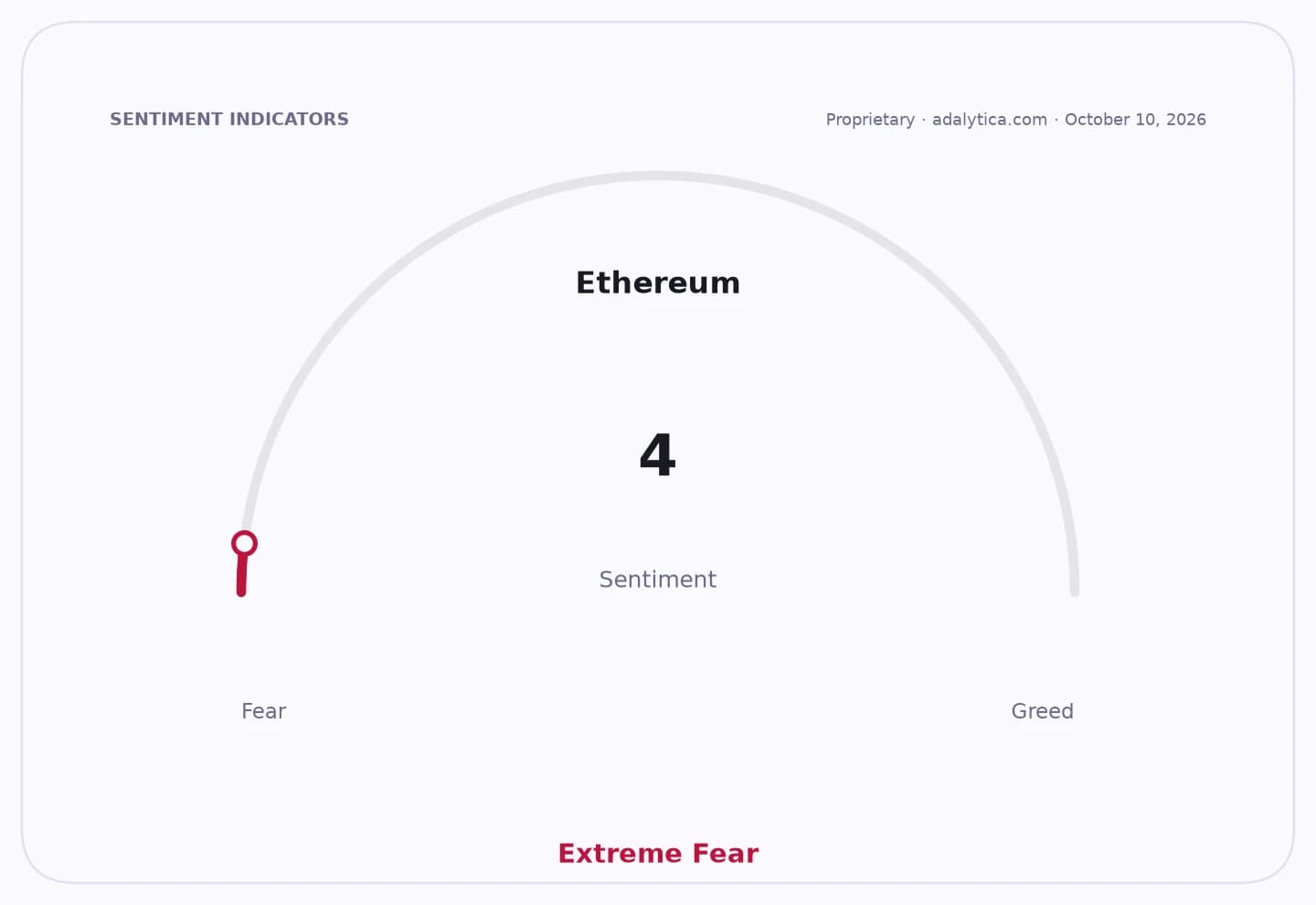
Ethereum slid to $2,474 after a sharp risk-off move hit crypto harder than equities, but the market is still looking past the drop toward a potential recovery path built on the upcoming Glamsterdam upgrade and a bullish technical setup.
Ethereum Falls to $2,474 on Risk-Off Selloff
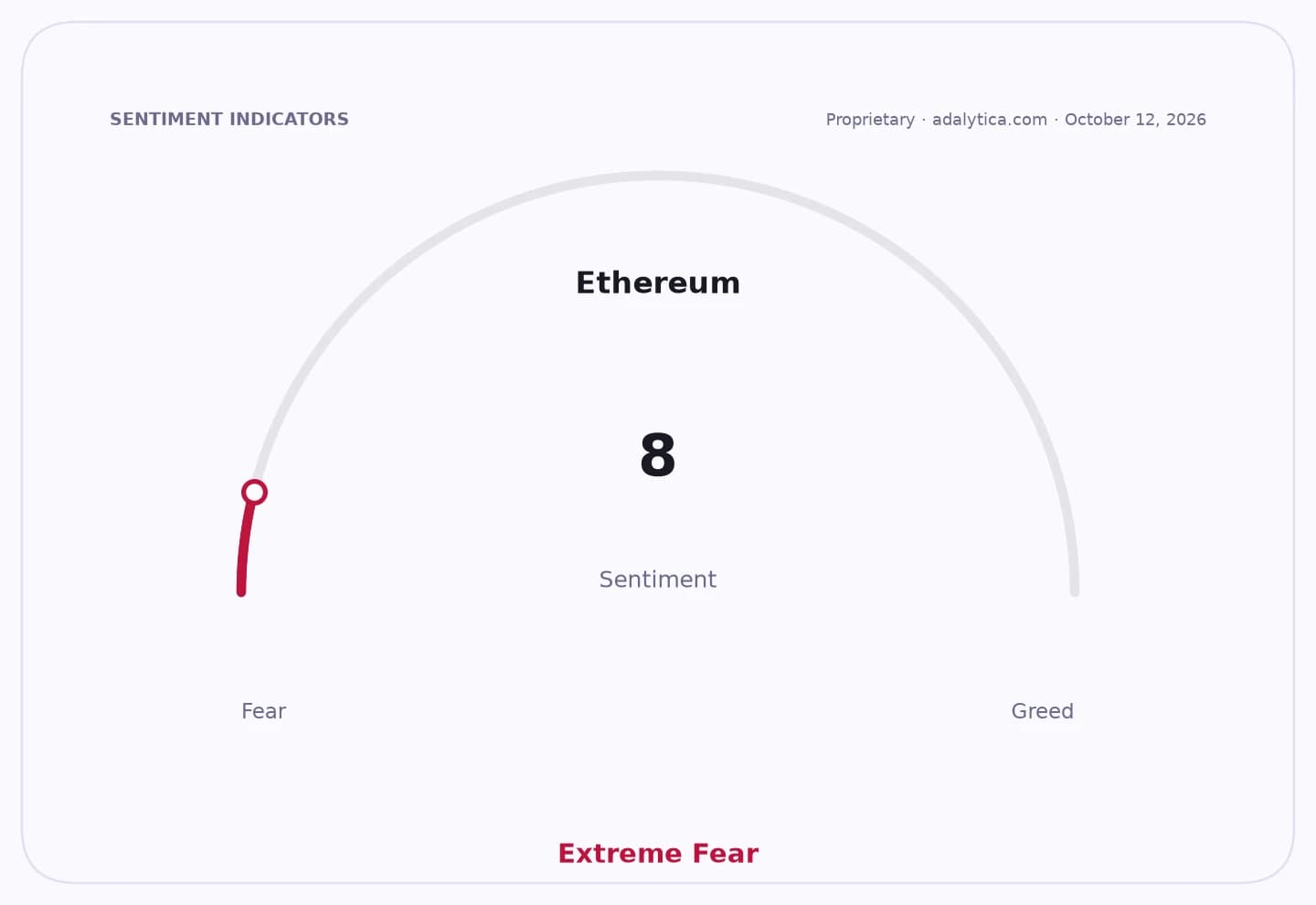
The token fell 3.9% in 24 hours as oil prices jumped on US-Iran tensions, Treasury yields climbed and investors cut exposure to risk assets. Ether ETF products saw $160.9 million of outflows on Wednesday, while Bitcoin spot ETFs shed $484.9 million, underscoring a broader pullback from digital assets rather than a problem unique to Ethereum. Adalytica’s Ethereum Fear & Greed Index is deep in “Extreme Fear” at 8, with sentiment down 65% over the past month, a sign that positioning has been washed out even as price holds above the recent lows.
Sentiment IndicatorsⓘProprietary · adalytica.com · October 12, 2026
This is a snapshot — live sentiment, awareness and momentum for 130+ markets update continuously in the dashboard.Open AlphaPulse
That matters because Ethereum is now trading at a level where macro pressure and crypto-specific flows are both pulling in the same direction. The drop from $2,573 to $2,474 came as markets reassessed the US-Iran standoff and the impact of higher energy prices on growth assets. The move also left ETH below its 50-day moving average, while the 100-day “golden cross” cited by traders offers support for the view that the broader trend has not fully broken. On conventional technical indicators, the relative strength index remains weak at 25.6, though it has started to recover from oversold territory.
The fundamental counterweight is Glamsterdam, Ethereum’s next major upgrade, which was activated on the Sepolia testnet on Oct. 6 and is slated for mainnet in the fourth quarter of 2026. Developers describe it as one of the most important hard forks since the Merge. The upgrade is expected to improve scalability through ePBS and block-level access lists, which should allow more parallel transaction processing and, eventually, lower friction for users and developers. That is why bullish forecasters are still pointing to $2,950 to $3,000, even after the latest selloff.
CoinDCX has set an October target of $2,950, with support at $2,611 and resistance near $3,100. Changelly sees a wider range between $2,336 and $2,641, highlighting how much near-term pricing depends on whether the market treats Ethereum as a macro proxy or as a network with an improving long-term throughput story. If ETH cannot reclaim $2,800, CoinDCX expects consolidation below that level, which would keep traders focused on whether ETF redemptions and Treasury yield pressure continue to dominate the tape.
For investors, the key question is whether the current weakness is a temporary de-risking event or the start of a longer period in which Ethereum must prove that protocol upgrades can offset waning speculative demand. The bull case is that severe fear, heavy ETF outflows and a still-intact technical base can set up a rebound once macro stress eases. The bear case is that higher yields, volatile energy markets and persistent competition from faster, cheaper chains keep a lid on flows even if the network keeps improving.
The next catalysts are the US CPI report on Oct. 14 and the Federal Reserve’s policy decision on Oct. 28, both of which could decide whether crypto’s latest dip becomes a deeper correction or the base for another attempt at $3,000.
| Entity | Gains | Losses |
|---|---|---|
| Ethereum bulls | ▲Upgrade-driven rebound case | ▼Near-term price action |
| ETH spot ETF holders | ▲Lower entry if support holds | ▼Outflows and volatility |
| Ethereum developers | ▲Validation of Glamsterdam roadmap | ▼Pressure to show real scaling gains |
| Risk assets | ▲Relief if macro stress fades | ▼Oil shock and higher yields |