Eurozone consumer confidence improved in November, but only marginally, underscoring how fragile household demand remains as the bloc heads into year-end.
Eurozone Consumer Confidence Rises to -16.9 in November

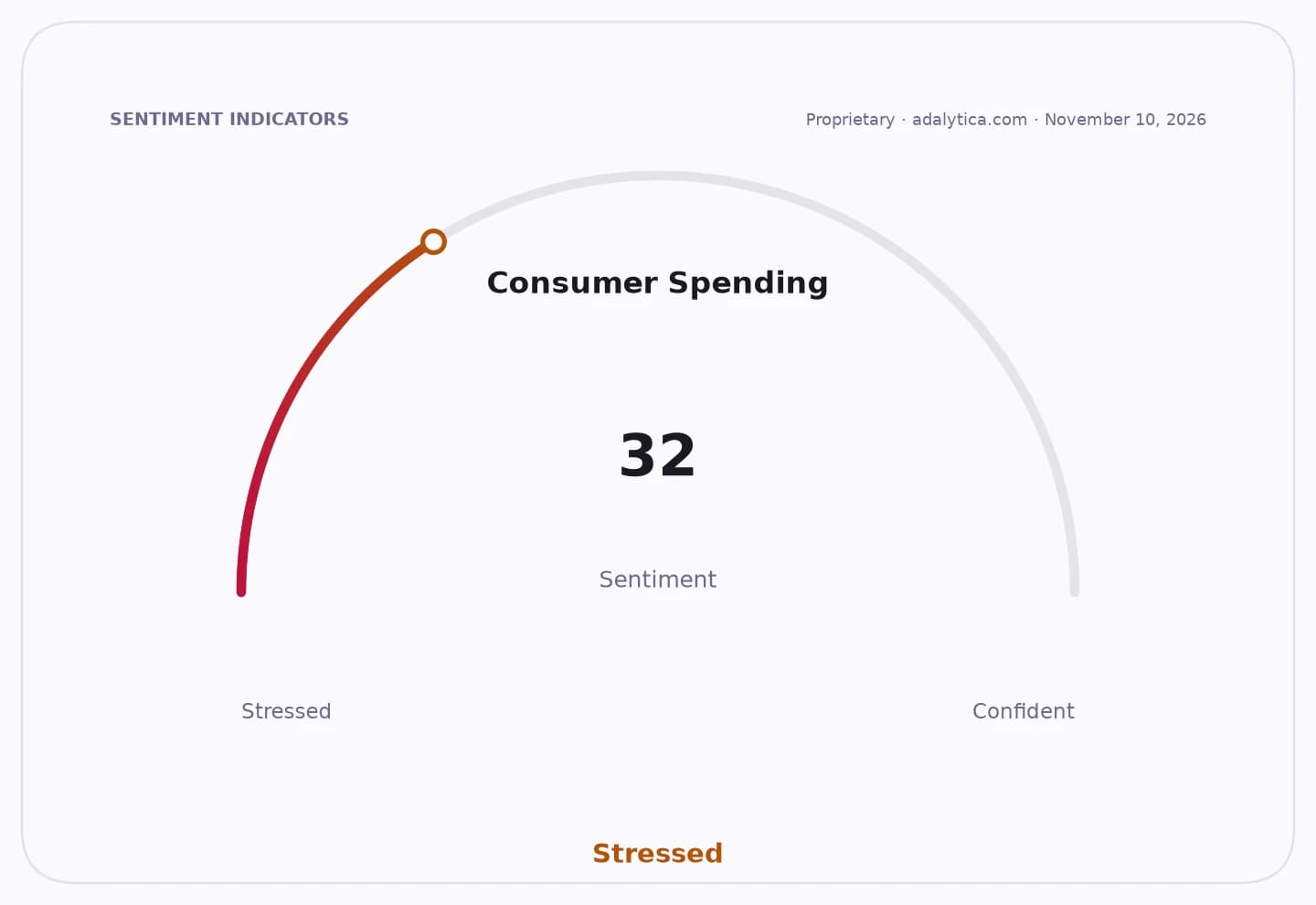
The European Commission’s flash estimate showed euro-area consumer sentiment rising 1 point to -16.9, while confidence across the European Union rose 0.8 point to -16.5. Both readings remain well below their long-run averages, pointing to consumers who are still cautious about spending even after a modest pickup in sentiment.
Sentiment Indicators

That matters for the euro zone because household consumption is one of the few levers that can still cushion growth when exports are subdued and industrial activity remains uneven. A move higher in confidence can help support discretionary spending, but a reading this deep in negative territory suggests any rebound in demand is likely to be slow and uneven rather than broad-based.
For investors, the figure is more useful as a constraint than a catalyst. It argues against assuming a strong consumer-led acceleration in the euro zone, which in turn limits upside for retailers, travel and leisure companies, and other cyclicals dependent on spending momentum. It also suggests the European Central Bank may not face an inflationary demand surge from households, even if wage growth and labor markets remain relatively resilient.
The contrast with other major markets reinforces the point. U.S. consumer sentiment has shown signs of stabilizing, while euro-zone households are improving from weak levels but remain far more pessimistic than is consistent with robust private consumption. That gap leaves Europe more exposed to external shocks, slower credit growth and lingering uncertainty around employment and real incomes.
The flash reading is only an early estimate, and the Commission will publish the final November data on Nov. 27. Still, the message from the latest release is clear: euro-area consumers are less gloomy than in October, but not confident enough to change the broader growth picture yet.
| Entity | Gains | Losses |
|---|---|---|
| Eurozone consumers | ▲Slightly improved sentiment | ▼Still weak spending confidence |
| European retailers | ▲Small lift to demand prospects | ▼Limited discretionary spending upside |
| European Central Bank | ▲Less immediate inflation pressure | ▼No strong consumption recovery |
| Cyclical stocks | ▲Narrower downside risk | ▼Weak macro impetus |