US consumer confidence is set to rise in October after a three-month slide, with the University of Michigan’s sentiment index forecast to climb to 52.5 from 48.1 in September, a modest but important stabilisation for households that remain deeply cautious.
US Consumer Confidence Seen Rising in October

The increase matters because consumer spending still anchors the US economy, and even a small improvement in confidence can help reduce the risk of a sharper pullback in discretionary demand. October’s gain would not signal broad optimism — the index would still sit well below the levels that typically accompany healthy expansions — but it would suggest households are becoming less pessimistic just as the labour market remains steady.
Sentiment Indicators
That labour-market resilience is the key offset. The unemployment rate is forecast to hold at 4.1% in October, after a 4.2% reading in September, implying that job losses are not accelerating and that income support for households remains intact. In historical terms, a 4.1% jobless rate is consistent with an economy still near full employment, even if hiring has cooled and consumers have grown more selective.
For investors, the read-through is mixed. A firmer confidence print can support cyclicals, retailers and travel-related names if it translates into better traffic and spending, but it also risks keeping pressure on sectors already exposed to cautious consumers and promotion-heavy competition. That tension is visible in discretionary equities: the Consumer Discretionary Select Sector SPDR Fund, XLY, has recovered sharply from its spring lows and is trading above both its 50-day and 200-day moving averages, while the Consumer Staples Select Sector SPDR Fund, XLP, has also advanced, underscoring a market that is still leaning toward defensive spending patterns rather than an outright growth-led consumption boom.
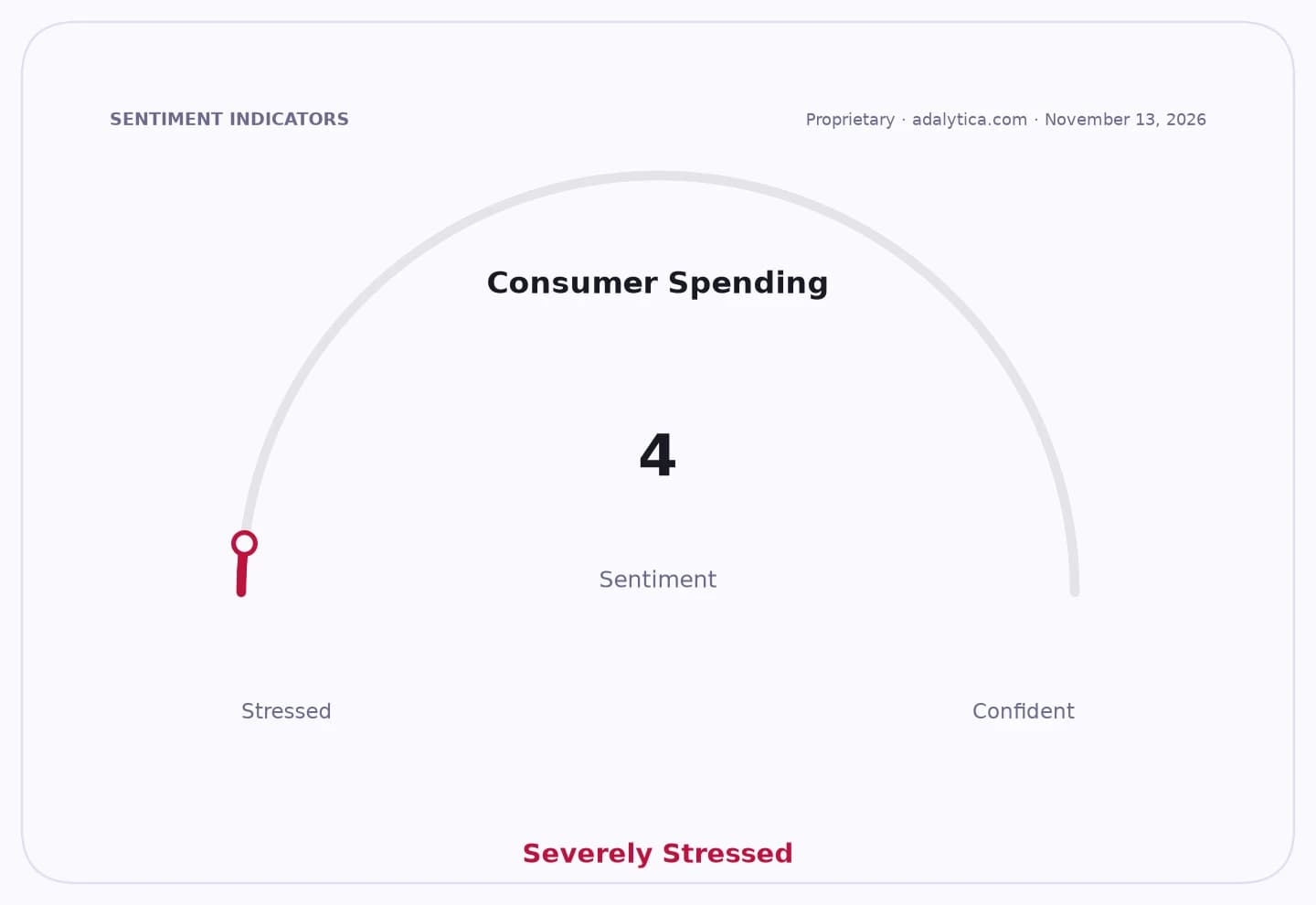
Adalytica’s consumer spending sentiment gauge remains in “Extreme Fear,” reinforcing the view that consumers are still wary even as headline sentiment improves. Retail sales sentiment is also weak. Together, those signals point to a household sector that is not collapsing, but is still prioritising essentials and price discipline over aggressive discretionary purchases.
The broader market backdrop matters as well. The S&P 500 has held near record territory and Adalytica’s trade signals show “Extreme Greed,” which can amplify sensitivity to macro data: a confidence rebound may be welcomed if it confirms resilience, but any disappointment in spending could quickly rotate investors back toward defensives. For now, October’s expected improvement looks more like a stabilisation than a turnaround, leaving the key question whether consumers will convert a better mood into stronger spending heading into year-end.
| Entity | Gains | Losses |
|---|---|---|
| US consumers | ▲Slightly improved sentiment | ▼Still cautious spending |
| Discretionary retailers | ▲Better holiday demand odds | ▼Promotional pressure persists |
| Staples stocks | ▲Defensive bid remains intact | ▼Less upside if spending broadens |
| Economically sensitive equities | ▲Support from stable labour market | ▼Risk if confidence fades again |