Euro zone retail sales likely rose only modestly in September, a sign that households are still spending cautiously even as the bloc’s labour market remains comparatively firm and the European Central Bank weighs the pace of further rate cuts.
Euro zone retail sales likely rose modestly in September
Consumer Spending
The latest consumer data matter because retail sales are one of the clearest readouts on whether domestic demand can offset weak industrial activity and uneven export growth. A restrained pick-up in spending would suggest the euro area is still expanding, but without the kind of consumer momentum that would allow policymakers to declare victory over the growth slowdown.
Sentiment Indicators
Consumer Confidence
That backdrop is important for the ECB. Inflation pressures have eased enough to keep the door open to additional rate reductions, but policymakers are still trying to avoid moving too quickly if lower borrowing costs reignite price pressures or weaken the euro. The euro has been relatively steady around $1.11, with technical indicators such as the 50-day moving average and 200-day moving average pointing to a market that is consolidating rather than trending sharply, while the euro-area equity gauges VGK and EZU have both held above their 50-day and 200-day averages, suggesting investors are pricing in gradual rather than abrupt policy easing.
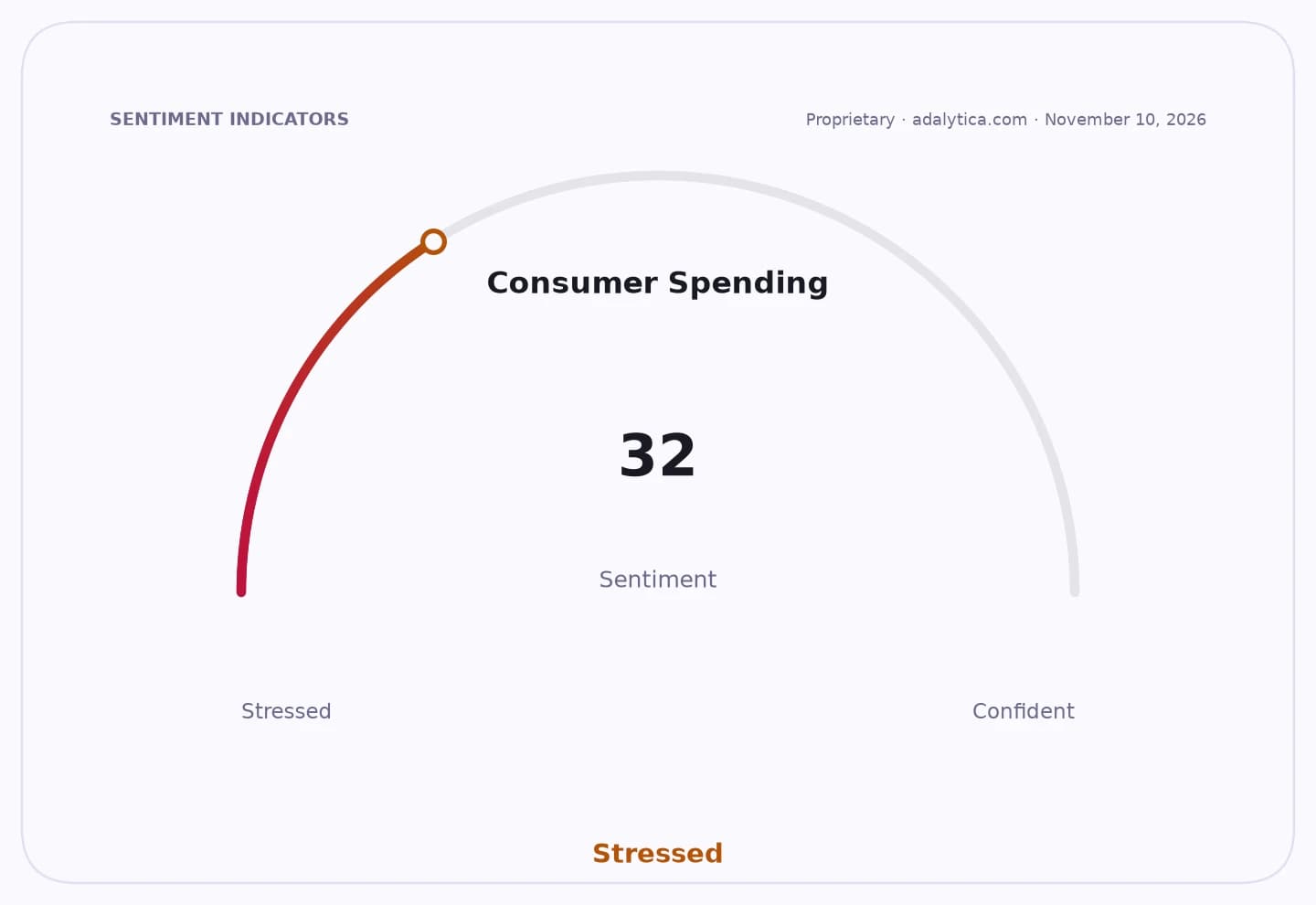
The broader macro picture is mixed. Euro zone unemployment has hovered near 4.1%-4.2%, which should support disposable income, but consumer mood remains fragile. Adalytica’s consumer spending sentiment is at 32, neutral, while its consumer confidence recession gauge sits in fear territory at 18, underscoring that households may be spending selectively rather than broadly. That helps explain why retail sales can still improve without signalling a true consumption boom.

For investors, the key question is not whether September retail sales were positive, but whether they confirm a soft landing or a more durable consumer recovery. A modest increase would be constructive for European retailers, banks and domestic demand-sensitive stocks, but it would also keep pressure on cyclical earnings assumptions if wage growth and lower rates fail to translate into stronger volumes. Conversely, a weak print would reinforce the case for more ECB easing, likely supporting bonds and rate-sensitive equities while weighing on the euro.
The next catalyst is whether subsequent data show the September improvement carrying into the fourth quarter. If spending broadens beyond essentials, it would strengthen the case that the euro zone can sustain growth without fresh policy stimulus. If not, retail sales will remain one of the clearest warning signs that the bloc’s recovery is still too dependent on monetary support.
| Entity | Gains | Losses |
|---|---|---|
| Euro zone consumers | ▲Lower borrowing costs | ▼Weak wage-to-spending pass-through |
| ECB dovish policymakers | ▲More room to cut rates | ▼Less urgency to ease aggressively |
| Retailers and domestic cyclicals | ▲Gradual demand recovery | ▼Cautious household spending |
| Euro bulls | ▲Stable growth without inflation spike | ▼Softer consumption momentum |