The Federal Reserve is running into a familiar problem: the two biggest forces keeping inflation sticky are largely outside its reach.
Fed Faces Sticky Inflation From Fuel and AI Demand

Wednesday’s hotter-than-expected inflation reading jolted markets into pricing a much higher chance of another Fed hike later this month, with CME Fed futures moving the odds from about 22% to 54%. But the data also underscored the central bank’s limited control over the price pressures doing the most damage: surging fuel costs and the heavy electricity and equipment demand tied to the AI data-center boom.
That matters economically because those two inputs hit the economy in different but reinforcing ways. Higher gasoline and diesel prices feed directly into consumers’ monthly budgets and into the cost of transporting nearly everything else. At the same time, hyperscaler spending on AI infrastructure is adding a new source of demand-led inflation in power, construction and industrial supply chains. Even if the Fed tightens policy again, it cannot directly increase oil supply or slow geopolitical risk around the Strait of Hormuz, and it has little leverage over Big Tech’s capital expenditure plans.
The September consumer price data captured that bind. Inflation accelerated from August, with the annual CPI rate rising to 3.7%, its highest since 2023. Energy was the major driver, and market participants quickly adjusted to the possibility that the Fed may feel compelled to respond anyway, even if the transmission mechanism is weak. ING economist James Knightley said rate hikes would have “limited impact” on the two price drivers and noted that “much hinges on what happens with the Strait of Hormuz.”
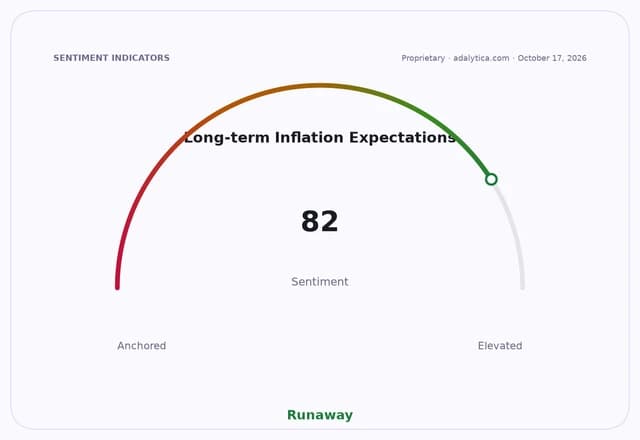
Long-term Inflation Expectations — 30-day sentimentadalytica.com
Explore this data interactively — full history, time series and cross-market comparisons.Open AlphaPulse
The bond and equity markets are treating the Fed’s dilemma as an inflation problem with a policy problem layered on top. US stocks fell sharply after the release, with the Nasdaq down about 1%, while the stronger dollar and higher rate expectations pressured risk assets including bitcoin. Energy shares, by contrast, have been among the clearest beneficiaries. The Energy Select Sector SPDR ETF has climbed to roughly $68.24, well above its 50-day moving average of $63.31 and 200-day average of $56.99, while its RSI reading near 79 suggests the move is technically stretched but still being supported by the inflation backdrop. Consumer staples, by comparison, have also held up, reflecting demand for defensive exposure when pricing power becomes more valuable.
The broader inflation picture is less one-sided than the headline suggests, and that is where the policy debate gets more complicated. Wages are cooling, with growth running near 3%, a pace below inflation and one that Knightley said should help dampen price pressures over the medium to longer term. That is the part of the data that could eventually give the Fed room to ease or at least pause. But for now, the central bank is being asked to solve an inflation problem driven by gasoline, geopolitics and AI-related capital spending — three forces it cannot fully control.
For investors, that argues for a more selective response than a simple “higher for longer” trade. Energy producers and some industrial suppliers look relatively well positioned if oil remains firm and AI infrastructure spending stays aggressive. Consumer-facing businesses and transport-heavy sectors face the more obvious margin squeeze. The key risk is that the Fed tightens into a supply-driven inflation shock, slowing demand without quickly fixing the underlying price pressures. Thursday’s retail sales and wholesale inflation data may offer another read on demand, but they are unlikely to change the basic story: the Fed still has little direct control over the two biggest inflation drivers.
| Entity | Gains | Losses |
|---|---|---|
| Energy producers | ▲Higher oil revenues | ▼Rate-sensitive growth stocks |
| Consumers | ▲None | ▼Higher fuel and living costs |
| Fed officials | ▲Tighter policy options | ▼Limited control over inflation |
| AI hyperscalers | ▲Strong infrastructure build-out | ▼Higher input and financing costs |