Inflation is cooling, but it is still doing the one thing that matters most politically and economically: keeping the cost of living elevated enough to shape the election.
Inflation Stays Sticky, Favor Energy Over Discretionary

That is the core contradiction in the U.S. economy right now. Price pressures are no longer surging the way they were in 2022, and headline inflation has moved down from its peak. But with consumer prices still rising around 3% and core inflation running at roughly the same pace, households are not getting relief — they are just getting a slower rate of pain. The result is an economy where the statistics say normalization, while voters still feel squeezed every time they shop, fill up, or pay rent.
Sentiment IndicatorsⓘProprietary · adalytica.com · October 3, 2026
This is a snapshot — live sentiment, awareness and momentum for 130+ markets update continuously in the dashboard.Open AlphaPulse

The data in this story shows why that gap is so persistent. The Consumer Price Index has climbed to 334.131 in August from 333.979 in May, while the core CPI, which strips out food and energy, rose to 337.765 from 336.121 over the same period. The PCE price index, the Federal Reserve’s preferred gauge, increased to 131.579 from 131.241. Those are not inflation spikes. They are much more dangerous politically: steady, cumulative increases that never let prices reset lower.
That matters because inflation is not just a macro debate anymore. It is a voting behavior issue, a wage negotiation issue and a valuation issue. If prices keep rising even modestly, consumers remain cautious, retailers protect margins by pushing through higher prices, and the Federal Reserve has little room to declare victory. The central bank’s credibility depends on getting inflation closer to its 2% target, not merely proving that it has stopped accelerating. That is why expectations around inflation remain so important.
Long-term Inflation Expectations — 30-day sentimentadalytica.com
Explore this data interactively — full history, time series and cross-market comparisons.Open AlphaPulse
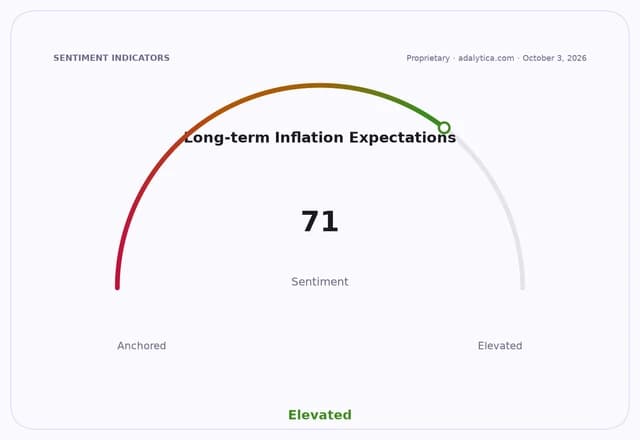
Market indicators are telling the same story. Adalytica’s Long-Term Inflation Expectations sentiment has jumped to 71, while confidence in the Fed’s 2% inflation target sits at 82, both sharply higher over the past week. The 5-year breakeven inflation sentiment also stands at 71. That combination suggests investors and households are becoming more convinced that inflation will stay sticky enough to keep policy restrictive. Wage inflation sentiment, meanwhile, is only 39, signaling that pay growth is not keeping pace with the political urgency of prices.
For investors, that creates a clear split. Consumer staples and energy are still the places where pricing power and inflation resilience matter most. The Consumer Staples ETF, XLP, is trading near 80.53, above its 200-day moving average of 82.68 only recently and now slipping back toward support, with its RSI down to 25.6, a sign the group has been sold hard despite its defensive profile. The Energy ETF, XLE, has been far stronger, closing at 62.82 and sitting above both its 50-day and 200-day moving averages. That is exactly what you would expect when inflation remains embedded in the economy: companies tied to necessities and hard assets retain leverage, while discretionary spending stays under pressure.
The real investment implication is that the market may be underestimating how long this “good enough” inflation regime can last. Investors hoping for a clean return to 2% may be too optimistic, and that matters for rates, margins and sector leadership. If inflation settles in a 3% range instead of snapping back to target, the winners are businesses with real pricing power, strong balance sheets and exposure to essential demand. The losers are companies dependent on consumers finally feeling relief that may never fully arrive.
That is why the election narrative and the market narrative are converging. The public does not vote on disinflation; it votes on affordability. And until prices stop climbing in the categories that matter most, the economy will remain a political headache and a reason to stay selective in equities. The best positioning now is to favor inflation-resistant sectors and hard-asset beneficiaries while remaining wary of consumer-dependent names that need inflation to fade faster than the data says it will.
| Entity | Gains | Losses |
|---|---|---|
| Energy stocks/XLE | ▲Pricing power; inflation hedge | ▼Lower oil prices |
| Consumer staples/XLP | ▲Defensive demand | ▼Margin pressure if costs rise |
| Federal Reserve | ▲Less inflation panic | ▼Credibility risk if 2% stays distant |
| Consumers/discretionary stocks | ▲— | ▼Persistent cost-of-living squeeze |