Finland’s proposed debt brake may be noisy in Helsinki, but the numbers show it would amount to only a modest fiscal tightening — and one that is unlikely to derail growth, bond markets or the country’s welfare model.
Finland Debt Brake Debate Seen as Modest Tightening

The core issue is not whether Finland can survive the plan. It can. The question is whether lawmakers can agree on the discipline needed to keep public finances from worsening further after the country was pushed into the EU’s excessive deficit procedure. Even under the rough outline now being debated, the required adjustment of 8 billion to 11 billion euros over a parliamentary term works out to about 2 billion euros a year, or just over 1% of public spending.
Sentiment IndicatorsⓘProprietary · adalytica.com · September 18, 2026
This is a snapshot — live sentiment, awareness and momentum for 130+ markets update continuously in the dashboard.Open AlphaPulse

That is politically contentious, but economically small relative to the size of the state. Finland’s general government spending is projected at about 173 billion euros in 2027, equal to roughly 57.5% of GDP, which the finance ministry sees at 300.5 billion euros. A 2 billion-euro annual adjustment is less than the kind of swing typically seen in a weak budget cycle, and it would still leave the public sector heavily in deficit and debt on a rising path.
That is why the debate matters less as a near-term macro shock than as a signal of whether Finland is finally willing to stop drifting. The market already knows the country is not facing an acute funding crisis. Ten-year German Bund yields remain the region’s benchmark, while Finnish fiscal politics are more likely to affect domestic sentiment than global asset prices. The bigger economic risk is inertia: without some form of credible consolidation, debt dynamics keep deteriorating, and every future adjustment becomes more painful.
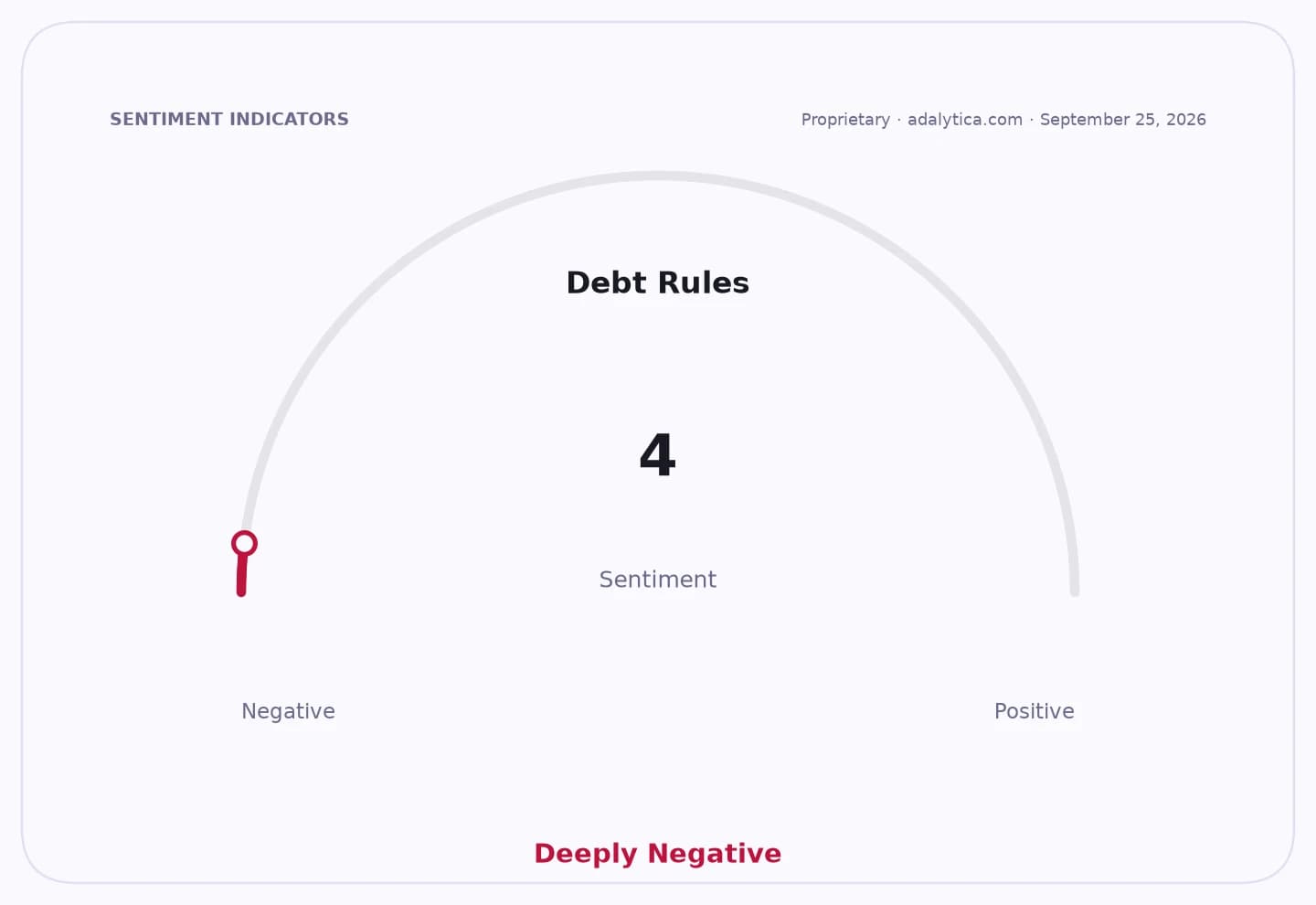
Debt Rules — 30-day sentimentadalytica.com
Explore this data interactively — full history, time series and cross-market comparisons.Open AlphaPulse

For investors, the implications are clearer in the second order effects. A mild spending brake, if it is enforced, supports the sovereign’s credibility and should help keep borrowing costs contained over time. If it is watered down or abandoned, the message is that Finland remains unwilling to make even small structural choices, which would matter for long-duration assets, domestic financials and any valuation premium attached to Nordic policy stability.
That is the underpriced part of this story. The market is not staring at a Greek-style fiscal event. It is pricing a country whose debt debate is still small enough to be solved with annual savings of around 1% of spending, yet politically difficult enough to reveal whether fiscal discipline still exists at all. For investors, that makes the issue less about immediate pain and more about whether Finland’s policy framework can preserve one of its last structural advantages.
If lawmakers settle the dispute, the beneficiaries are clear: sovereign-credit holders, rate-sensitive assets and a broader market that values predictability. If they do not, the losers are just as obvious: the state’s fiscal flexibility, longer-term bond confidence and any expectation that Finland can avoid bigger, harsher cuts later. The best investment reading is simple — this is not a collapse story, but it is a credibility test, and credibility is what keeps small fiscal problems from becoming large market ones.
| Entity | Gains | Losses |
|---|---|---|
| Finnish government bondholders | ▲Credibility if brake passes | ▼Higher risk premium if diluted |
| Finland’s fiscal hawks | ▲Policy leverage | ▼Political resistance |
| Public sector / spending beneficiaries | ▲Status quo if plan stalls | ▼Modest budget restraint |
| Domestic equities and banks | ▲Stability from clearer rules | ▼Uncertainty if debate drags on |