France’s borrowing problem is becoming less a one-off market scare than a structural test of how long a major euro-zone economy can live with persistently high deficits, rising interest costs and limited political room to fix either.
France Debt Stress Weighs on Bonds and EWQ

That matters because France is not Greece, but it is one of Europe’s anchor economies, and its debt burden is now large enough to influence bond markets, bank funding conditions and the European Central Bank’s policy calculus. When sovereign debt starts to look riskier than corporate credit, investors are no longer just pricing a fiscal debate — they are pricing the durability of the entire economic settlement.
Sentiment IndicatorsⓘProprietary · adalytica.com · October 15, 2026
This is a snapshot — live sentiment, awareness and momentum for 130+ markets update continuously in the dashboard.Open AlphaPulse
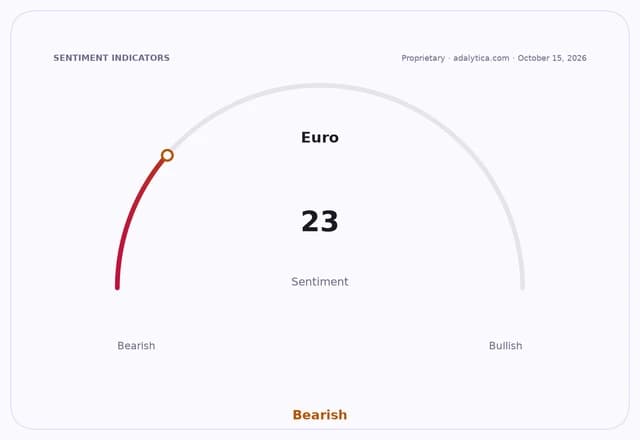
The numbers help explain the concern. France’s public debt stands around 3.6 trillion euros, while the economy is still expanding only modestly and unemployment is hovering near 4%, according to the data context. The 10-year U.S. Treasury yield near 5.2% underscores the global backdrop of higher-for-longer rates that makes debt servicing more painful everywhere, including Europe. In that environment, every additional point of borrowing cost compounds the problem.
For investors, the message is not simply that France is in trouble; it is that chronic deficits can outlast political cycles. Markets can absorb a shock, a protest wave or even a cabinet crisis. What they struggle to discount cleanly is a country that keeps rolling debt forward while avoiding the fiscal surgery needed to stop the stock from rising. That is why debt stories often fade from the headlines before they disappear from balance sheets.
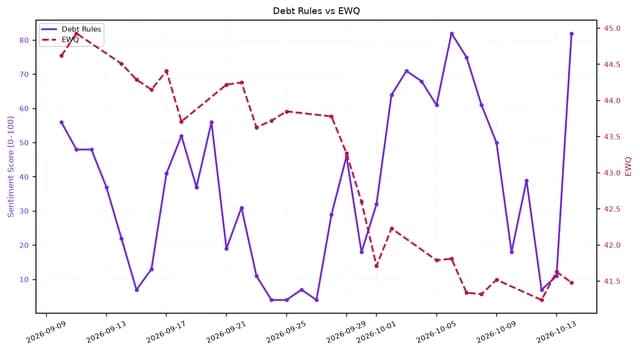
The exchange-traded fund tracking France, EWQ, has slipped to about $41.48, below both its 50-day and 200-day moving averages, while its RSI reading is in deeply oversold territory. Spain’s EWP has also softened but is holding above its longer-term average, suggesting investors are drawing a distinction between countries with heavier political overhangs and those with steadier reform momentum. In other words, Europe is not being sold as a single trade; investors are becoming more selective about fiscal credibility.
The European Union’s own fiscal-debt sentiment gauge from Adalytica shows the tension clearly. The reading on EU debt rules has jumped sharply, but awareness remains extremely low, a combination that often appears when policy risk is real but underpriced by the broader market. The ECB, meanwhile, is still viewed as highly attentive, yet Christine Lagarde has made clear that the central bank cannot solve France’s problem for it. That is important: once investors believe rescue is unlikely, the burden shifts back to Paris.
That is the heart of the narrative. Crises pass because markets adapt, governments patch, and central banks stabilize funding conditions. Deficits remain because the political incentives to fix them are weaker than the economic incentives to postpone the fix. France’s challenge is not an isolated panic; it is the slower, more dangerous version of sovereign stress, where the bill keeps growing even after the emergency fades.
For long-term investors, this argues for patience and selectivity rather than fear. France-linked assets may eventually become attractive if reforms take hold, but until there is clearer evidence that deficits are heading lower, the safer approach is to diversify broadly across Europe and focus on balance-sheet strength, pricing power and cash generation. This is a story worth watching, but not one to rush into.
| Entity | Gains | Losses |
|---|---|---|
| French government | ▲Time to delay reforms | ▼Fiscal credibility |
| Bondholders | ▲Higher yields | ▼Principal protection |
| ECB | ▲Policy flexibility | ▼Pressure to backstop France |
| Equities in France | ▲Eventual reform upside | ▼Near-term valuation pressure |