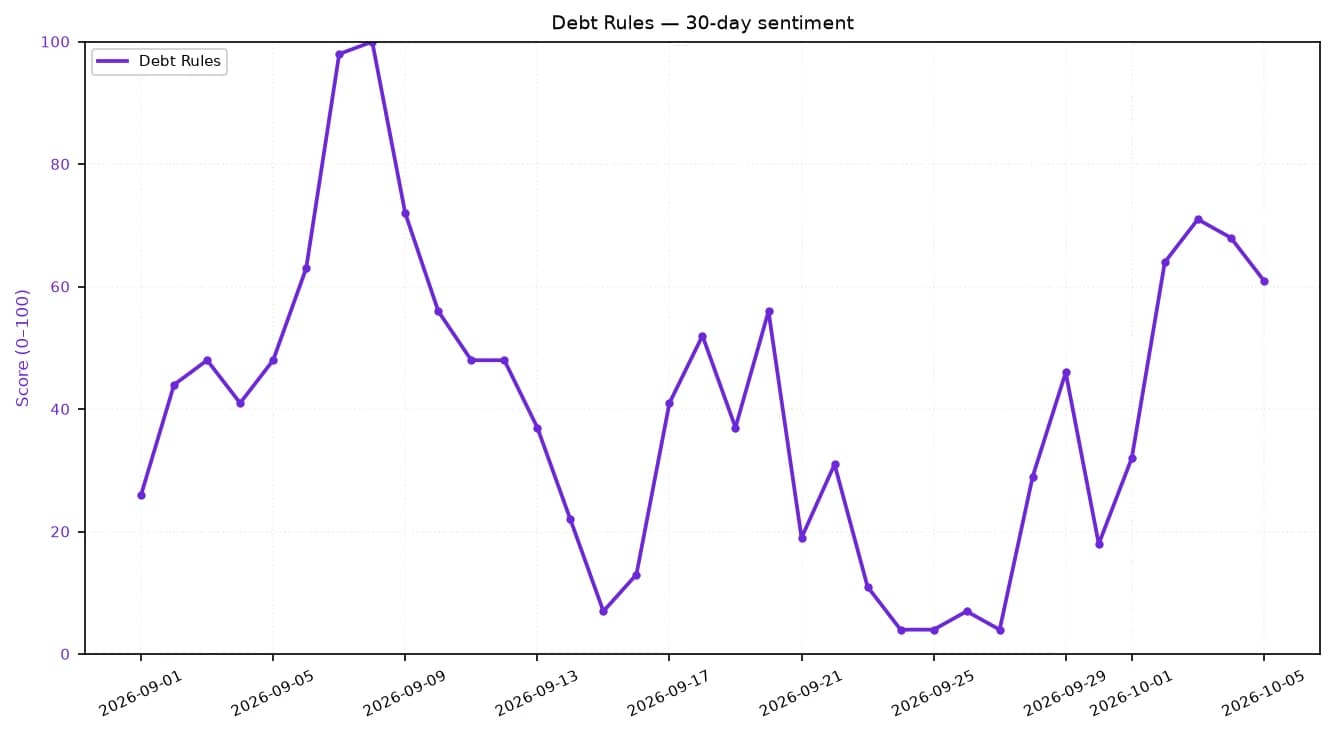
France’s swelling public debt is emerging as the euro zone’s most consequential sovereign risk, because the problem is no longer just whether Paris can borrow, but what happens to the currency bloc if markets keep demanding a higher premium to fund it.
France debt spreads widen vs Germany

With French government debt around 119% of GDP, the country is now well above the level where growth alone can stabilize the debt burden unless nominal expansion runs faster than borrowing costs. That is not the case at present. The result is a debt dynamic that can reinforce itself: higher interest bills absorb growth, deficits stay sticky and investors ask for still more compensation to own the paper.
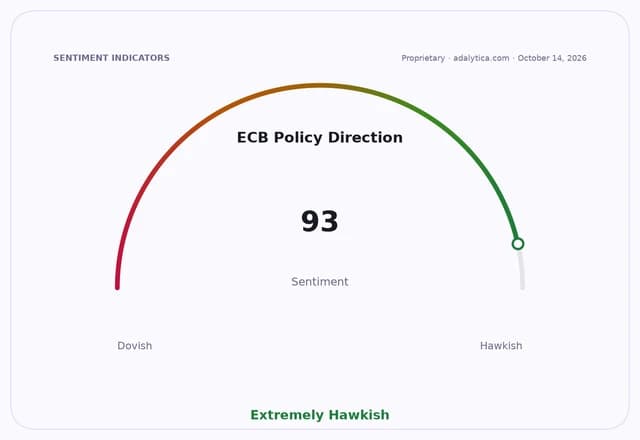
Sentiment IndicatorsⓘProprietary · adalytica.com · October 14, 2026
This is a snapshot — live sentiment, awareness and momentum for 130+ markets update continuously in the dashboard.Open AlphaPulse
The pressure is already visible in bond markets. The gap between 10-year French and German yields, which was typically below 50 basis points from 2015 to 2024, has widened back toward levels last seen during the euro sovereign crisis. France is being treated less like a core borrower and more like a “semi-core” credit, a shift that matters because the country is not Greece. Its economy is roughly 10 times larger, making any loss of confidence a systemic event rather than a peripheral one.
That is why the market is assuming the European Central Bank would step in if fragmentation became disorderly. The ECB now has the tools to limit bond-market stress, and a classic sovereign default still looks unlikely. But even if the central bank prevents a run on French debt, it does not eliminate the economic cost. History suggests heavily indebted states more often escape through financial repression, higher inflation or currency weakness than through outright repayment.
For investors, that is the key distinction. The danger is less a nominal default than a long period in which bondholders and currency holders absorb the adjustment. The euro has already shown signs of strain as French spreads widened, and a weaker common currency would spread the cost across the bloc by eroding purchasing power rather than just re-pricing one country’s debt.
That leaves the ECB in an increasingly awkward position: defend market functioning while not appearing to underwrite fiscal slippage. The more monetary policy is forced to accommodate indebted members, the more pressure builds on the euro’s credibility as a stable store of value. France’s financing challenge is therefore not only a national fiscal problem, but a test of whether the euro zone can keep a large member solvent without weakening the currency that binds it together.
For now, the market is still betting the system can contain the shock. The harder question is whether it can do so without transferring the bill to savers, bondholders and the euro itself.
| Entity | Gains | Losses |
|---|---|---|
| ECB | ▲Buys time | ▼Faces bigger intervention burden |
| French government | ▲Keeps market access | ▼Pays higher borrowing costs |
| Bondholders | ▲Receive higher yield | ▼Risk inflation and FX erosion |
| Euro | ▲Potential support from ECB backstop | ▼Faces depreciation pressure |