French consumer confidence is under pressure as a Pew Research Center survey found 85% of adults in France rated the economy poorly, the bleakest reading among 18 high-income countries and a warning sign for domestic demand as the government grapples with debt and street protests.
France Consumer Confidence Falls on Pew Survey

The finding matters because household sentiment often shapes spending, savings and political tolerance for austerity at a time when France is under fiscal strain. Pew said about four in 10 respondents called economic conditions “very bad,” while the share describing the economy as bad has climbed back to roughly summer 2020 levels, when the pandemic was still battering Europe.
Sentiment IndicatorsⓘProprietary · adalytica.com · October 12, 2026
This is a snapshot — live sentiment, awareness and momentum for 130+ markets update continuously in the dashboard.Open AlphaPulse
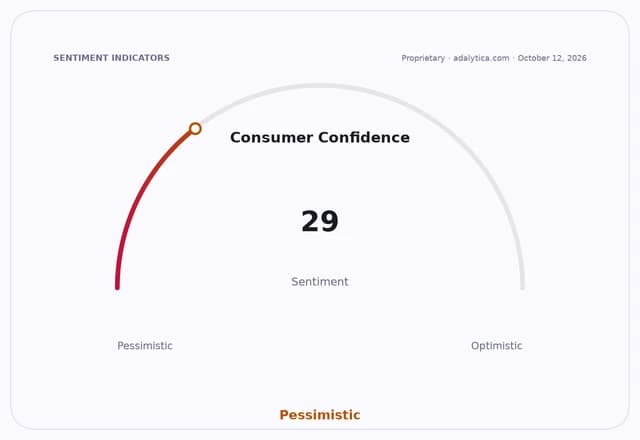
The survey, conducted among 1,006 adults from Feb. 9 to April 17, shows pessimism running well beyond any one age group. Adults 18 to 34 were nearly as negative as those 50 and older, suggesting the malaise is broad-based rather than limited to younger workers facing weak prospects.
Political polarization is even starker. Pew said 91% of people on the ideological right viewed the economy negatively, while 92% of respondents who held a favorable view of Marine Le Pen’s National Rally said conditions were bad. That kind of entrenched gloom can harden opposition to tax rises, spending cuts and labor-market reforms needed to stabilize public finances.
For investors, the data reinforces the risk that France’s fiscal problem is no longer just a bond-market story but a consumer and political one as well. Public frustration can make deficit reduction harder, extend policy uncertainty and weigh on French equities, banks and cyclical stocks tied to domestic growth.
Shares of the iShares MSCI France ETF, traded under the ticker EWQ, have been under pressure in recent months and were last around $41.52, below both the 50-day and 200-day moving averages. The broader European benchmark FEZ was last near $65.92, also trading under its 50-day moving average, underscoring how France’s weak mood is landing in an already cautious regional market.
Pew’s report does not measure output or prove that France’s economy is objectively worse than peers, and its interviews were completed before the latest protests. Still, the survey points to a public mood that could make the next round of budget negotiations and reform efforts more volatile for President Emmanuel Macron’s government.
| Entity | Gains | Losses |
|---|---|---|
| French households | ▲Potential policy relief | ▼Confidence in the economy |
| Macron government | ▲Pressure to act on debt | ▼Room for austerity |
| Domestic equities | ▲Possible stimulus upside | ▼Demand and sentiment risk |
| Eurozone peers | ▲Relative comparison clarity | ▼Spillover political uncertainty |