A former European Central Bank policymaker has warned that the ECB’s decision to keep shrinking its balance sheet could help trigger the next bout of debt stress in Europe, as governments must absorb more sovereign issuance into a market already facing higher long-term yields.
ECB QT Warning on Europe Debt Stress
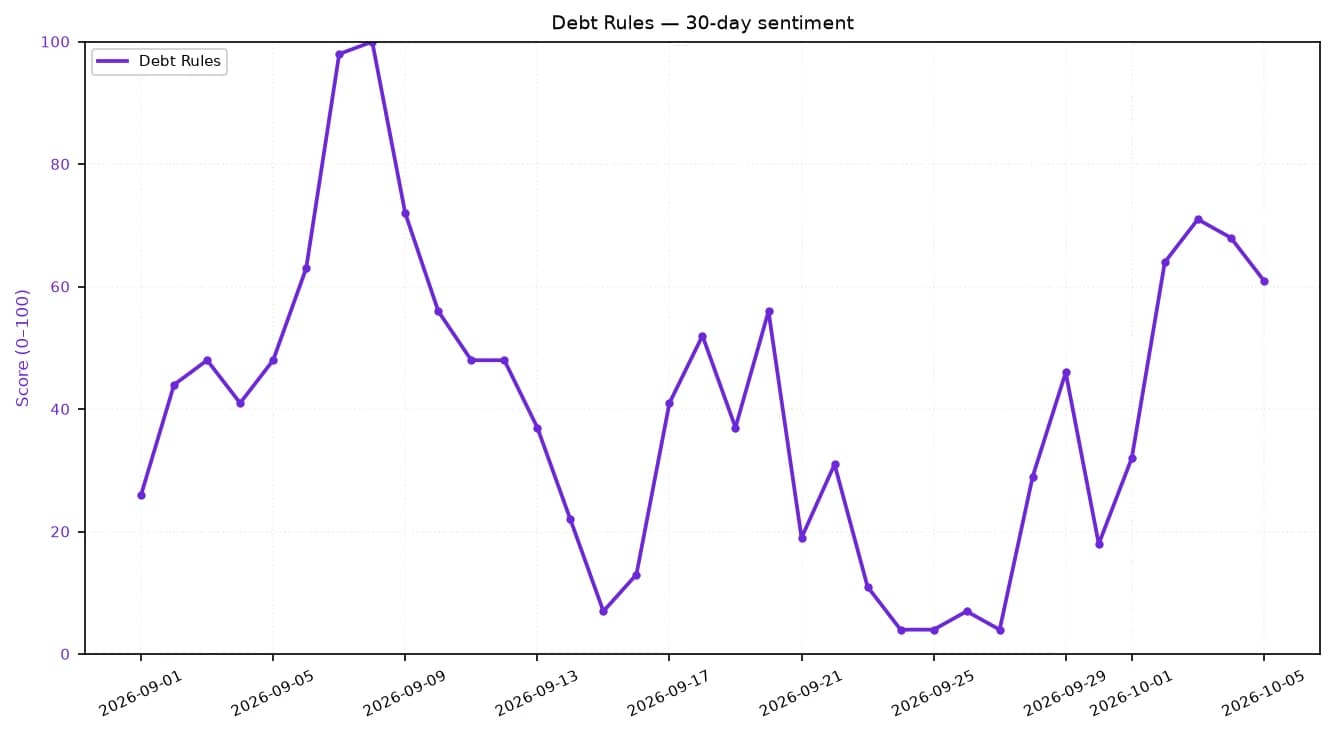
The warning matters because quantitative tightening is no longer a bookkeeping issue for central banks: it is changing who funds Europe’s debt at a time when bond markets are already more fragile. Since March 2023, the ECB has stopped reinvesting maturing assets, including government bonds, steadily reducing its balance sheet and forcing a larger share of new issuance onto private investors. That comes as long-dated yields are rising, making refinancing more expensive for states and more painful for banks and other balance-sheet buyers.
Sentiment IndicatorsⓘProprietary · adalytica.com · October 6, 2026
This is a snapshot — live sentiment, awareness and momentum for 130+ markets update continuously in the dashboard.Open AlphaPulse
Lorenzo Bini Smaghi, a former ECB Governing Council member, said the central bank has treated balance-sheet “normalisation” almost as an obligation, rather than a policy choice that should be tested against current market conditions. His argument is that the post-2008 financial system is structurally different from the one that existed when central banks first expanded their holdings, and that those changes make QT riskier than the ECB appears to assume.
The most immediate economic concern is the impact on sovereign borrowing costs. When a central bank steps back as a buyer of public debt, the market has to clear at higher yields unless private demand rises enough to offset the lost official support. In Europe, that is especially sensitive because governments are already issuing more debt to finance deficits and higher interest bills, while the ECB is still lifting or maintaining pressure on the long end through balance-sheet reduction. The spread between the 10-year and 2-year US Treasury yields widened to 0.47 percentage point on Monday, underscoring how markets remain attuned to term-premium moves and duration risk globally.
Bini Smaghi said the case for caution is reinforced by three structural changes. First, banking rules now encourage institutions to hold more high-quality liquid assets, including sovereign bonds, which changes demand patterns for government paper. Second, hedge funds and other non-bank players now play a larger role in market-making, which can worsen liquidity in stressed periods. Third, banks are often forced to fund themselves through central bank operations at rates above policy benchmarks, encouraging them to hold more government bonds and increasing the feedback loop between sovereign risk and bank balance sheets.
That feedback loop is the real investor issue. If sovereign yields rise sharply, the market value of banks’ bond holdings falls, collateral needs increase and funding conditions tighten. In the worst case, sovereign stress feeds into bank stress and back into sovereign stress — the kind of “bank-state vicious circle” Europe spent years trying to weaken after the euro zone crisis. The concern is not hypothetical: investor attention has already turned toward safer core government debt, with German bonds benefiting when volatility rises elsewhere in the bloc.
For bond investors, the message is that the ECB’s withdrawal as a balance-sheet buyer may be just as important as the policy rate path. Bini Smaghi argues the ECB should suspend QT until conditions stabilize and use the time to study its market effects more carefully. That position does not imply an immediate crisis, but it does suggest the current regime is adding pressure to long yields at the very moment Europe is trying to finance large fiscal needs without destabilizing its financial system.
The ECB has said the pace of QT is relatively slow and that the design of its new liquidity framework is still uncertain. But that uncertainty is exactly what concerns critics: when the central bank is reducing its backstop without fully clarifying what replaces it, investors tend to demand a higher risk premium. For markets, the next test will be whether rising European yields are absorbed smoothly — or whether the ECB’s retreat from sovereign bond markets becomes the catalyst for the debt stress Bini Smaghi is warning about.
| Entity | Gains | Losses |
|---|---|---|
| ECB hawks / QT supporters | ▲Faster balance-sheet “normalisation” | ▼Greater market stress risk |
| Euro-zone governments | ▲None | ▼Higher refinancing costs |
| Banks and sovereign-bond holders | ▲Potentially higher yields on new purchases | ▼Mark-to-market losses, tighter funding |
| Core euro debt, including German Bunds | ▲Safe-haven inflows | ▼Peripheral bonds under pressure |