Germany’s spending on artificial intelligence is set to surge this year as companies shift from pilot projects to broad deployment, a sign the country’s industrial base is moving AI from a productivity experiment to a capital budget priority.
Germany AI spending to rise 48% in 2026

The Bitkom industry group said total German outlays on AI software, services and hardware will rise 48% in 2026 to 28.7 billion euros, up from 19.4 billion euros a year earlier, according to data from IDC. That pace matters because it suggests AI is no longer confined to a handful of large tech buyers; it is spreading across firms of all sizes and sectors, with implications for corporate margins, IT procurement and the competitive gap between early adopters and laggards.
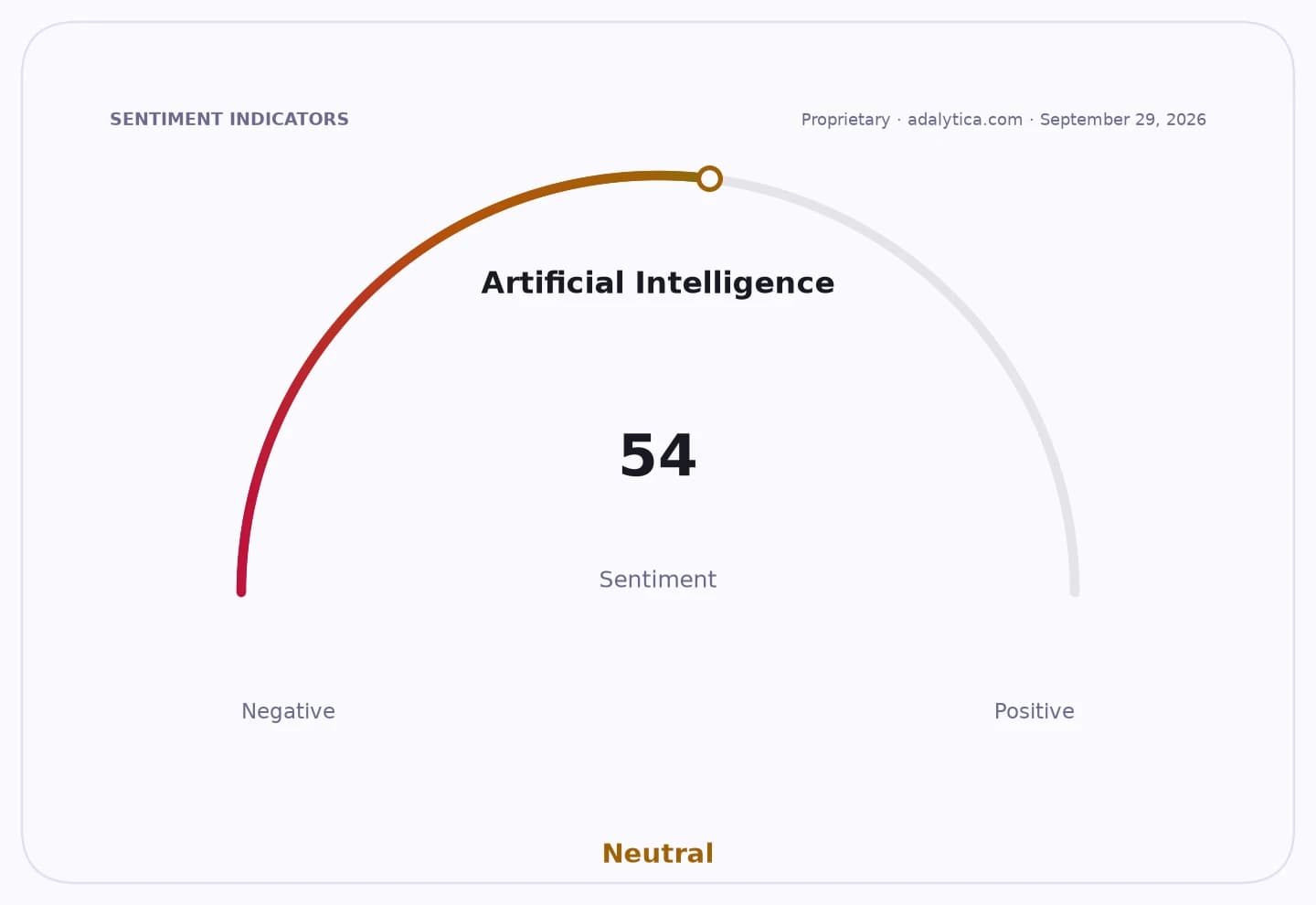
Sentiment IndicatorsⓘProprietary · adalytica.com · September 26, 2026
This is a snapshot — live sentiment, awareness and momentum for 130+ markets update continuously in the dashboard.Open AlphaPulse
The clearest growth engine is generative AI, where spending is expected to double to 11.5 billion euros from 5.7 billion euros. That segment would account for roughly 40% of the market, underscoring how quickly tools such as ChatGPT, Microsoft Copilot, Claude and Google Gemini are being embedded in business workflows. Bitkom president Ralf Wintergerst said the market is moving out of the “experiment phase” and into productive use, with companies increasingly using AI to speed up processes and improve products.
The mix of spending is also telling. AI software is forecast to absorb 16.0 billion euros, up 65%, while services should rise 30% to 6.8 billion euros and hardware 32% to 5.8 billion euros. In economic terms, that points to a second-order investment cycle: software demand rises first, then consulting, integration and infrastructure follow as firms try to scale deployments and connect them to existing systems. For Germany, where manufacturing, automotive and industrial services remain central to growth, productivity gains from AI could become a meaningful offset to weak cyclical demand and high labor costs.
IDC’s forecast for another 40% increase in 2027 to 40.3 billion euros suggests this is not a one-year surge but a multi-year buildout. That has direct implications for investors: winners are likely to include enterprise software vendors, cloud and infrastructure providers, data-center equipment makers and systems integrators, while companies that cannot translate AI spending into measurable efficiency gains may face pressure to justify the outlay. For large industrial groups, AI investment could support margins; for smaller firms, the upfront cost could be harder to absorb.
The broader market backdrop also matters. After a long period in which the United States dominated the AI investment narrative, Europe is increasingly trying to carve out a larger role in deployment and commercialization. Germany’s scale is especially important because it is Europe’s biggest economy and a bellwether for industrial adoption. If the current spending trend holds, the debate will shift from whether German companies are willing to buy AI tools to whether those tools can deliver enough productivity lift to improve profitability and sustain competitiveness.
For investors, the key question now is not whether AI demand exists in Germany, but how quickly it turns into earnings. The companies that can sell, integrate and support AI at scale stand to benefit first; the broader payoff for the economy will depend on whether the technology starts showing up in higher output per worker, faster product cycles and lower operating costs.
| Entity | Gains | Losses |
|---|---|---|
| Enterprise software vendors | ▲Higher AI license demand | ▼Pricing pressure from rivals |
| Cloud and hardware suppliers | ▲Bigger infrastructure spending | ▼Buyers delaying capex |
| German industrial firms | ▲Productivity gains | ▼Upfront integration costs |
| Laggard competitors | ▲— | ▼Wider efficiency gap |