UAE manufacturers are moving industrial AI from pilot projects into core operations faster than their global peers, a shift that could reshape factory productivity, energy demand and spending on digital infrastructure across the Gulf.
UAE Manufacturers Adopt Industrial AI Faster Than Peers
A Schneider Electric study released in Abu Dhabi found 23% of manufacturers in the UAE now view AI as a core part of operations, above the 16.3% global average. The gap matters because it points to a region using automation and software not just to cut costs, but to strengthen industrial resilience and competitiveness in a more data-heavy economy.
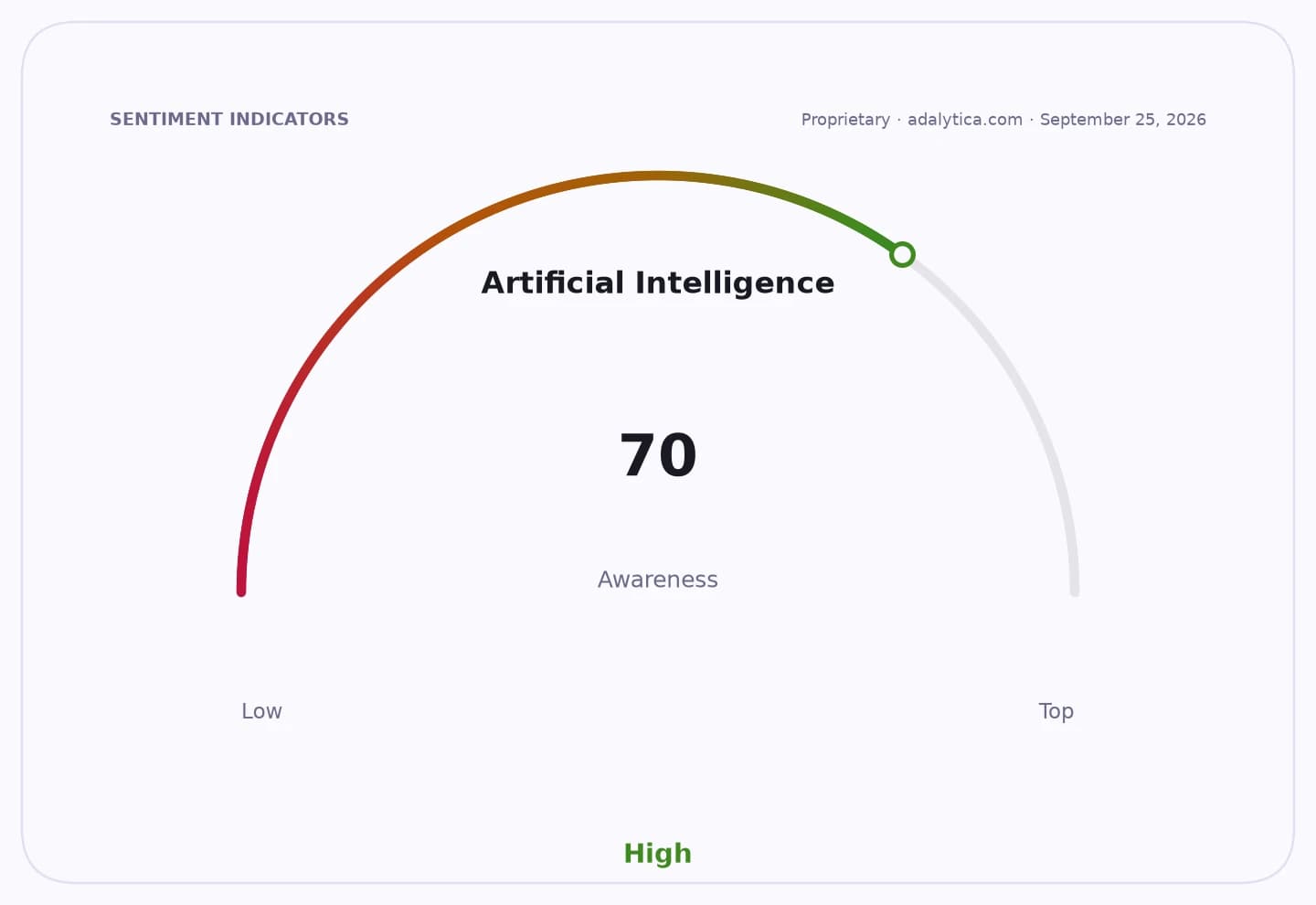
Sentiment IndicatorsⓘProprietary · adalytica.com · September 28, 2026
This is a snapshot — live sentiment, awareness and momentum for 130+ markets update continuously in the dashboard.Open AlphaPulse
The survey, part of Schneider Electric’s 2026 Industrial AI in CPG Study: UAE, also showed 59% of UAE manufacturers expect AI to have a transformational impact by 2030, compared with 42.2% globally. That level of confidence suggests industrial AI is becoming a strategic investment rather than an experimental one, with implications for factory software, cybersecurity, cloud-linked control systems and equipment suppliers.
Cybersecurity is emerging as a top constraint and spending priority, cited by 38% of manufacturers as AI adoption expands. That is likely to benefit firms selling industrial software, monitoring tools and secure automation systems, while raising execution risk for manufacturers that deploy AI faster than they can harden their networks.
Schneider Electric used the summit to frame AI as part of a broader “era of intelligence” that also drives more electricity demand and infrastructure buildout. For investors, that ties industrial AI to a wider capex cycle spanning grids, data centers, electrification and factory modernization — all areas that can lift demand for power equipment, automation and semiconductor content.
The company also said the UAE Ministry of Economy and Tourism will launch a 12-week NEST Accelerator Programme with Schneider Electric for early-stage startups in energy technology, industrial technology and enterprise AI across the Middle East and Africa. It launched a 3,000-square-metre Innovation Hub in Abu Dhabi at the same event, underscoring how policy, startups and industrial vendors are converging around AI adoption.
The immediate takeaway is that the UAE is positioning itself as a faster-moving test bed for industrial AI than many developed markets. The next question for investors is whether that pace turns into durable productivity gains — and whether the infrastructure and cybersecurity buildout needed to support it keeps up.
| Entity | Gains | Losses |
|---|---|---|
| UAE manufacturers | ▲Faster productivity gains | ▼Higher cybersecurity exposure |
| Schneider Electric | ▲More automation demand | ▼Execution risk on deployments |
| Power and grid suppliers | ▲More infrastructure spending | ▼Strain from higher AI electricity use |
| Industrial software vendors | ▲Stronger adoption cycle | ▼Slower-moving peers |