Germany’s private-sector expansion accelerated to a four-and-a-half-year high in November, a sign that Europe’s biggest economy is shaking off stagnation and giving investors a cleaner reason to own German cyclicals again.
Germany PMI Rises to 55.0 in November
The flash composite purchasing managers’ index rose to 55.0, with both manufacturing and services improving. That matters because Germany has spent much of the past two years as the laggard in developed Europe, weighed down by weak industrial orders, high energy costs and a stop-start export backdrop. A reading above 50 signals expansion, and a move to 55.0 is not a marginal beat — it points to a broadening upswing that can filter through to earnings, hiring and capital spending.
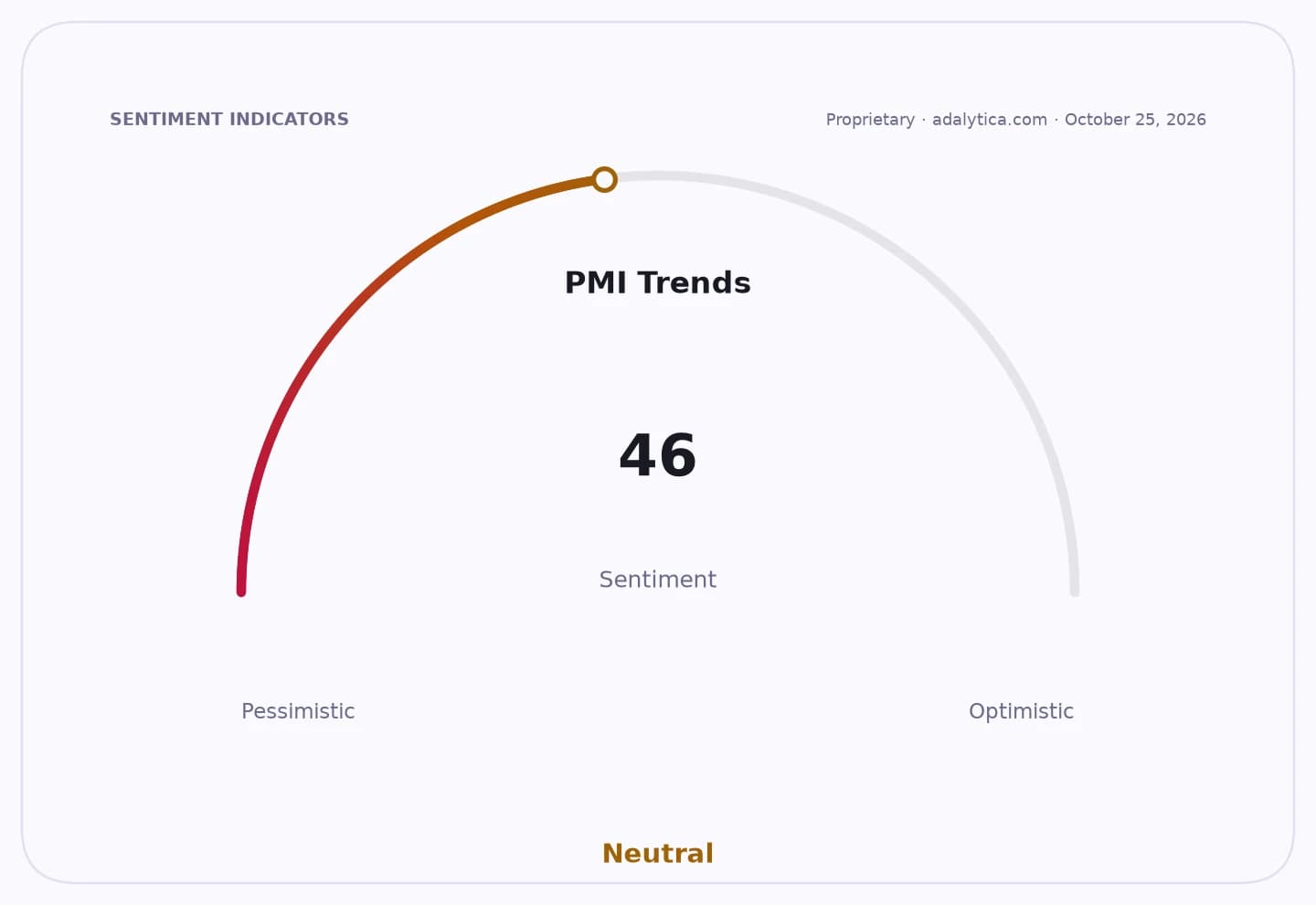
Sentiment Indicators
For investors, the message is bigger than a single data point. Germany’s recovery can act as a relay point for the wider European trade: banks, industrials, autos, chemicals and domestic demand plays tend to outperform when growth turns from fragile to self-sustaining. That is especially important now, when global markets are still focused on U.S. growth concentration and China’s uneven recovery. A firmer Germany improves the case for Europe as a relative-value trade, particularly in sectors levered to manufacturing activity and credit demand.
The market backdrop suggests that opportunity is still underpriced. The EWG Germany ETF has been trading around $40.08, well below its 50-day moving average near $41.63, while RSI readings around 32.6 show the fund remains technically washed out rather than overheated. Deutsche Bank shares at $32.82 are also still below their 50-day average of $34.51, even after recent stabilization, suggesting investors have not fully priced in a cyclical rebound. The DAX, at 42.68, is still below its 50-day average of 44.35, which tells you the index has not yet caught up to the improving macro narrative.
That sets up a classic early-cycle trade. If German activity keeps improving, the second-order winners are not just the obvious exporters but also lenders, domestic-capex beneficiaries and suppliers tied to a broader industrial recovery. Banks can gain from stronger loan growth and better credit quality, while automakers and industrials benefit from firmer order books and more confidence around demand. The losers are shorts betting on an endless German malaise and investors hiding only in U.S. mega-cap growth.
The bigger narrative is that Europe may be moving from a valuation discount story to a re-rating story. If November’s strength holds into year-end, it strengthens the case for rotating into German equities before consensus catches up. In our view, that means favoring broad Europe exposure with a tilt to cyclicals and financials, while using weakness in the DAX and EWG as a chance to position for a multi-quarter rebound rather than waiting for perfect confirmation.
| Entity | Gains | Losses |
|---|---|---|
| German cyclicals | ▲Stronger orders and earnings leverage | ▼Growth skeptics |
| Deutsche Bank | ▲Better loan demand, credit outlook | ▼Rate-cut panic trades |
| EWG / DAX buyers | ▲Catch-up upside if PMI strength persists | ▼Short-term macro bears |
| Autos and industrials | ▲Rebound in manufacturing momentum | ▼Defensive relative-value holders |