Global bond markets are losing ground because investors are no longer treating the rise in yields as a clean growth story — they are pricing in a more durable mix of inflation, bigger government borrowing, geopolitical risk and still-solid economic activity.
Global bond yields rise on inflation and fiscal risk
That matters because higher long-term yields feed directly into borrowing costs for governments, companies and households, while also challenging the valuation case for stocks that have benefited from easy money. In other words, this is not just a bond-market problem; it is a repricing of capital across the global economy.
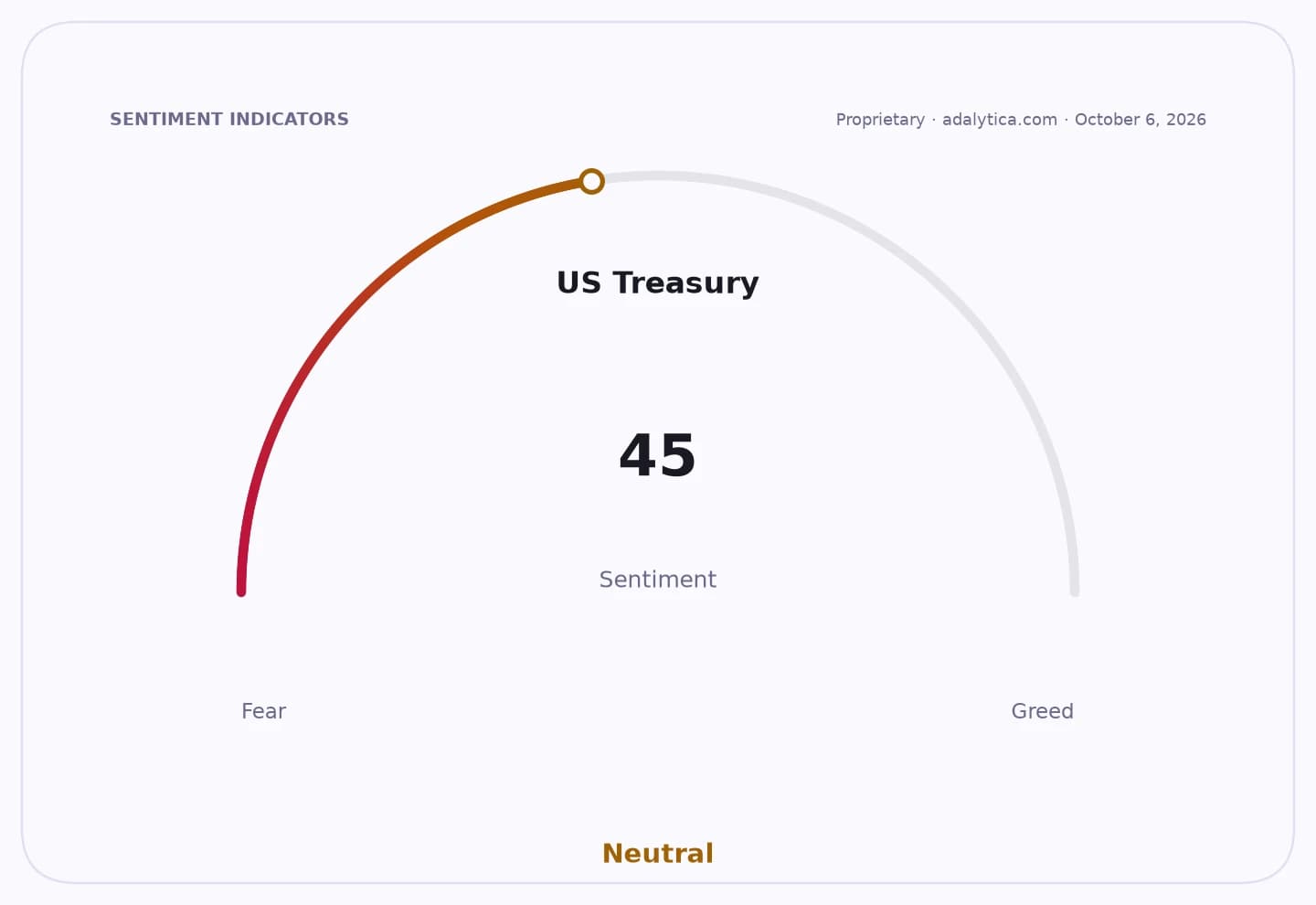
Sentiment IndicatorsⓘProprietary · adalytica.com · October 6, 2026
This is a snapshot — live sentiment, awareness and momentum for 130+ markets update continuously in the dashboard.Open AlphaPulse
The sharpest move remains in the US, where the 10-year Treasury yield has climbed more than 110 basis points this year to levels last seen in 2002, after already pushing through a 2007 pre-financial-crisis high. The 30-year yield has also reached its highest level since 2002. The ETF most closely tied to long-dated Treasurys, TLT, has been under heavy pressure, with its price sliding to about $77.11 from $85.32 in November, while technical readings such as the 50-day moving average and RSI point to an oversold market rather than one that has found a stable floor.
The sell-off is global because the forces behind it are global. Energy prices remain elevated after the war in Iran disrupted expectations for supply, keeping Brent crude near $100 a barrel for much of the year and stoking inflation worries from Europe to Australia. At the same time, governments are borrowing more just as investors are demanding a bigger premium to hold longer-dated debt.
DGS10 vs T10Y2Y — macro contextadalytica.com
Explore this data interactively — full history, time series and cross-market comparisons.Open AlphaPulse
France shows how quickly fiscal anxiety can bleed into markets. Ten-year OAT yields have jumped roughly 130 basis points this year, and the gap over German bunds has widened to levels not seen since the eurozone crisis. Japan is facing a different but equally important test: inflation, wage gains and yen weakness have pushed the Bank of Japan away from ultra-low rates, sending 10-year government bond yields up about 100 basis points. Britain, Germany and Australia have also seen yields climb as central banks confront sticky prices and tighter labor markets.
For investors, the key point is that rising yields are happening even as the global economy still looks resilient. JPMorgan’s global composite PMI rose to 54.3 in September, its best reading in four years, suggesting activity is expanding at an above-trend pace. That gives central banks less room to cut, and it means the term premium — the extra compensation investors demand for holding long-term debt — can keep rising even if growth slows later.
Stocks are not immune. The same higher-rate backdrop that has knocked bond prices lower also makes equity valuations harder to defend, especially for long-duration growth names that were priced off low discount rates. Yet there is a silver lining for patient investors: higher yields can eventually create better long-term entry points in both bonds and equities, if they reflect durable growth rather than runaway inflation.
For now, the message from global fixed income is straightforward: the market is no longer just betting on stronger growth, it is learning to live with a more expensive cost of capital. Investors should expect continued volatility, keep an eye on central-bank reaction functions and use any dislocations to build diversified positions for the long run.
| Entity | Gains | Losses |
|---|---|---|
| Borrowers | ▲Delayed access to cheap capital | ▼Higher refinancing costs |
| Savers / bond buyers | ▲Better income on new debt | ▼Mark-to-market losses on existing bonds |
| Banks with rate-sensitive income | ▲Wider lending spreads | ▼More credit risk if growth slows |
| Long-duration growth stocks | ▲Potential buying opportunities on sell-offs | ▼Lower valuations from higher discount rates |