Global stocks recovered and the dollar slipped after Democrats won control of Congress, a result that could restrain President Donald Trump’s policy agenda and cool expectations for the next round of U.S. rate hikes.
Global stocks rise as dollar slips after Congress vote
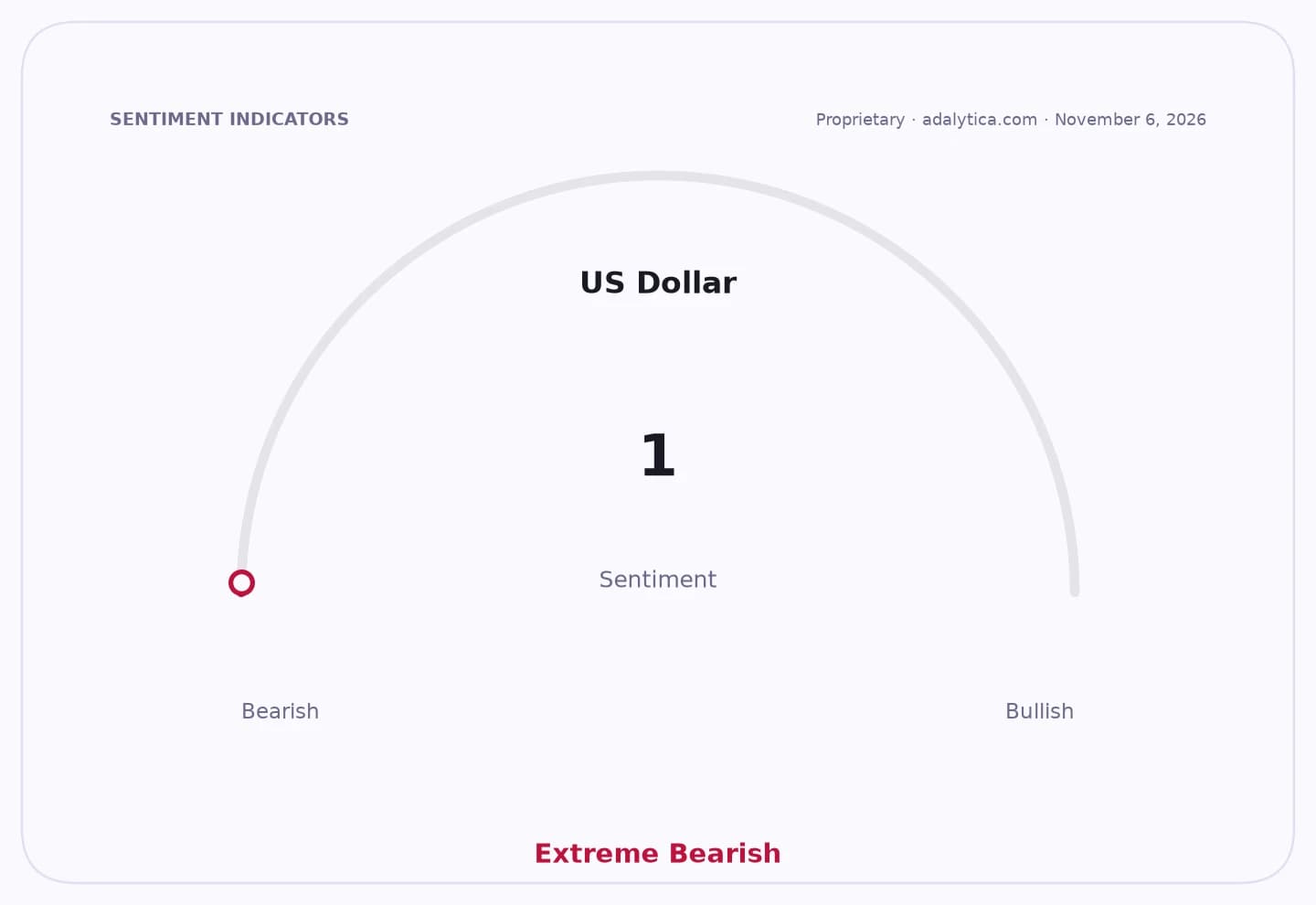
US Dollar
That matters because markets are not just pricing politics — they are repricing the path of growth, regulation and capital flows. A divided Washington often reduces the odds of abrupt fiscal or tax changes, but in this case investors also see a higher risk of tougher scrutiny on artificial intelligence and broader technology spending, just as companies are committing billions to data centers, semiconductors and AI infrastructure.
Sentiment Indicators
The reaction was swift. MSCI’s All-Country World index rose 0.13%, Europe’s STOXX 600 added 0.5%, and U.S. stock futures bounced after dropping as much as 2% overnight. The 10-year Treasury yield fell three basis points to 4.92%, while the dollar weakened against major peers. On Adalytica’s US Dollar Trade Signals, sentiment slid to 16, marked “Fear,” even as awareness stayed elevated, underscoring how quickly investors are positioning for a softer greenback.
For equities, the political shift is a mixed bag. On one hand, a split government can limit policy shock and reduce the odds of sweeping new taxes or spending measures. On the other, it raises the probability of regulatory drag on the market’s biggest earnings engine: Big Tech. Tesla and SpaceX shares fell about 4.5% to 5% on Tradegate, a sign that politically sensitive growth names remain vulnerable whenever Washington starts talking tougher oversight.
US Dollar vs SPYadalytica.com
Explore this data interactively — full history, time series and cross-market comparisons.
The bond market is telling the same story. A lower 10-year yield eases discount-rate pressure on risk assets and improves the case for longer-duration sectors, but it also reflects a market that is trimming expectations for tighter policy. That is why the move matters far beyond Wall Street: if U.S. yields keep easing and the dollar weakens, capital tends to look harder at emerging markets, where local assets can suddenly become more attractive on a relative basis.
That is the real investment angle here. A weaker dollar and lower U.S. yields can improve the backdrop for emerging-market equities and debt, including Nigeria, where portfolio inflows already rose to $7.09 billion in the second quarter of 2026 from $6.03 billion in the first. But the opportunity is not automatic. Currency stability, foreign-exchange liquidity and domestic policy credibility still decide whether global money stays.
For Nigeria, the setup is especially interesting because a softer dollar can help reduce import costs and ease pressure on the naira, while lower Treasury yields can make local assets comparatively more compelling. Yet Brent crude falling 0.4% to $103.17 shows the other side of the ledger: oil revenues remain a key variable, and weaker crude would blunt the benefit of friendlier global financial conditions.
The market’s message is clear: Democrats taking Congress has shifted the balance in Washington, and that alone is enough to move currencies, yields and risk appetite. The bigger question for investors is whether this is the start of a cleaner, lower-dollar global trade — one that favors equities, emerging markets and selected AI beneficiaries — or just a temporary repricing before the next policy fight in the U.S.
| Entity | Gains | Losses |
|---|---|---|
| Global equities | ▲Lower yields, softer dollar | ▼Policy uncertainty |
| U.S. dollar | ▲— | ▼Weaker demand, lower yields |
| Big Tech / AI stocks | ▲Easier funding backdrop | ▼Stricter regulation risk |
| Emerging markets | ▲Better capital-flow backdrop | ▼Stronger dollar scenario |