Gold is pressing against the $4,200-an-ounce line because investors are treating the metal less as a trade and more as a macro hedge against sticky inflation, elevated yields and the risk that the Federal Reserve stays tight for longer.
Gold Tests $4,200 as CPI and Yields Drive Trade

That matters because the next move in bullion will be decided less by jewelry demand or local pricing and more by whether the market believes U.S. inflation data due next week can keep real rates under pressure. Spot gold was holding around $4,195.6 an ounce on Oct. 10, just below a resistance level that Kitco and market analysts say has capped the rally, while support remains near $4,100. If that floor holds, the path to $4,260 and even $4,300 opens up quickly.

The setup is being shaped by the bond market. The U.S. 10-year Treasury yield is still elevated at about 5.27%, a level that normally works against a non-yielding asset like gold. Crude oil near $95.8 a barrel is also keeping inflation expectations alive, and that combination is why traders are reluctant to chase bullion blindly into the week’s close. But the key point is that gold has absorbed those headwinds and kept buyers interested on dips, a sign that the market is still assigning value to portfolio insurance.
That is why the technical picture matters now. GLD, the largest gold ETF, recently slipped to 382.15, with its 50-day moving average near 397 and RSI readings in the mid-30s, showing the metal is cooling from overbought levels rather than breaking its longer-term trend. GDX, the gold miners ETF, has also backed off from recent highs, which tells you equity traders are not yet pricing a full breakout, even as bullion itself hovers within striking distance of record territory. In other words, the market is positioning for a decision, not settling it.
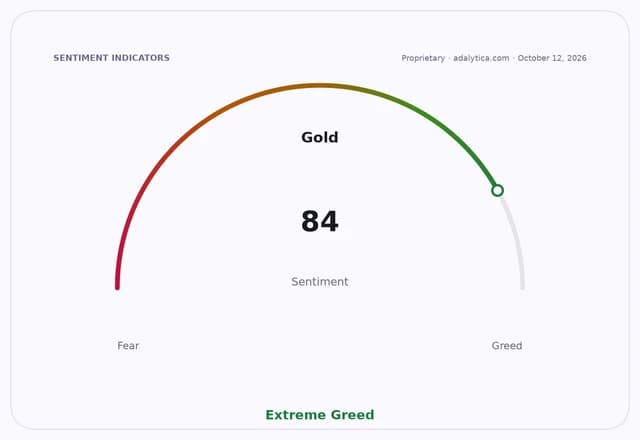
The narrative is straightforward: gold is being pulled between two forces. On one side are stubbornly high yields and the prospect of another Federal Reserve hike later this year if inflation surprises higher. On the other side are persistent demand for inflation protection and central-bank-style allocation flows into bullion ETFs. Adalytica’s Gold Fear & Greed Index at 84 shows sentiment has turned strongly greedy, but that kind of momentum often feeds on itself when a market is this close to a visible threshold.
For investors, the threshold matters because a clean break above $4,200 would likely trigger trend-following buying in bullion funds, lift large producers and royalty names, and reinforce the case that gold remains one of the few true macro hedges in a world of expensive money and geopolitical uncertainty. If the level fails, the retreat toward $4,100 — or even $4,000 — would likely be swift, especially if next week’s U.S. CPI prints hot.
My view is that the market is underestimating how much inflation anxiety is already embedded in gold’s resilience. The trade here is not to chase every tick, but to stay positioned for an upside breakout. If next week’s data softens the Fed’s hawkish case, $4,200 may not act as resistance for long. That makes bullion, and selective miners with leverage to the next leg higher, the more asymmetric setup.
| Entity | Gains | Losses |
|---|---|---|
| Gold bullion | ▲Breakout buyers | ▼Short-term sellers |
| Gold ETFs like GLD | ▲Momentum inflows | ▼Tactically bearish traders |
| Gold miners like GDX | ▲Margin leverage | ▼Higher-cost producers |
| U.S. Treasury yields | ▲Yield-seeking bondholders | ▼Non-yielding gold holders |