Goldman Sachs has lifted its oil price outlook and warned Brent could spike to $120 a barrel if attacks on Middle East shipping intensify, putting a sharper number on the risk premium that has already tightened energy markets.
Goldman lifts Brent forecast on Middle East shipping risk

The bank’s revised call matters because it shows the geopolitical shock is no longer being treated as a temporary flare-up but as a supply-risk regime that could persist into 2026 and 2027. Goldman raised its Brent and WTI forecasts by $5 each, to $85 and $80 a barrel for December 2026 and to $80 and $75 for 2027, while also laying out a downside case of $80 if Gulf exports normalize. With Brent last near $97 when the note went out, the range underscores how sensitive pricing remains to events around the Strait of Hormuz.
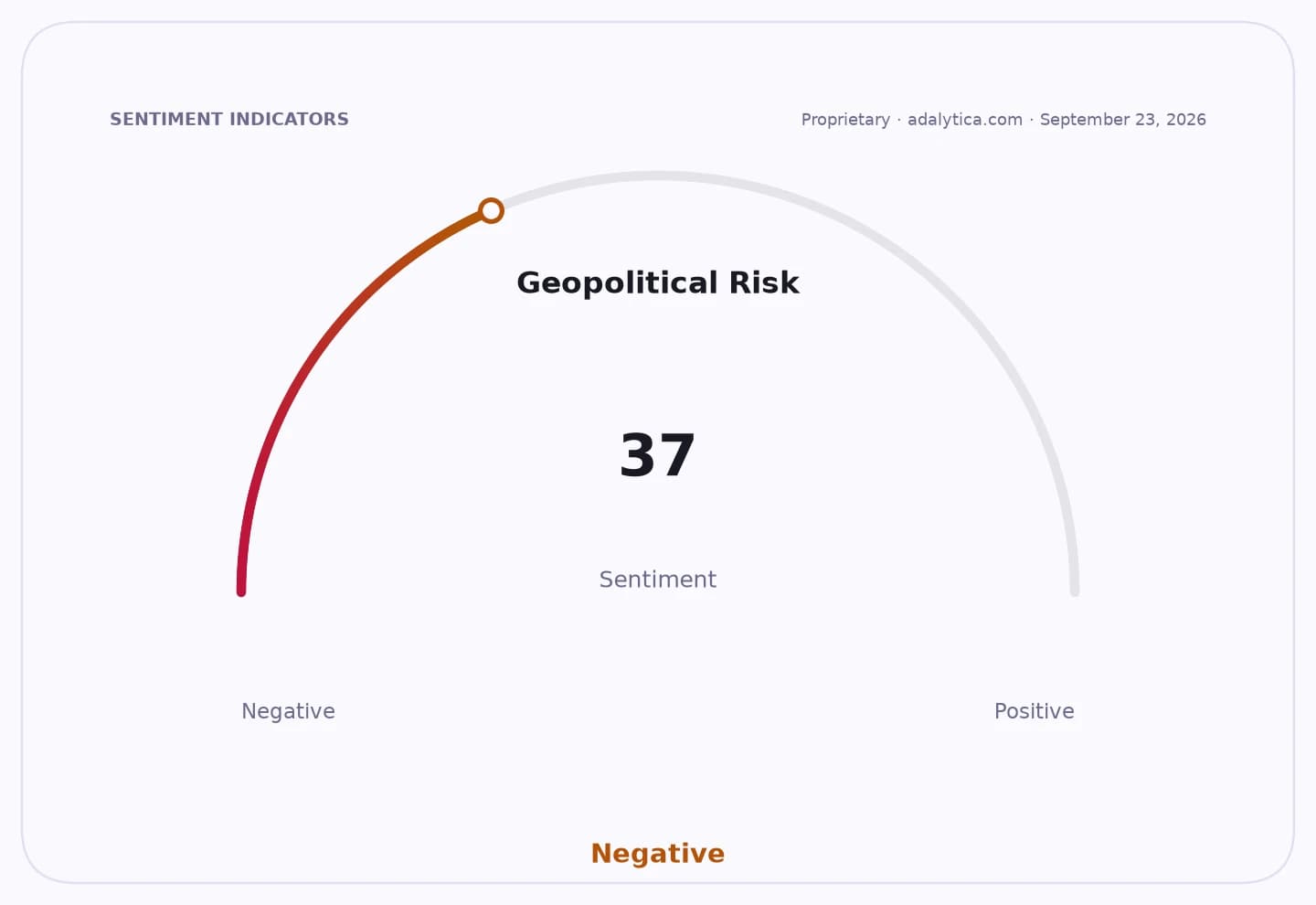
Sentiment IndicatorsⓘProprietary · adalytica.com · September 8, 2026
This is a snapshot — live sentiment, awareness and momentum for 130+ markets update continuously in the dashboard.Open AlphaPulse

The key economic issue is not just higher crude prices, but the risk that shipping disruption bleeds into refined products and gas, where Goldman sees the larger shock. That matters for inflation, trade balances and transport costs because diesel, in particular, feeds through to freight, agriculture and industrial supply chains more directly than headline crude. Goldman’s preference for hedging the geopolitical risk through long natural gas and diesel positions, rather than crude alone, suggests the market may be underestimating how uneven the energy shock could be across the complex.
Goldman’s higher base case reflects an oil market that has already absorbed a meaningful risk premium. Brent has traded around the high-$90s as the US and Iran face off over the waterway, and the bank said shipping attacks broadening and intensifying have become more likely. That is a material shift for producers, refiners and tanker operators because the Strait of Hormuz remains a critical transit route for Gulf exports. If flows are interrupted for long enough, prices could move beyond the usual geopolitical spike and into a supply-shortage environment.
DCOILWTICO vs DCOILBRENTEU — macro contextadalytica.com
Explore this data interactively — full history, time series and cross-market comparisons.Open AlphaPulse

For investors, the implications are immediate. Upstream energy names, tanker rates and defensive inflation hedges should benefit if the higher-risk scenario dominates, while refiners and fuel-intensive sectors face margin pressure if product prices outrun crude. The bank’s call also gives oil bulls a framework for positioning around upside asymmetry without assuming a full-blown supply outage. Bears, by contrast, will point to China’s tendency to curb crude imports when prices rise, a stabilizing force Goldman says is less reliable in gas and refined products.
The broader message is that oil is being repriced less as a function of near-term demand and more as a geopolitical option on shipping security. If attacks remain contained, the market can drift back toward Goldman’s lower range. If they widen, Brent’s path toward $120 would quickly become a macro story, not just a commodities trade.
| Entity | Gains | Losses |
|---|---|---|
| Oil producers | ▲Higher realized prices | ▼Demand destruction risk |
| Refiners / diesel users | ▲— | ▼Higher feedstock and fuel costs |
| Long natural gas / diesel positions | ▲Geopolitical upside | ▼If shipping risk fades |
| Oil consumers / importers | ▲— | ▼Inflation and transport pressure |