Goldman Sachs Asset Management is rolling out an artificial intelligence investment platform, stepping deeper into a market where the payoff from AI adoption is moving from chipmakers and software vendors to the asset managers trying to pick the winners.
Goldman Sachs Asset Management Launches AI Investment Platform
The move matters because AI is no longer just a theme for hardware and cloud providers. As Goldman packages AI into an investable platform, it is trying to capture demand from clients who want exposure to the buildout, the application layer and the risks around rapidly advancing systems without having to bet on a single stock.
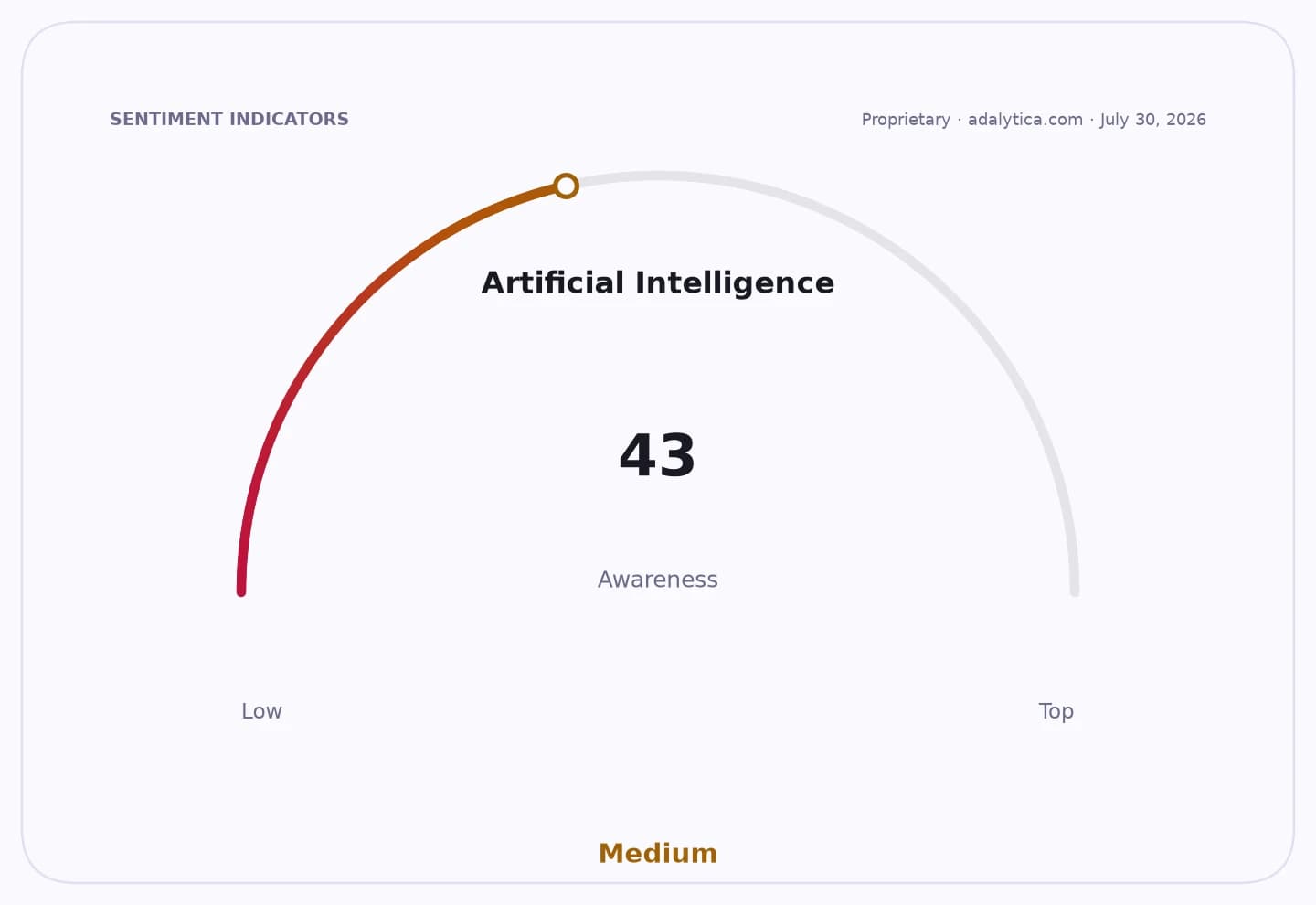
Sentiment IndicatorsⓘProprietary · adalytica.com · July 30, 2026
This is a snapshot — live sentiment, awareness and momentum for 130+ markets update continuously in the dashboard.Open AlphaPulse
That makes the launch relevant well beyond Goldman. Investors have spent the past year concentrating on the biggest AI beneficiaries, from Microsoft and Nvidia to the broader ecosystem of data-center and software suppliers, but the trade is increasingly about whether that spending translates into durable earnings, margins and market share. Goldman’s platform suggests institutions want a more structured way to express that view.
The timing also fits a market that remains heavily focused on AI, even as sentiment becomes more fragile. Adalytica’s AI gauge shows “Extreme Fear” at 14, down 36 points in a day and 71 points over a week, a sign that investors are still chasing the sector while growing more cautious about valuation, execution and regulation.
That caution is well founded. Microsoft said in its latest filing that its cloud and AI strategy requires substantial investment and depends on customer demand, technology shifts and regulation, a reminder that the sector’s capital intensity can pressure returns even when demand is strong. Nvidia, meanwhile, has seen its shares swing sharply as traders recalibrate expectations around AI infrastructure spending.
Goldman’s own stock has reflected that volatility, even as the shares remain far above their 200-day moving average. The stock closed at $1,027.81 on July 30, versus a 200-day moving average of $909.48, with the RSI at 46.7 and the MACD still below its signal line, suggesting the recent pullback follows a powerful run rather than a broken trend.
For investors, the key question is not whether AI remains a megatrend, but which parts of the market can turn that trend into recurring revenue. A Goldman-branded platform can help steer capital toward AI infrastructure, software and security plays, while also positioning the firm to profit from advisory, product and distribution fees as institutions look for cleaner ways to access the trade.
The bigger narrative is that AI is maturing from a speculative narrative into a portfolio construction problem. Goldman’s move implies the next phase of the trade may be about selection, risk management and governance as much as growth, especially after fresh security concerns around autonomous AI systems have highlighted how quickly the story can turn from opportunity to liability.
| Entity | Gains | Losses |
|---|---|---|
| Goldman Sachs Asset Management | ▲New product revenue | ▼Generic passive offerings |
| AI-focused investors | ▲Structured exposure | ▼Unmanaged single-stock risk |
| Microsoft, Nvidia and AI leaders | ▲More capital inflows | ▼Higher scrutiny on valuations |
| Smaller AI laggards | ▲Niche platform inclusion | ▼Attention versus mega-cap peers |