Greece sold three-month treasury bills at a yield of 2.64%, up from 2.58% at the previous auction, signaling a modestly higher funding cost even as investor demand remained comfortably strong.
Greece sells 3-month bills at 2.64% yield
The rise in the short-dated yield matters because it tracks the market’s near-term view on Greek sovereign financing and, more broadly, euro-area money-market conditions. A small move higher at the front end usually reflects firmer expectations for policy rates, tighter liquidity or a slightly heavier supply backdrop, rather than a sudden shift in credit risk. For Athens, the increase is manageable, but it shows that the government is not borrowing at the ultra-cheap levels seen when central banks were still flooding markets with liquidity.
Sentiment IndicatorsⓘProprietary · adalytica.com · October 26, 2026
This is a snapshot — live sentiment, awareness and momentum for 130+ markets update continuously in the dashboard.Open AlphaPulse
The auction drew bids of 1.031 billion euros for 400 million euros offered, or 2.58 times cover, with another 100 million euros taken through non-competitive bids. That suggests domestic banks and other primary dealers were still willing to absorb the paper without requiring a large concession on price. Greece’s debt management agency kept the issue size unchanged at 400 million euros, pointing to a steady, routine refinancing operation rather than a stress-driven cash raise.
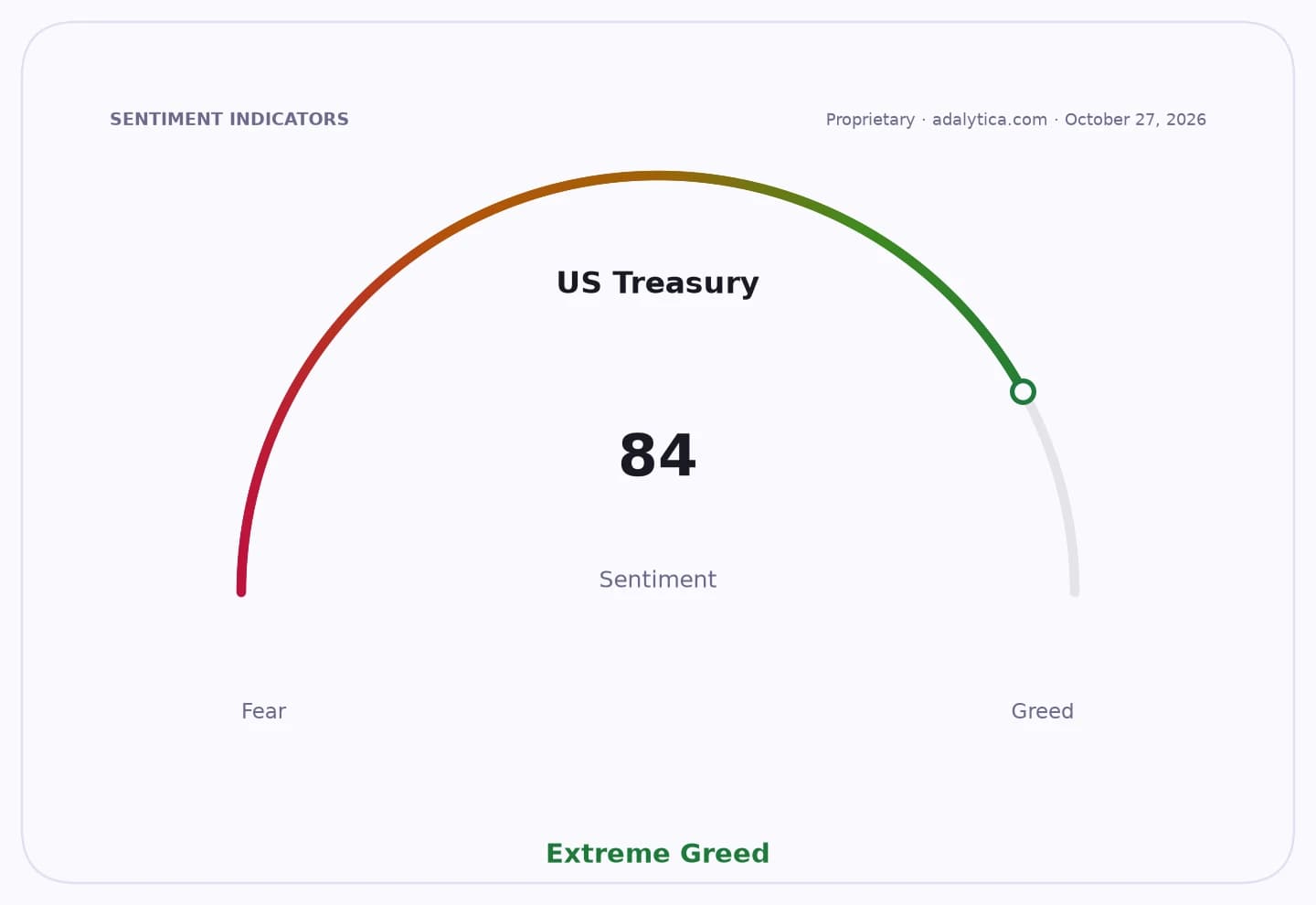
For investors, the auction reinforces the appeal of short-dated sovereign debt as a parking place for cash in a higher-rate world. It also highlights the current trade-off in bond markets: front-end yields remain elevated enough to attract demand, but they are sensitive to shifts in rate-cut expectations. The move comes against a backdrop of volatile U.S. Treasury trading, where short-term yields have been edging higher and market expectations for Federal Reserve policy have turned more cautious, keeping global funding costs from falling decisively.
The bigger picture is that Greece continues to fund itself smoothly, with no sign of stress in the bill market, even as the cost of rolling short-term debt has inched up. If euro-area rates remain sticky, subsequent auctions could price a little higher still. For now, though, the combination of solid bid-to-cover and a contained yield rise points to stable sovereign access and limited immediate market concern.
| Entity | Gains | Losses |
|---|---|---|
| Greek Treasury | ▲Reliable funding access | ▼Slightly higher borrowing cost |
| Primary dealers / banks | ▲Liquid short-term paper | ▼Lower price if yields rise further |
| Cash investors | ▲Higher front-end carry | ▼Less upside if yields fall |
| Existing bondholders | ▲Stable auction tone | ▼Mark-to-market pressure from firmer yields |