The U.S. government’s debt market is increasingly being financed by investors who can leave as quickly as they arrive, a shift that is pushing borrowing costs higher and making Treasury yields more vulnerable to swings in sentiment.
U.S. Treasury Market Faces Faster-Moving Buyers
That matters because the world’s benchmark bond market, now about $32 trillion after doubling and then some over the past two decades, has long relied on buyers that hold for reserve management or liability matching rather than short-term return hunting. As foreign central banks, pension funds and the Federal Reserve step back, hedge funds, dealers and other more price-sensitive investors are taking a larger share of the load — and they demand more compensation for the risk.
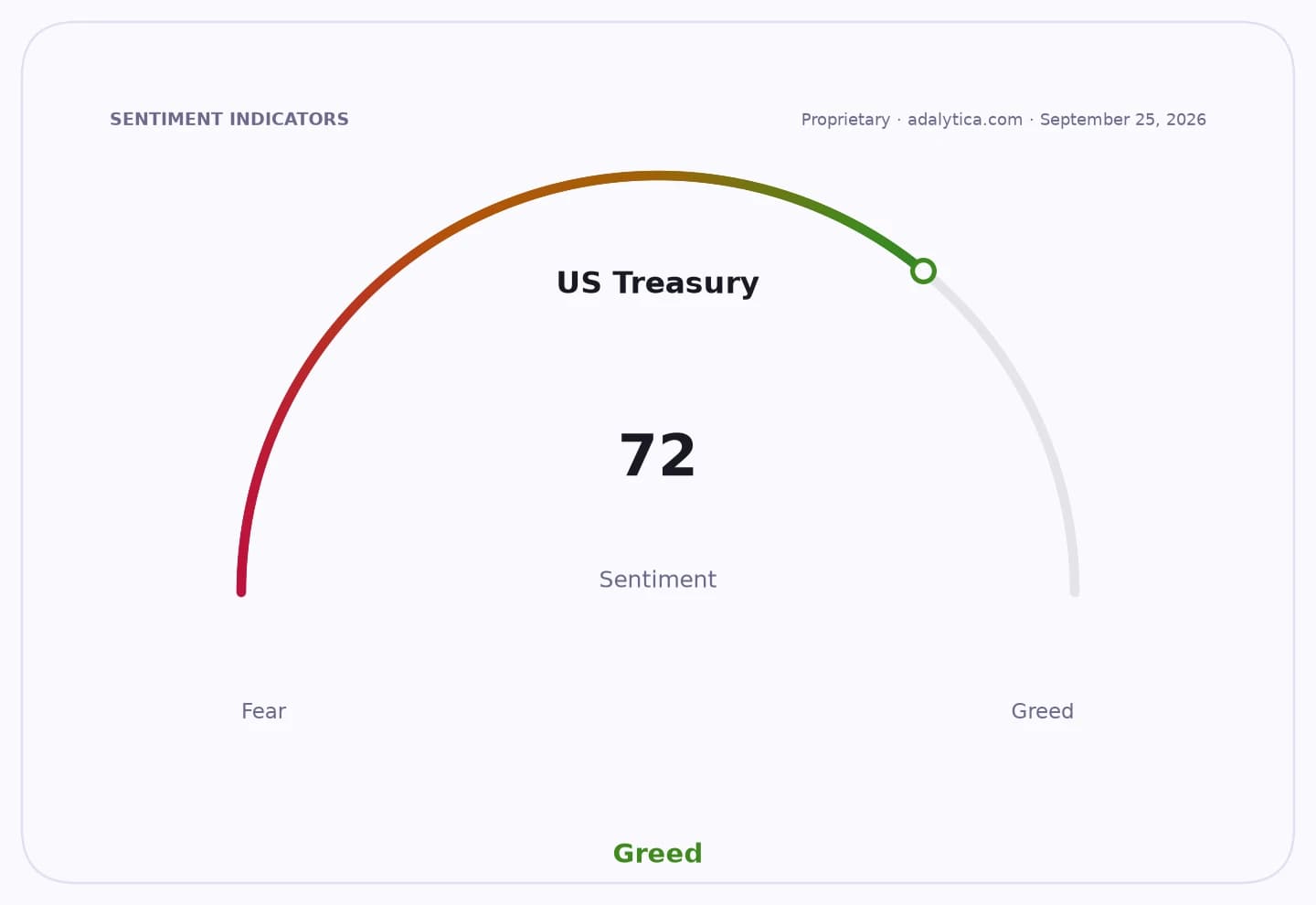
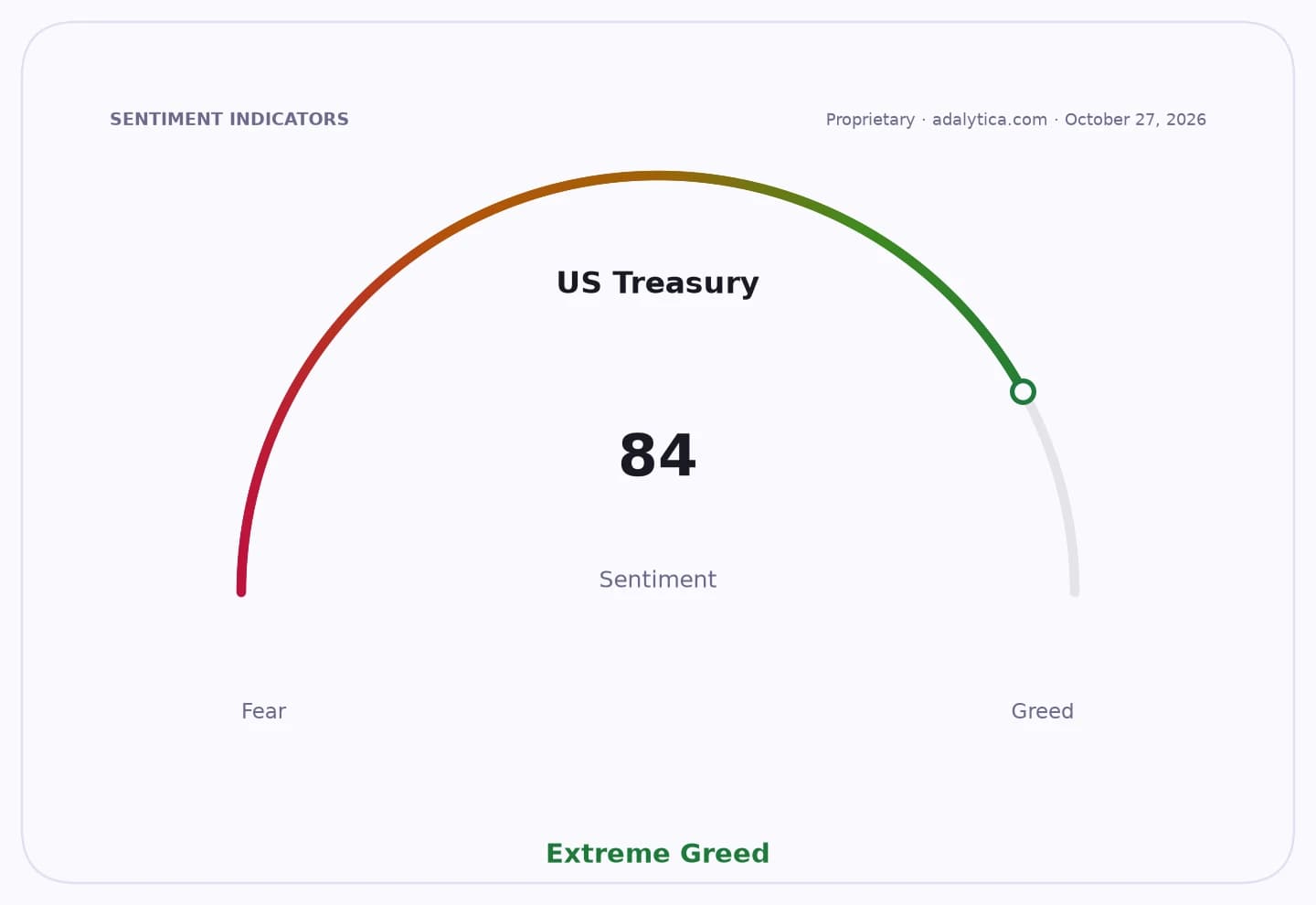
Sentiment IndicatorsⓘProprietary · adalytica.com · October 27, 2026
This is a snapshot — live sentiment, awareness and momentum for 130+ markets update continuously in the dashboard.Open AlphaPulse
The result is not a funding crisis, but it is a more expensive one. Barclays’ Anshul Pradhan said the shift reveals the true cost of U.S. borrowing, noting that a market with fewer insensitive buyers has to offer a wider yield cushion to clear supply. Bloomberg Economics has estimated that reduced purchases by the Fed and foreign official holders helped lift the term premium by as much as 105 basis points at one point, underscoring how much the buyer base itself can move rates.
Treasury yields have already reflected that repricing. The 10-year note was around 4.93% in the latest forecast, while the 2-year/10-year curve remained only slightly positive at about 0.31 percentage point, a sign that investors still expect the Fed to ease eventually but are demanding more term compensation in the meantime. In the cash market, that has kept longer-duration bonds under pressure even as short-dated rates remain anchored by policy expectations.
US Treasury — 30-day sentimentadalytica.com
Explore this data interactively — full history, time series and cross-market comparisons.Open AlphaPulse
The changing mix of buyers also helps explain why rallies in Treasuries have become harder to sustain. Foreign central banks and sovereign wealth funds typically buy to manage reserves and currencies; they are slower to react to price moves. Private investors can rotate just as quickly into corporate bonds or equities, especially when those markets offer better risk-adjusted returns. With companies issuing record amounts of debt to fund artificial intelligence infrastructure, some of the capital that once sat in Treasuries now has obvious alternatives.
Pension funds, another traditional source of steady demand, are also less supportive than they used to be. Corporate plans now sit at roughly 114% funding, up from 82% in mid-2020, reducing the need to buy long-dated bonds to match future liabilities. That shift could encourage the Treasury to lean more on bills and less on longer maturities, though that would leave the government more exposed to refinancing risk over time.
Hedge funds have become the most important expression of the “fast money” argument. Fed researchers have said their Treasury holdings quadrupled between 2012 and 2025, and they now account for almost one-fifth of hedge fund assets. By late last year, they held about 8.5% of Treasuries outstanding, or roughly $2.7 trillion. Their leverage can suppress yields when the trade is working, but it can also amplify disorder if funding costs rise and positions are unwound.
That is why regulators still worry about the basis trade and repo-market stress even though that strategy has recently shrunk. March 2020 remains the warning case: when markets seized up, leveraged holders were forced to sell Treasuries into a falling market, worsening the selloff and forcing the Fed to intervene. The current setup is less fragile than that episode, but it leaves the market more exposed to sudden shifts in financing conditions, policy rhetoric or fiscal alarm.
For investors, the implication is straightforward: Treasuries remain the deepest and most liquid safe-asset market in the world, but the marginal buyer is more mercenary than before. That argues for structurally higher term premiums, more volatile long-end yields and a Treasury financing strategy that may have to pay up more often to keep auctions covered. The U.S. will keep finding lenders, but increasingly on terms set by investors who can walk away.
| Entity | Gains | Losses |
|---|---|---|
| Hedge funds | ▲Higher yield opportunities | ▼Greater funding stress risk |
| U.S. Treasury | ▲Ready buyers for debt | ▼Higher borrowing costs |
| Pension funds | ▲Lower duration risk | ▼Fewer long-bond opportunities |
| Long-duration bondholders | ▲Brief yield support | ▼More price volatility |