Bond investors are confronting a familiar but increasingly dangerous question: when do higher yields stop being a market adjustment and start becoming a sovereign funding problem?
France, U.S., Japan bond yields rise on fiscal strain
That line is moving closer for several major economies as public debt piles up, growth remains uneven and central banks are less able — or less willing — to cushion governments from refinancing pressure. The immediate backdrop is not a panic, but a repricing of duration risk that is lifting borrowing costs across the developed world and forcing investors to reassess how much fiscal strain bond markets can absorb before they demand a more dramatic response.
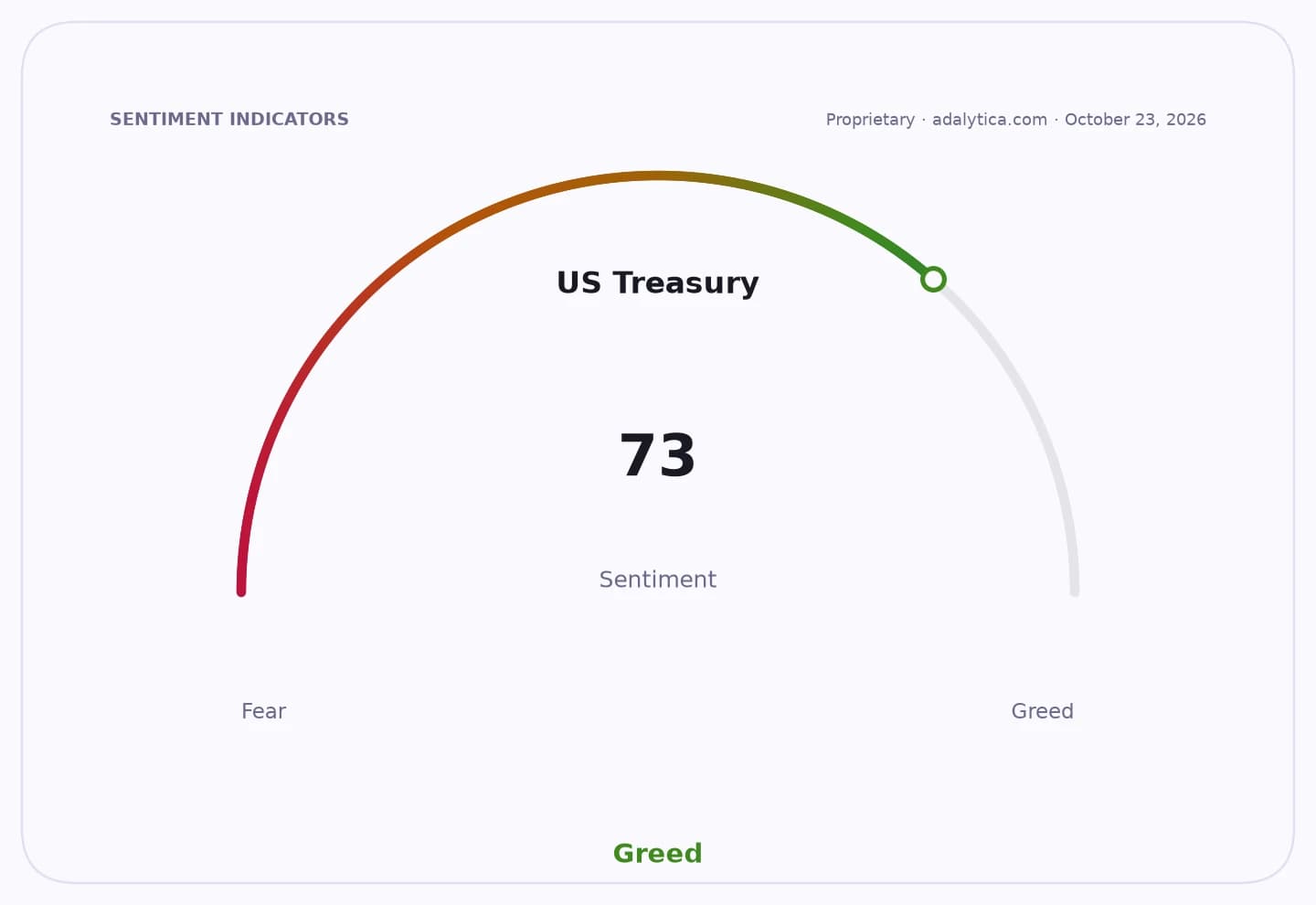
Sentiment IndicatorsⓘProprietary · adalytica.com · October 25, 2026
This is a snapshot — live sentiment, awareness and momentum for 130+ markets update continuously in the dashboard.Open AlphaPulse
The clearest warning sign is in France, where the gap between 10-year French and German borrowing costs has widened to 1.5 percentage points, the highest since the euro-area debt crisis. With France expected to run a budget deficit of 5.4% of GDP this year, The Economist calculates that stabilizing debt at current five-year yields would require a fiscal tightening of more than 4% of GDP — a scale that looks politically remote. That is the sort of arithmetic that turns a market selloff into a solvency debate.
The pressure is not confined to Europe. In the United States, the 10-year Treasury yield has climbed to around 5% after an extraordinary run-up in recent days, while the federal deficit is running near 6% of GDP. That is not a level that implies an imminent default, but it does mean the cost of carrying debt is rising at the same time as issuance remains heavy. The bond market is effectively telling Washington that AI-led growth may help the economy, but it will not automatically fix the fiscal gap. Higher yields also have a tighter transmission into financial conditions: the dollar has strengthened as Treasury rates rose, underscoring how quickly the world’s reserve currency still attracts capital when investors seek safety and carry.
Japan remains a different kind of risk. Its 10-year yield has moved above 3% for the first time since 1996, a historic shift for a market long anchored by ultra-low rates and heavy central bank support. Yet Japan’s real borrowing costs remain low and debt dynamics are still manageable for now. The danger is less immediate insolvency than global spillover: if Japanese investors begin repatriating some of their huge stock of overseas assets, the shock could ripple through global bond and currency markets.
For now, the market’s most acute vulnerability is in Europe, where growth is weaker and energy costs remain a drag. Britain has already lived through a gilt-market revolt in 2022 and has not fully escaped the fiscal bind. Italy’s debt ratio, at 129% of GDP, leaves little room for complacency even if its near-term numbers appear more stable. France, however, sits at the center of the story because its political system offers the least reliable path to fiscal repair. Populist pressure on the left and right raises the odds that markets eventually test whether the European Central Bank would step in before a full-blown funding crisis emerges.
That is why the selloff matters to investors beyond the level of yields. Rising rates are not just reducing bond prices; they are changing the hierarchy of risk across asset classes. Long-duration government debt is more vulnerable. Credit spreads can widen if higher sovereign yields reset discount rates across the market. Equities, especially expensive growth stocks, face a higher hurdle rate. And if governments respond by leaning on inflation or by pressuring central banks to soften policy, nominal bonds could suffer another leg down.
The bull case is that today’s move reflects healthy growth, not collapse: the U.S. economy is still expanding, unemployment claims remain low and productivity has improved, which helps explain why markets have been willing to price higher yields without yet triggering disorder. The bear case is that fiscal deficits, aging populations and political resistance to spending cuts are colliding with a market that is running out of patience. If inflation flares again or investors begin to doubt policy credibility, the adjustment could become much sharper.
The next phase will be decided less by one country than by whether markets conclude that advanced economies can still finance large deficits without forcing a painful political reset. If that answer is no, then the bond market may not “explode” in the literal sense — but it could do something just as consequential: impose austerity by pricing.
| Entity | Gains | Losses |
|---|---|---|
| Bond sellers | ▲Higher yields, lower prices | ▼Duration holders |
| Cash and short-duration investors | ▲Better carry, lower mark-to-market risk | ▼Long-bond bulls |
| U.S. dollar | ▲Safe-haven inflows | ▼Foreign borrowers |
| France and other high-deficit sovereigns | ▲None | ▼Fiscal flexibility, market credibility |