Bond yields have made a powerful comeback, yet the bigger story for investors is that higher income does not automatically mean lower risk has disappeared.
Treasury Yields Rise as Bond Income Returns
That is the lesson behind the latest move in U.S. government and credit markets. The 10-year Treasury yield is hovering around 5.15%, a level that would have seemed unthinkable during the zero-rate era, while the gap between 10-year and 2-year Treasuries sits near 0.31 percentage point, signaling a market that is still digesting a restrictive policy backdrop rather than celebrating a clean economic landing.
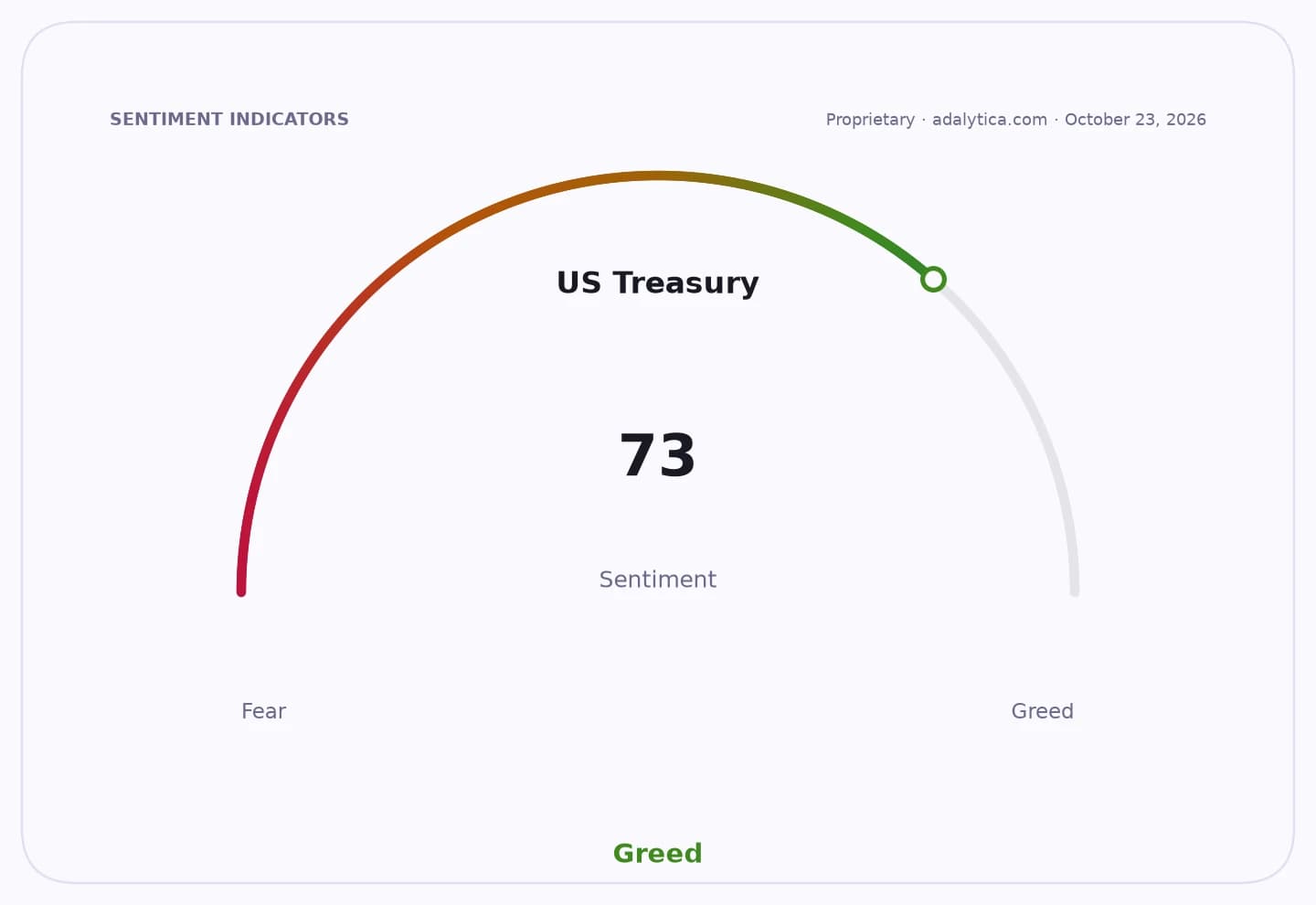
Sentiment IndicatorsⓘProprietary · adalytica.com · October 23, 2026
This is a snapshot — live sentiment, awareness and momentum for 130+ markets update continuously in the dashboard.Open AlphaPulse
For savers and long-term investors, the appeal is obvious. After years when bonds offered little return and little protection, income is back. Exchange-traded bond funds such as iShares 20+ Year Treasury Bond ETF, or TLT, have bounced sharply, closing at 81.74 after a recent stretch of volatility, while iShares Core U.S. Aggregate Bond ETF, or AGG, ended at 96.12. That rebound reflects a simple fact: when starting yields are high, future income potential improves materially.
But the comeback comes with a catch. Higher yields are not a free lunch. They can still be pushed around by inflation, Treasury supply, fiscal deficits and currency swings, all of which matter just as much as coupon income. Credit markets are also pricing in more caution than the headlines suggest. The Bloomberg U.S. corporate high-yield spread remains around 3.3 percentage points, a reminder that investors still want paid well for taking balance-sheet risk.
DGS10 vs T10Y2Y — macro contextadalytica.com
Explore this data interactively — full history, time series and cross-market comparisons.Open AlphaPulse
That is why the bond story matters far beyond fixed income portfolios. Rising yields can support retirement income, improve prospective returns and even make some equities look less attractive on a discounted-cash-flow basis. At the same time, they raise borrowing costs for companies, households and governments. For sectors dependent on cheap financing, such as leveraged technology and speculative growth, the new bond environment is a headwind. For insurers, banks and income funds, it is a tailwind.
The market message is also nuanced. Treasury funds have been volatile, but not broken. TLT’s recent price action and technical readings show a market trying to stabilize rather than capitulate, while broader bond products remain close to their 50-day averages. That suggests investors are still searching for balance between the allure of higher yields and the risk that rates stay elevated longer than expected.
For long-term investors, the right takeaway is not to chase the comeback, but to respect it. Bonds are useful again as a source of income, portfolio ballast and diversification, especially after the lost decade of near-zero rates. But returns are not everything. Credit quality, duration and currency exposure will matter more than ever if this new bond regime turns out to be the lasting one.
| Entity | Gains | Losses |
|---|---|---|
| Bond investors | ▲Higher income potential | ▼Duration and rate risk |
| Borrowers | ▲— | ▼Higher financing costs |
| Income funds | ▲Better yield backdrop | ▼More price volatility |
| Equity investors | ▲Potential portfolio ballast | ▼Higher discount rates |