Rising U.S. yields and a rebound in oil are forcing investors to reprice credit risk across markets, even as corporate borrowing and geopolitical tensions keep pressure on funding conditions.
U.S. Yields Rise as Credit Spreads Widen

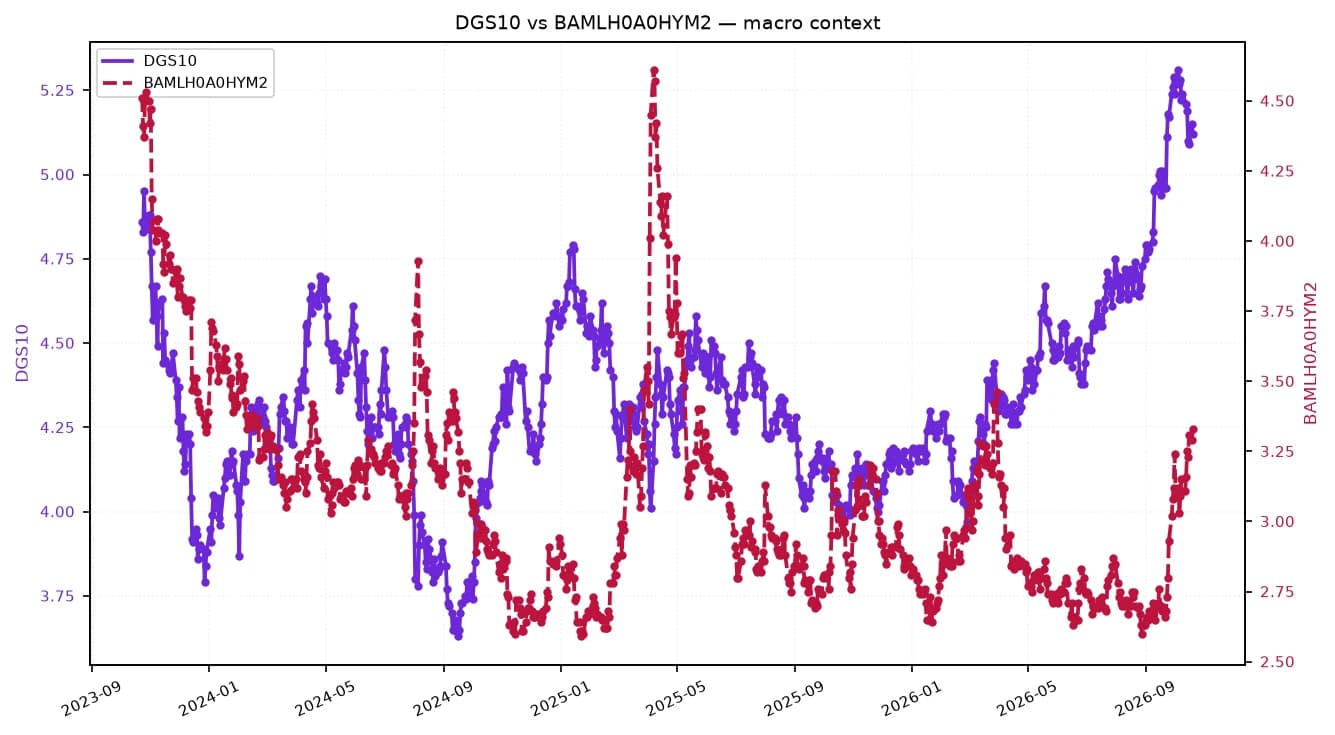
The 10-year Treasury yield has climbed back above 5.1%, a level that tightens financial conditions for companies, households and governments alike. At the same time, high-yield credit spreads have widened to 3.4 percentage points, while benchmark bond funds have shown a mixed but fragile tone: investment-grade LQD has slipped to 103.82 from recent highs, and high-yield HYG remains pinned near 77.04. The message is that the market is not in crisis, but it is demanding more compensation for duration and lower-quality credit.
Sentiment IndicatorsⓘProprietary · adalytica.com · October 23, 2026
This is a snapshot — live sentiment, awareness and momentum for 130+ markets update continuously in the dashboard.Open AlphaPulse

That matters because rates at these levels do not just affect sentiment; they change financing math. Corporate issuers with heavy refinancing needs face higher interest expense, which can pressure margins and constrain buybacks, acquisitions and capital spending. The cost of debt is particularly relevant for sectors already leaning on external funding, from utilities and infrastructure to highly levered growth companies. For borrowers, the window is still open, but it is less forgiving.
Oil’s move adds another layer. U.S. crude is around $108 a barrel and forecast to push toward $114, underscoring the inflation risk embedded in energy markets. Higher energy costs can feed through to transportation, input prices and consumer spending power, complicating the policy outlook for the Federal Reserve and keeping real yields elevated. That creates a difficult backdrop for bonds, especially if inflation expectations prove sticky.
The dollar is also losing momentum. Adalytica’s U.S. Dollar Trade Signals show sentiment at 35 with “extreme fear” in awareness, after a sharp decline in both the seven-day and 30-day readings. A softer dollar can ease pressure on emerging markets and multinational borrowers with overseas revenues, but it also reflects a market that is less convinced the greenback can keep absorbing global stress while U.S. yields climb.
For fixed income investors, the near-term tradeoff is becoming clearer. Treasury buyers are being compensated more for duration risk, as reflected in the stronger tone in TLT and the bond-market bid more broadly, while credit investors face the risk that tighter spreads are not wide enough if funding costs keep rising. High-yield debt is particularly vulnerable if oil-driven inflation keeps rates higher for longer or if economic growth slows into a refinancing-heavy period.
The broader narrative is that financial markets are moving from a phase of abundant liquidity to one of selective financing. That tends to favor stronger balance sheets and punish weaker ones. If yields remain near current levels and commodity prices stay elevated, investors may continue to rotate toward higher-quality debt, while issuers with more leverage and less pricing power face a tougher market into year-end.
| Entity | Gains | Losses |
|---|---|---|
| Treasury buyers | ▲higher carry | ▼mark-to-market volatility |
| Levered borrowers | ▲temporary access to funding | ▼higher refinancing costs |
| Energy producers | ▲stronger pricing | ▼consumers and margin-sensitive sectors |
| High-yield investors | ▲elevated yields | ▼wider spread risk |