Rising US Treasury yields are putting fresh pressure on bank shares and reviving the old warning that sovereign debt stress and lender balance sheets move together when bond markets turn rough.
US Treasury Yields Pressure Bank Shares
The benchmark 10-year Treasury yield climbed to 5.006% for Oct. 23, up from 4.96% a day earlier, while the 2-year yield was seen at 4.71%, from 4.65%. That keeps borrowing costs elevated across the curve and reinforces the market’s focus on how banks, insurers and bond investors absorb mark-to-market losses when government debt sells off.
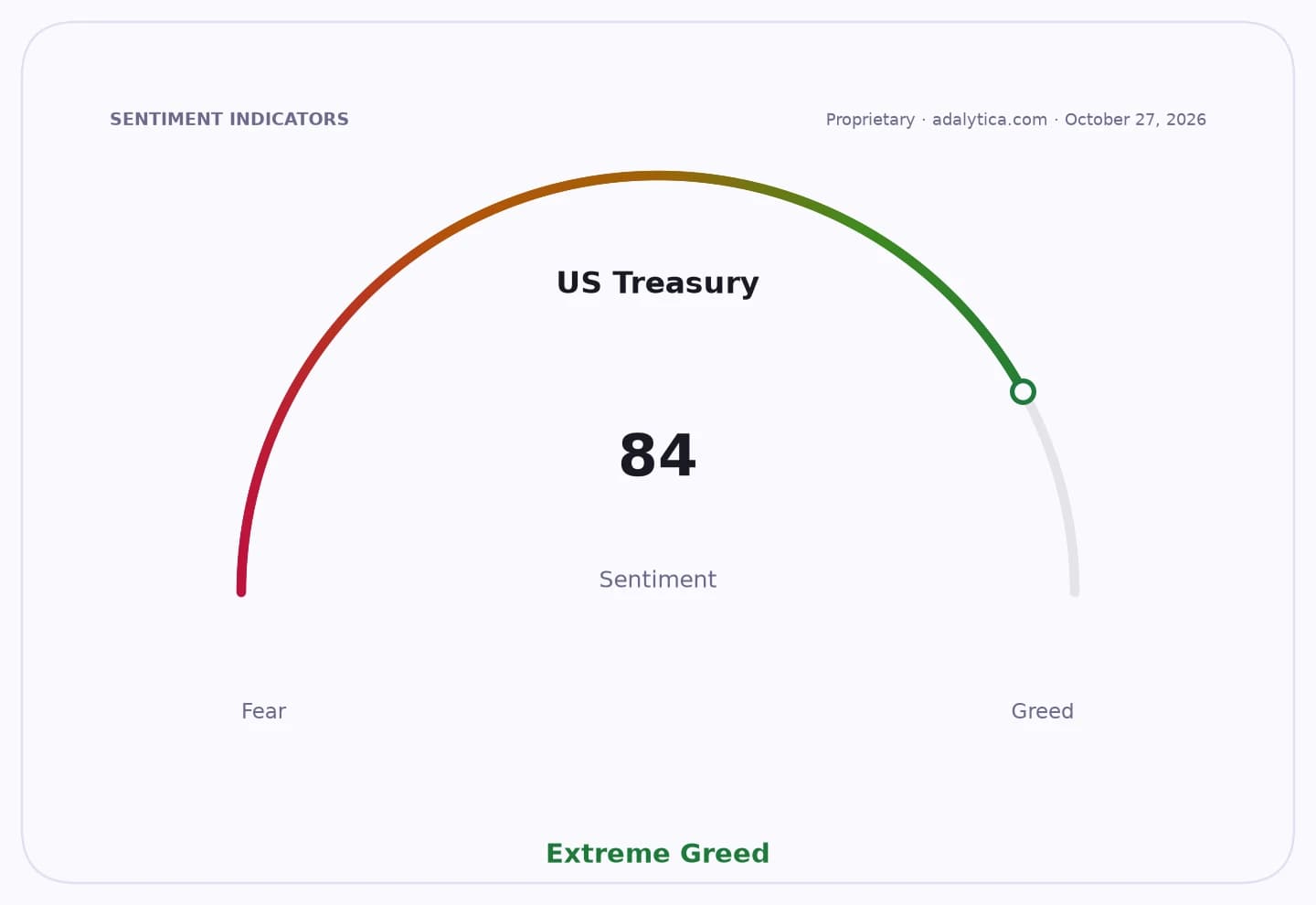
Sentiment IndicatorsⓘProprietary · adalytica.com · October 26, 2026
This is a snapshot — live sentiment, awareness and momentum for 130+ markets update continuously in the dashboard.Open AlphaPulse
The move matters because banks are among the biggest holders and dealers of Treasuries, and rising yields can squeeze the value of their fixed-income portfolios even as funding costs stay high. The spread between the 10-year and 2-year notes held at a relatively flat 29.6 basis points, underscoring a still-tight rate environment rather than a clear easing in stress.
The pressure is showing up in financial stocks. JPMorgan Chase closed at $335.33 on Oct. 26, down from $341.36 on Sept. 25, while Bank of America finished at $50.78, near a six-week slide from $56.70 a month earlier. Citigroup also fell to $121.67 from $135.05 over the same stretch, reflecting investor caution over margin pressure, balance-sheet sensitivity and the risk that higher sovereign yields eventually feed into broader credit conditions.
DGS10 vs DGS2 — macro contextadalytica.com
Explore this data interactively — full history, time series and cross-market comparisons.Open AlphaPulse
Corporate balance sheets are still strong enough to weather the move for now. JPMorgan reported third-quarter net income of $15.3 billion, or $5.57 a share, while Bank of America posted $6.9 billion in net income, or 91 cents a share. JPMorgan also tapped the debt market on Oct. 20 with $3.25 billion of notes, highlighting that large banks are still active issuers even as secondary-market conditions tighten.
Adalytica’s US Treasury Bonds Trade Signals show sentiment on TLT at 76, labeled “Greed,” even as awareness remains at 2 and the 1-day change points to a 15-point drop, a sign of how quickly bond positioning can turn. The dollar’s trade signals remain neutral, but awareness of fear in the currency market has climbed, adding to the sense that investors are still recalibrating around higher-for-longer US rates.
For investors, the key risk is less an immediate banking crisis than the possibility that persistent sovereign bond volatility keeps capital markets choppy and compresses valuations for rate-sensitive lenders. The next catalyst is whether Treasury yields can hold above 5% and whether banks’ upcoming disclosures show more pressure on portfolios, deposits and lending margins.
| Entity | Gains | Losses |
|---|---|---|
| US Treasury holders | ▲Higher yields on new purchases | ▼Mark-to-market losses |
| Banks | ▲Wider lending rates | ▼Bond portfolio pressure |
| JPMorgan, Bank of America, Citigroup | ▲Higher loan income potential | ▼Lower share prices |
| Bond investors | ▲Entry yields near 5% | ▼Price volatility |