Greece is set to overhaul private-sector pay from April 2027, with a higher minimum wage and a half-point cut in employee social security contributions that will lift net pay for millions of workers while raising labor costs for businesses.
Greece Minimum Wage and Payroll Tax Cut in 2027
The two measures matter because they work in opposite directions for households and employers. The minimum wage increase will directly boost the pay of workers on the statutory floor and those with seniority allowances, while the cut in employee contributions applies across the private sector, widening the gain beyond low earners. For companies, however, the relief is partial: employer contributions are unchanged, so payroll costs still rise even as workers keep a slightly larger share of their gross pay.
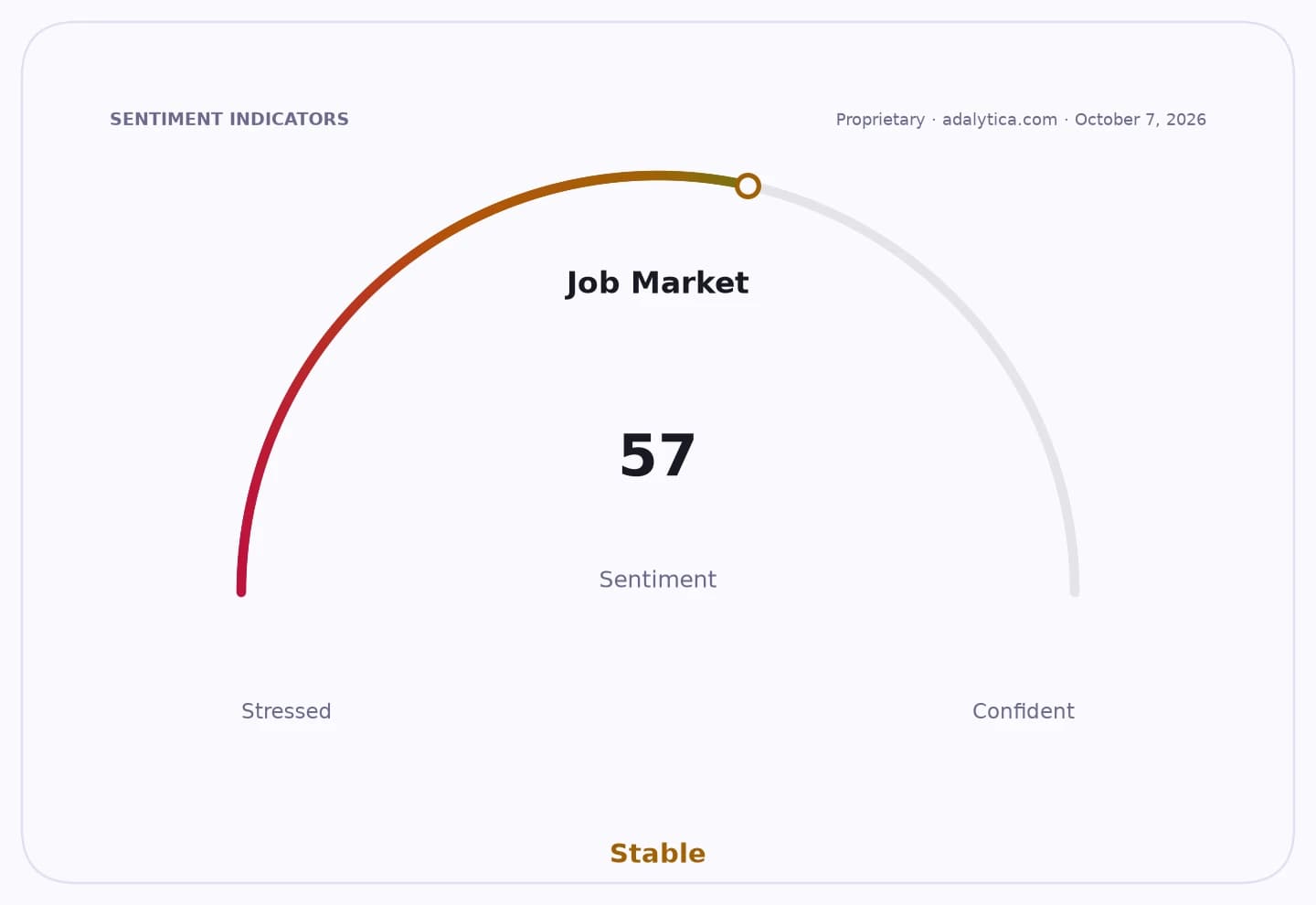
Sentiment IndicatorsⓘProprietary · adalytica.com · October 7, 2026
This is a snapshot — live sentiment, awareness and momentum for 130+ markets update continuously in the dashboard.Open AlphaPulse
The government’s working assumption in its official examples is a rise in the minimum wage from 920 euros to 960 euros in April 2027, before a further step to 1,000 euros in January 2028. That path is not yet the final legal setting for 2027, but it signals the policy direction: higher statutory pay, lower labor taxation on workers, and a continuing effort to support disposable income without fully offsetting the cost for employers.
On the contribution side, the employee rate would fall to 12.87% from 13.37%, cutting total private-sector payroll deductions to 34.66% from 35.16%. The employer share would stay at 21.79%. The fiscal cost of the reduction is estimated at 163 million euros in 2027 and 218 million euros annually from 2028.
For workers on the minimum wage, the contribution cut does not fully reverse the effect of the higher pay base. On a 960-euro wage, monthly deductions would still be about 123.55 euros, only slightly above the roughly 123 euros paid today on 920 euros. Without the rate cut, the monthly charge would have climbed to about 128.35 euros, meaning the policy mainly blunts the increase rather than creating a large standalone boost.
The bigger economic effect is on spending power. A 23-year-old minimum-wage worker without seniority would see net monthly pay rise from 797 euros to 836 euros in the government’s example, while a 34-year-old worker with three seniority increments would move from about 959 euros to 999 euros net. That supports consumption at a time when wage pressures remain central to household budgets, but it also risks adding to operating pressure for small employers already managing labor shortages and higher compliance costs.
Businesses face the sharper arithmetic. For a minimum-wage worker without seniority, the total monthly cost to the employer would rise to about 1,169.18 euros from 1,120.47 euros, an increase of nearly 48.72 euros a month, even though the cash wage rises by 40 euros. With three seniority steps, the wage increase of 40 euros translates into a 52-euro gross pay gain and roughly 63.3 euros in additional monthly employer cost. That makes payroll inflation more pronounced for labor-intensive sectors, including retail, hospitality and food service.
Investors will read the move as mildly supportive for domestic demand but potentially more mixed for margins. Consumer staples and other low-ticket discretionary chains may benefit from stronger household spending, while employers with large hourly workforces could face pressure on operating costs unless they offset it through pricing, productivity gains or staffing changes. The policy also aligns with the broader European pattern of governments trying to cushion workers from inflation without fully socializing the cost onto the state budget.
The debate now shifts from whether Greece will move toward a 1,000-euro minimum wage to how fast it can do so without squeezing smaller firms. For markets, the key test will be whether the gains in consumption and tax receipts outweigh the drag from higher unit labor costs as 2027 approaches.
| Entity | Gains | Losses |
|---|---|---|
| Low-wage workers | ▲Higher net pay | ▼Higher wage-base deductions |
| Private-sector employers | ▲No change in contributions | ▼Higher payroll costs |
| Consumer-facing retailers | ▲Stronger household spending | ▼Margin pressure from labor costs |
| Greek government | ▲Political support for wages | ▼Budget cost from contribution cut |