Greece is preparing to lift its minimum wage to 1,000 euros a month by January 2028, a step that will support household incomes, ripple through private-sector pay scales and force employers to adjust to a more durable wage floor.
Greece plans minimum wage rise to 1,000 euros by 2028
For investors, the key point is not just the headline number. It is the way Athens plans to get there: a two-stage increase, first through a government decision in April 2027 and then through a new formula tied to inflation for the poorest 20% of workers and to half of wage growth. That shifts minimum-wage setting from a one-off political choice to something closer to an automatic mechanism, which makes future labor costs more predictable but also less flexible for low-margin employers.
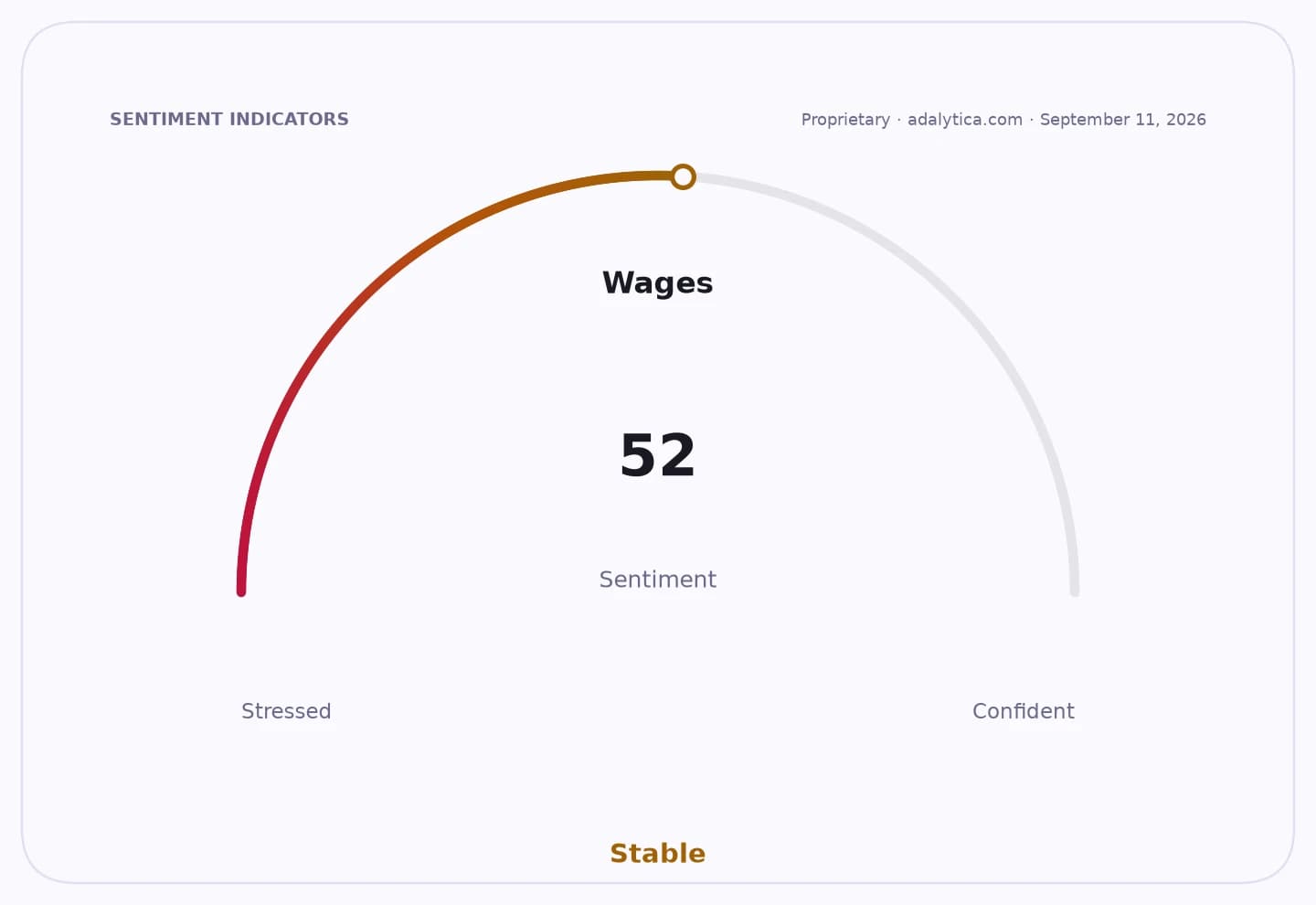
Sentiment IndicatorsⓘProprietary · adalytica.com · October 3, 2026
This is a snapshot — live sentiment, awareness and momentum for 130+ markets update continuously in the dashboard.Open AlphaPulse
The government’s target implies a rise of about 40 euros to 50 euros in April 2027, taking the current 920-euro minimum to 960 euros or 970 euros. A second increase would close the gap to 1,000 euros at the start of 2028. In practice, that means the minimum wage will have climbed meaningfully over two years, even before accounting for the larger effect on workers with seniority premiums.
That matters because Greece’s “triennities,” or three-year service increments, were unfrozen in 2024 and add 10% per period to pay. So the real gain for many workers will be larger than the base wage increase suggests. An unmarried employee on the minimum wage with one triennity could see gross pay rise from 1,012 euros today to 1,056 euros in 2027 and 1,100 euros in 2028 under the 40-euro scenario. Workers with two or three triennities would see even bigger jumps, with gross monthly pay potentially reaching 1,200 euros to 1,300 euros.
That is why this is a labor-market story as much as a social-policy story. Higher pay for the lowest earners supports consumption at a time when cost-of-living pressure has squeezed lower-income households. It can also help narrow the gap between nominal wage growth and actual purchasing power, which is important in an economy that still depends heavily on domestic spending and services.
For companies, though, the change is a reminder that wage inflation rarely stops at the minimum. Once the floor rises, pay structures above it often move too, especially in retail, hospitality and other labor-intensive sectors. The government is also signaling that public-sector pay will not be left untouched, with a 500-euro gross Christmas bonus for civil servants due to return in December 2027.
There is a second economic reason this matters: the new formula links the minimum wage to inflation faced by the lowest-paid workers and to broader wage dynamics. That could make pay policy more responsive to living costs, but it also embeds wage growth more deeply into the economy’s cost structure. If productivity does not keep pace, employers may face tighter margins or eventually pass some of the cost on to consumers.
For investors, the long-term takeaway is simple. Greece is moving toward a more structured wage regime, and that usually favors workers and domestic demand more than it favors low-wage employers. The winners are households, consumption-oriented businesses and firms with pricing power. The losers are labor-intensive employers that compete mainly on cost.
The minimum wage path to 2028 is therefore worth watching not as a one-off raise, but as a signal of where Greek wage policy is heading: higher, more automatic and more consequential for the economy over the next few years.
| Entity | Gains | Losses |
|---|---|---|
| Low-wage workers | ▲Higher take-home pay | ▼— |
| Consumer-facing retailers and services | ▲Stronger household spending | ▼Higher payroll costs |
| Labor-intensive employers | ▲— | ▼Squeezed margins |
| Greek consumers overall | ▲Better income floor | ▼Possible price pass-through |