Greek-born founders are helping shape some of Silicon Valley’s most closely watched AI startups, with firms from Runway to Resolve AI now valued at as much as $5.3 billion as investors keep rewarding tools that can cut costs, speed workflows and secure payments.
Greek founders in Silicon Valley AI startups

The common thread is not nationality but where AI spending is going next: content generation, model evaluation, infrastructure automation and fraud prevention. Those are the parts of the market that promise immediate enterprise adoption and revenue, even as broader AI valuation multiples stay under pressure.
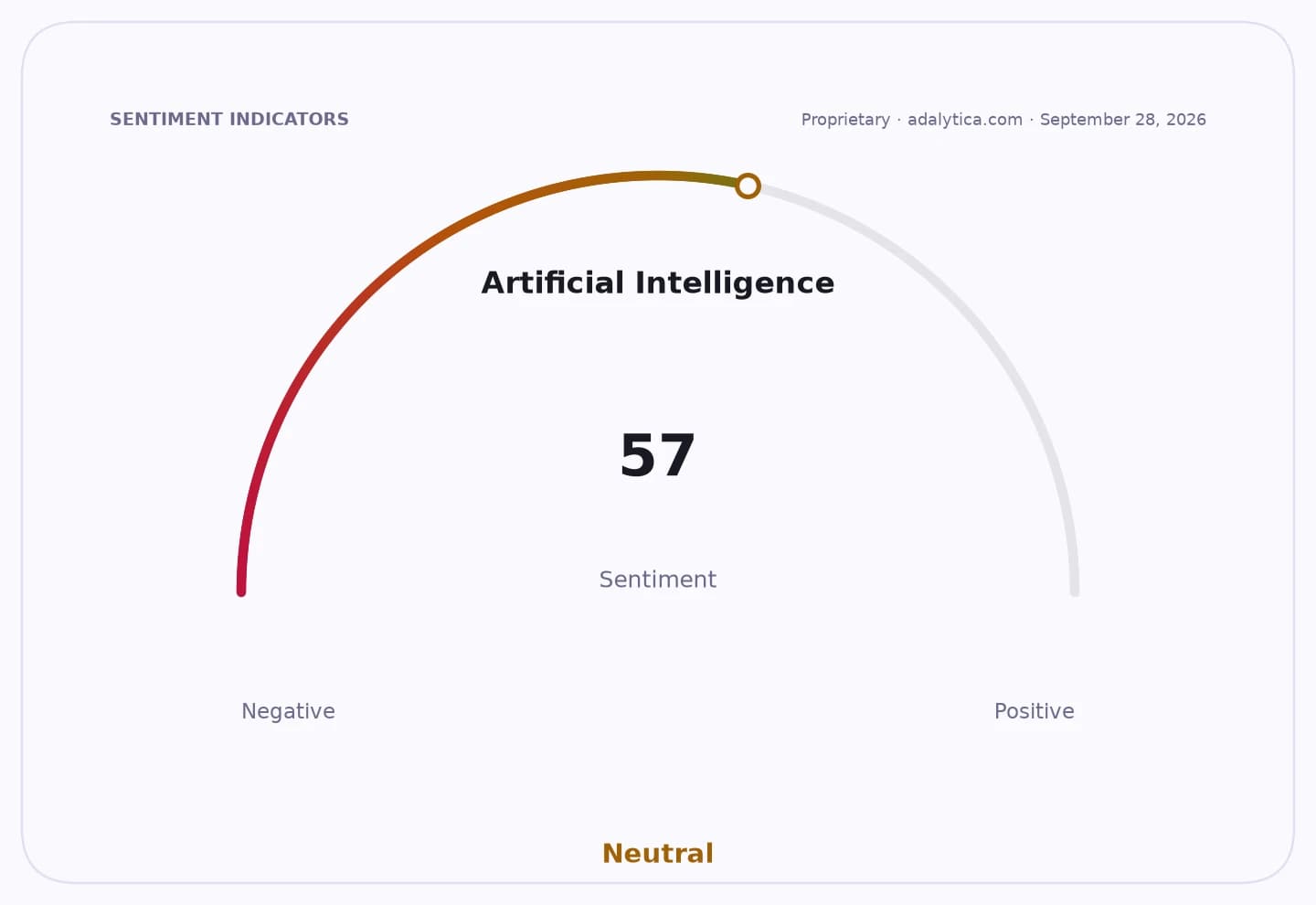
Sentiment IndicatorsⓘProprietary · adalytica.com · September 28, 2026
This is a snapshot — live sentiment, awareness and momentum for 130+ markets update continuously in the dashboard.Open AlphaPulse
Runway, co-founded by Anastasis Germanidis, sits at the intersection of film, advertising and generative AI. Its image and video tools are already used by studios, agencies and creators, and its latest funding round lifted its valuation to $5.3 billion. The company is now pushing beyond video production into world models, systems designed to understand and simulate the physical world, a sign that investors are backing bigger technical ambitions beyond content creation.
Arena, co-created by Anastasios Angelopoulos after starting as a UC Berkeley research project, is tackling another key bottleneck in AI: deciding which models actually work best. The platform lets users compare anonymized answers from different models and generates rankings based on real-world usage, not just lab tests. With a $1.7 billion valuation, it is positioned to expand into evaluating AI agents, which can perform multi-step tasks and could become central to enterprise software buying decisions.
Resolve AI, founded by Spiros Xanthou, is targeting one of the most expensive problems in enterprise computing: diagnosing outages across complex digital systems. The company uses AI agents to connect signals from code, cloud infrastructure and monitoring tools, and counts Coinbase, DoorDash, Salesforce, MSCI and Zscaler among its customers. Its $1.5 billion valuation suggests investors see infrastructure automation as one of the clearest near-term monetization paths in AI.
Tunic Pay, founded by Nicky Goulimis, is focusing on payment fraud, using more data around each transaction so banks and neobanks can flag suspicious activity before money moves. That matters because fraud prevention has to work without blocking legitimate payments, a balancing act that can save lenders money and reduce customer friction.
For investors, the story is less about a diaspora success narrative than about how AI capital is being allocated. The companies linked to Greek founders are clustered in segments where buyers are businesses, budgets are recurring and the payoff is measurable, which helps explain why these startups keep attracting premium valuations even as the broader AI trade turns more selective.
For Greece, the implication is that its best technical talent is already embedded in the global AI value chain. The question now is whether those links can be converted into more capital, know-how and startup activity back home as the industry enters a phase where execution matters as much as model hype.
| Entity | Gains | Losses |
|---|---|---|
| Greek AI founders | ▲Global capital access | ▼Home-country talent drain |
| Silicon Valley startups | ▲Product innovation funding | ▼Higher valuation scrutiny |
| Banks and neobanks | ▲Better fraud detection | ▼More compliance costs |
| Enterprise buyers | ▲Faster automation, lower costs | ▼Vendor dependence |