Looking for work? The most important place to look may be the jobs that are never formally posted, as companies continue to plan hiring, reorganize budgets and fill openings through networks long before a vacancy reaches a public board.
Hidden job market grows as year-end hiring plans rise
That is the central lesson from recruiters and career advisers who say the “hidden job market” becomes more active toward year-end, when employers sketch out next year’s staffing needs but often have not yet released headcount or opened formal searches. For job seekers, that means opportunity is increasingly a function of access, timing and relationships rather than applications alone.
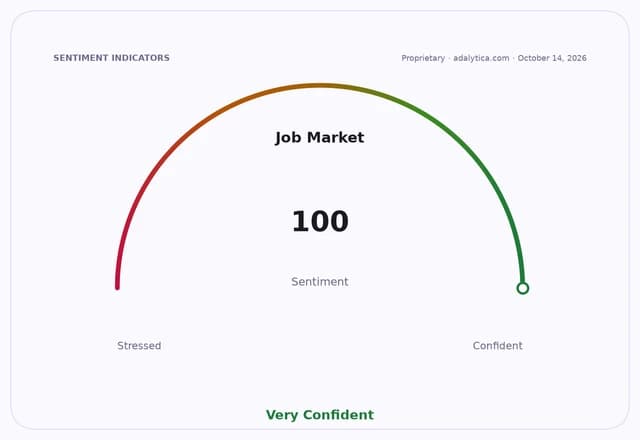
Sentiment IndicatorsⓘProprietary · adalytica.com · October 14, 2026
This is a snapshot — live sentiment, awareness and momentum for 130+ markets update continuously in the dashboard.Open AlphaPulse
The economic significance is straightforward: labor demand does not disappear just because it is not advertised. In a period when firms are still managing headcount carefully, the early stages of hiring are often internal, discretionary and informal. That favors candidates who can identify where budgets are being set, which business lines are expanding and which managers are preparing to hire before human resources is brought in.
That dynamic also helps explain why the official labor market picture can look tighter or softer than the reality workers face on the ground. In the US, nonfarm payrolls remain at 159.0 million, while the unemployment rate is projected at 4.09% in October, a level consistent with a labor market that is still functioning but no longer overheating. Job openings have cooled too, with the JOLTS series forecast at about 6.98 million for September, well below the post-pandemic peak above 12 million. In that environment, pre-advertised hiring matters more: it is where the next marginal jobs are often created.
UNRATE vs JTSJOL — macro contextadalytica.com
Explore this data interactively — full history, time series and cross-market comparisons.Open AlphaPulse

For investors, the story matters because hidden hiring is a read on corporate confidence, margin discipline and labor-cost behavior. Companies that plan jobs quietly are signaling they still expect growth, but they are also preserving flexibility. That can reduce visible turnover and lower recruitment costs, while keeping wage pressure contained compared with a broad public search. The flip side is that job seekers face a less transparent market, which can keep wage bargaining uneven and slow the pace at which labor shortages ease in specific professions.
The advice from career coaches is built around that reality. Rather than starting with human resources, they recommend approaching the direct manager or business line first, asking where expansion, succession or new projects are likely to create openings. Networking is the other essential channel: former colleagues, LinkedIn contacts and managers inside target firms are often the first people to know where talent is needed. In large companies, the route is slower and more hierarchical; in the Mittelstand, it can be far quicker.
There is a broader shift underneath this. As more hiring happens before a role is public, the labor market becomes less about passive applications and more about informational advantage. That benefits workers with strong networks and transferable skills, but it can deepen the disadvantage for people changing sectors, younger candidates and those outside major business hubs.
The next test is whether employers move from planning to posting as budget season unfolds. If they do, the headline numbers on job growth may strengthen only gradually; if not, the hidden job market will remain one of the few places where labor demand can still be found before it shows up in the data.
| Entity | Gains | Losses |
|---|---|---|
| Well-networked job seekers | ▲Earlier access to openings | ▼Less-connected applicants |
| Employers | ▲Faster, quieter hiring | ▼Transparency in recruiting |
| Recruiters / managers | ▲Better-fit candidates | ▼HR’s early visibility |
| Career changers | ▲Opportunity to target upcoming roles | ▼Applicants relying on job boards |