Borrowing to pay off borrowing can be a smart move when it lowers the interest rate, simplifies monthly payments and frees up cash flow — and for many households, that is exactly the point.
Household Debt Refinancing in a High-Rate Market
The basic idea is straightforward: if a new loan comes with a meaningfully lower all-in cost than the debt you already carry, refinancing can turn a punishing balance into something manageable. That matters economically because household debt stress feeds through to spending, savings and credit quality. When consumers are squeezed by high monthly payments, they cut back elsewhere. When they can consolidate debt into one fixed payment, they regain liquidity and reduce the odds of falling behind.
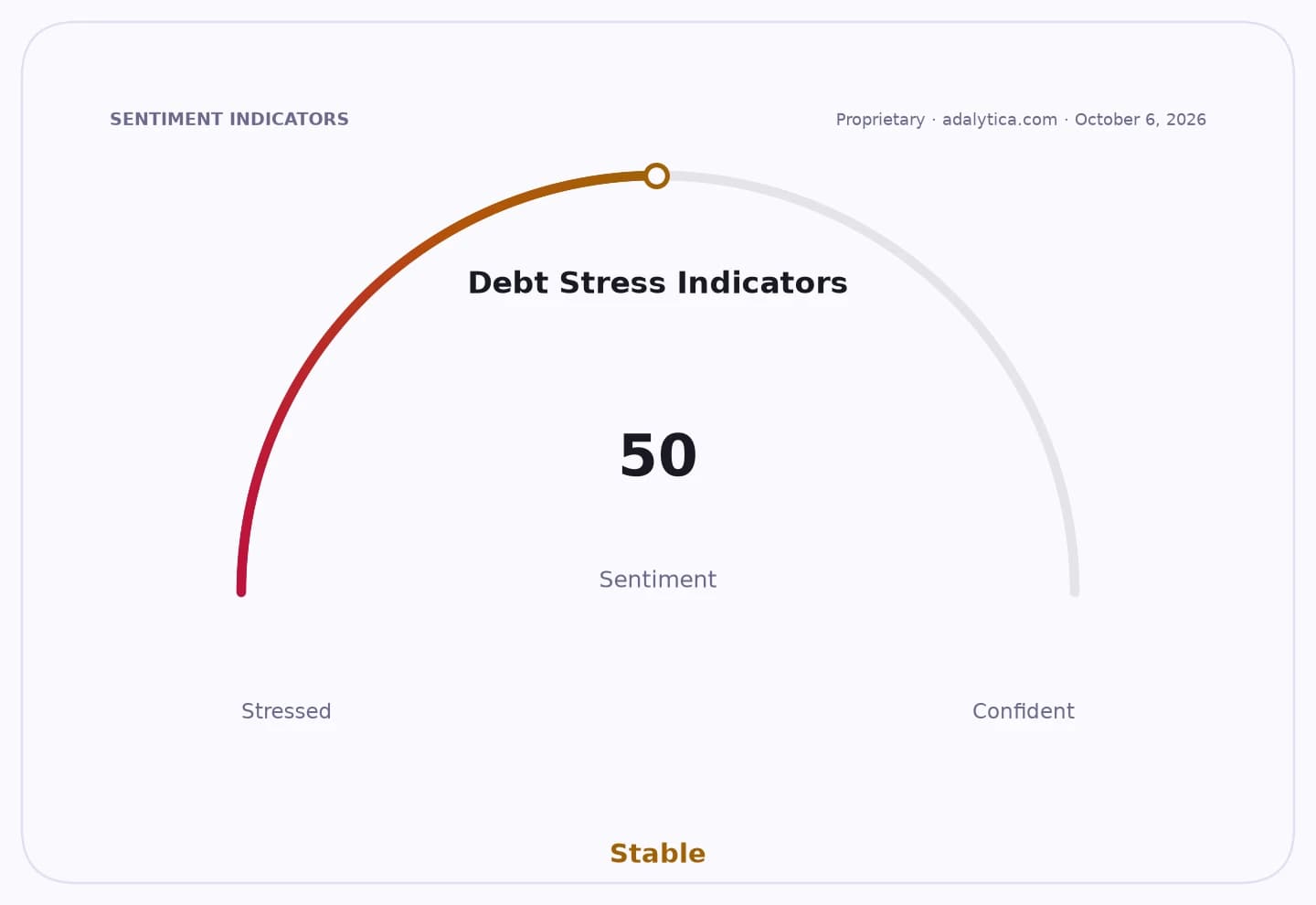
Sentiment IndicatorsⓘProprietary · adalytica.com · October 6, 2026
This is a snapshot — live sentiment, awareness and momentum for 130+ markets update continuously in the dashboard.Open AlphaPulse
That is not a niche issue. More than 70% of the loans originated on Yotepresto are used to pay off credit cards and existing bank financing, according to the crowdfunding platform. In other words, a large share of consumer borrowing is not funding new consumption at all — it is being used to restructure old obligations. The pattern makes sense in a high-rate world, where the cost of carrying revolving debt can quickly overwhelm a budget.
The interest-rate backdrop helps explain why the strategy is getting attention. The Federal Reserve’s benchmark rate is around 3.75%, while the 10-year Treasury yield is near 5.28%. Credit costs remain elevated, and the spread matters for households facing credit-card APRs and personal-loan offers that can vary dramatically. In that environment, the difference between a debt with a variable, high-cost structure and one with a fixed rate can be the difference between stability and a spiral.
FEDFUNDS vs DGS10 — macro contextadalytica.com
Explore this data interactively — full history, time series and cross-market comparisons.Open AlphaPulse
That is why the article’s guidance is worth taking seriously. Refinancing only works if the new loan’s total cost — including fees and repayment terms — is lower than what you are already paying. A lower annual total cost can help, but only if the borrower can actually service the new monthly payment. If the payment is smaller but the term is longer, the arithmetic can still work in the lender’s favor rather than yours. And if the new payment is too high for your income, you have not solved the problem — you have just changed the label on it.
For investors, the real story is about credit quality and consumer resilience. The household debt stress picture remains fragile, even if not catastrophic. Adalytica’s Household Debt Stress Sentiment is neutral at 50, but awareness sits at an “Extreme Fear” 4, suggesting consumers are still highly attuned to financial strain. That helps explain why lenders with disciplined underwriting can benefit from refinancing demand, while borrowers carrying high-rate revolving balances remain vulnerable to missed payments and late fees.
The stock market is already telling a similar story. Capital One Financial, Synchrony Financial and Ally Financial have all traded below recent highs, reflecting the market’s sensitivity to consumer credit conditions. Capital One’s shares recently hovered around $195, well below a 50-day average near $211, while Synchrony sat near $72, under its 50-day average around $77. Ally was even weaker, at about $37.63 versus a 50-day average close to $42, with a deeply oversold RSI reading around 14. Those are not permanent verdicts, but they do show investors are pricing in caution around consumer borrowing and repayment behavior.
Still, there is opportunity here. Refinancing is not about getting deeper into debt; it is about replacing expensive, unmanageable debt with cheaper, more predictable debt. That is especially useful for credit-card balances, where rates tend to move higher and stay there, and for borrowers juggling multiple payments at once. Consolidation can protect credit scores, reduce stress and preserve the cash flow needed to keep spending on essentials.
The long-term lesson for investors is the same one that applies to households: debt is not inherently bad, but bad debt is expensive. In a still-elevated-rate environment, lenders that can help consumers refinance responsibly may continue to see demand, while borrowers who use new credit without changing habits are likely to stay under pressure. If you are evaluating this strategy as a borrower or an investor, the winning formula is the same — lower cost, fixed terms, and enough room in the budget to stay current. Worth watching, and for many households, worth considering only if it truly improves the math.
| Entity | Gains | Losses |
|---|---|---|
| Borrowers with high-rate debt | ▲Lower payments, simpler cash flow | ▼Upfront fees if terms are poor |
| Credit card issuers | ▲None | ▼Balance transfer outflows |
| Personal-loan lenders | ▲New refinancing demand | ▼Higher default risk if underwriting is weak |
| Patient long-term investors | ▲Better risk-adjusted entry points | ▼Short-term volatility in consumer finance stocks |