Science is giving employers and workers a firmer answer to one of the most contentious questions in post-pandemic labor: a hybrid schedule of two or three days in the office appears to deliver the best balance of productivity, collaboration and employee flexibility.
Hybrid Work Studies Support 2-3 Office Days
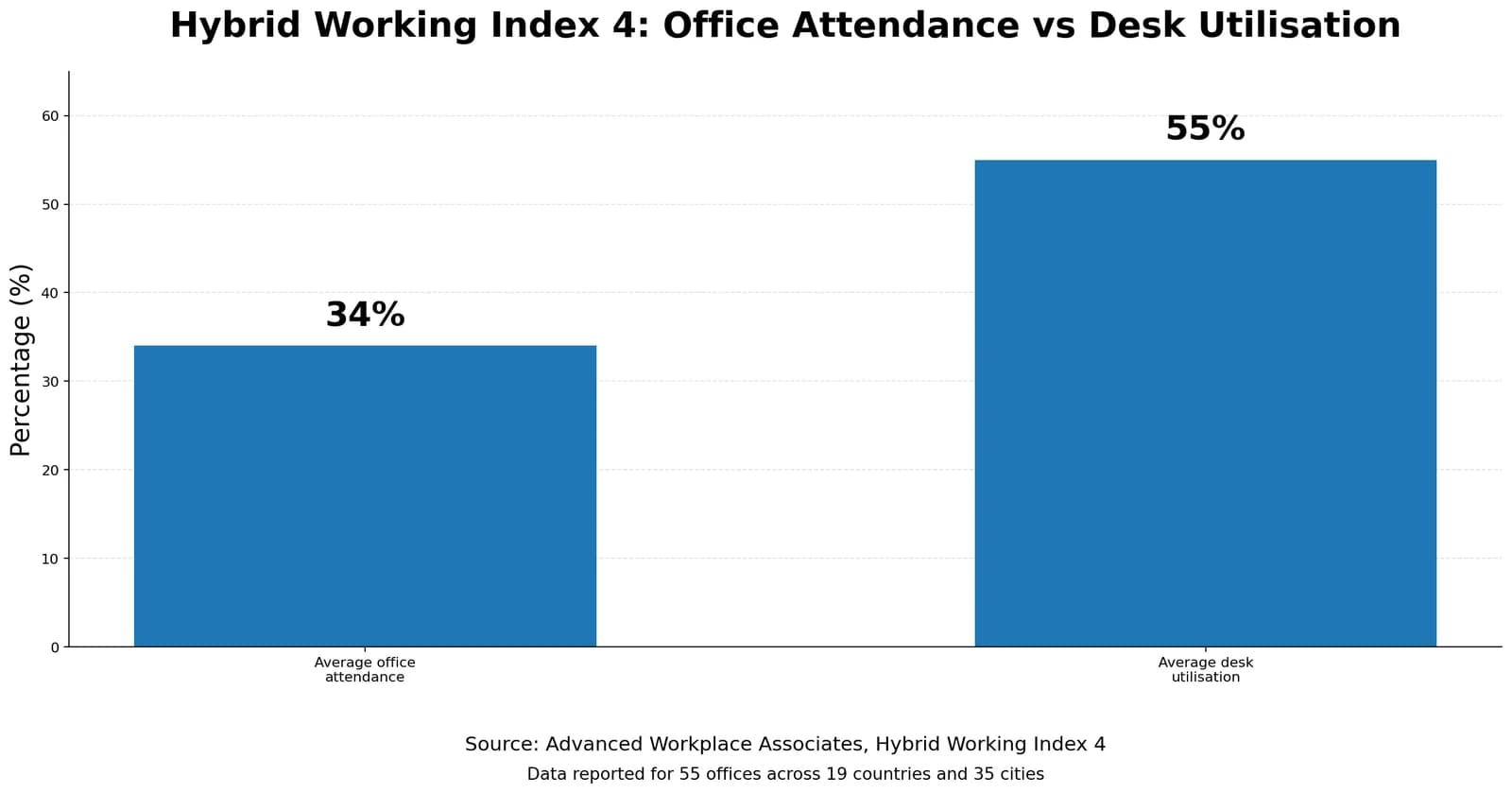
That matters economically because the office is no longer just a real estate issue. It has become a lever on labor productivity, corporate costs, commute patterns and the valuation of office-heavy business districts. If the sweet spot is fewer than the five days many companies once demanded, the implications run from lower demand for desk space to sharper competition for talent and a more durable redesign of how work gets done.
Sentiment Indicators
The case for hybrid work is stronger than the old argument that being physically present automatically produces better output. A study cited by Umar Boodoo of the University of Warwick points to two or three days onsite as the point at which firms can capture the benefits of face-to-face interaction without giving up the concentration and autonomy of remote work. That conclusion is reinforced by evidence from Trip.com, where 1,612 employees were randomly assigned either to a five-day office schedule or a hybrid model with work-from-home on Wednesdays and Fridays. Published in Nature in 2024, the experiment found no deterioration in performance quality among hybrid workers.
That is important for companies still weighing whether to enforce return-to-office mandates. The research suggests the productivity penalty once feared by managers was overstated, at least for roles that can be performed digitally. For investors, that supports the idea that hybrid work is not a temporary concession but a stable operating model that can influence everything from headcount strategy to office leasing demand.
The office still has an edge, but a more limited one. Research by Melanie Brucks and Jonathan Levav, also published in Nature, found that virtual meetings were less effective at generating creative ideas than in-person sessions, though they worked just as well when the task was choosing among proposals. That distinction matters. It suggests the office is most valuable for collaboration, mentoring, training and idea generation, while home remains better suited to focused individual work.
The biggest risk to hybrid productivity is not the number of office days alone, but poor coordination. A Scientific Reports study of more than 48,000 employees at an Indian IT services company found innovation suffered when teams failed to synchronize their in-office and remote schedules. In practice, that means an employee can incur the cost and friction of commuting only to spend the day on video calls with colleagues who are not there. In that scenario, the office becomes an expensive half-measure rather than a productivity tool.
That is why the most effective hybrid model is likely to be collective rather than individual. Companies that reserve common onsite days for meetings, project work and training are more likely to extract value from the office, while setting a reasonable cap on attendance may prevent hybrid arrangements from quietly drifting back toward full-time presence. The latter risk is not trivial: if workers believe that turning up more often improves promotion prospects or pay, the system can revert to presenteeism without delivering measurable gains.
For investors, the broader narrative is clear. Hybrid work is settling into a pragmatic equilibrium rather than disappearing. That is constructive for software firms that enable distributed work, for employers looking to hold down fixed costs, and for workers with bargaining power. It is less favorable for landlords, transport providers and downtown service businesses that depend on five-day office occupancy. The next battleground is not whether hybrid work survives, but whether companies can implement it well enough to preserve both culture and output.
| Entity | Gains | Losses |
|---|---|---|
| Hybrid workers | ▲Flexibility; less commuting | ▼Risk of career bias |
| Employers | ▲Stable productivity; lower overhead | ▼Coordination complexity |
| Office landlords | ▲Selective demand for space | ▼Lower full-week occupancy |
| Downtown services | ▲Partial footfall recovery | ▼Fewer weekday visits |