Bill Ackman is betting that Intercontinental Exchange can turn artificial intelligence into a bigger, stickier business, and the market is being forced to price ICE less as a sleepy market-utility and more as an AI-powered financial infrastructure platform.
ICE and Ackman Bet on AI Infrastructure

That matters because ICE sits on some of the highest-value rails in global finance — exchanges, data, clearing and mortgage technology — businesses that get more valuable when trading, compliance and information flows become faster and more automated. If AI meaningfully boosts the speed and usefulness of ICE’s data products and workflow tools, the payoff is not just higher revenue per customer, but a wider moat and stronger pricing power across the market plumbing Wall Street cannot easily replace.
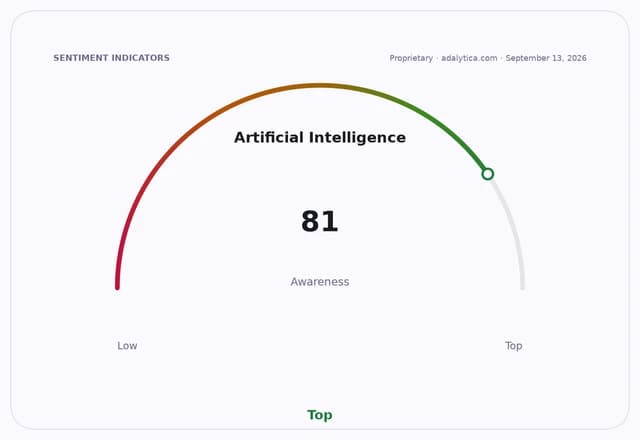
Sentiment IndicatorsⓘProprietary · adalytica.com · September 13, 2026
This is a snapshot — live sentiment, awareness and momentum for 130+ markets update continuously in the dashboard.Open AlphaPulse
The investment case is sharpened by the broader AI trade. Microsoft’s shares are near $496, Nvidia is still above $218, and both remain central to the capital-spending cycle that has defined the AI boom. But the next leg of the trade is not just chips and cloud. It is the infrastructure layer that captures the spending once enterprises move from experimentation to deployment. ICE belongs in that second wave. As financial institutions use AI to automate research, surveillance, risk management and execution, the winners are the firms that own the data, the distribution and the transaction rails.
Ackman’s wager also lands at a time when ICE itself has already shown it can access capital cheaply and scale strategically. The company sold $3 billion of senior notes in August, giving it firepower to keep investing in technology and acquisitions. That is important in a market where the best AI beneficiaries are often not the loudest names, but the toll collectors. ICE does not need to build frontier models. It needs to embed them into daily institutional workflows, where switching costs are high and recurring revenue is prized.
The stock’s recent technical profile suggests investors are still warming up to that story rather than fully embracing it. ICE traded around $157.40 on Friday, above its 50-day moving average of about $150.56, but still below its 200-day average of roughly $154.66 after a volatile stretch that saw the shares sink to $137.94 in June before rebounding sharply. The move back above long-term trend levels tells you the market is starting to re-rate the name, but not yet as aggressively as a pure AI beneficiary.
Adalytica’s sentiment snapshot underscores the same point. ICE-linked enthusiasm is building, but the bigger message is that the market still appears to underappreciate the AI optionality embedded in a company whose business model is already tied to information asymmetry, transaction velocity and regulated workflow. In other words, this is not a speculative AI story. It is a compounding one.
For investors, that creates an asymmetric setup. If AI adoption in financial services accelerates, ICE can expand its role as the infrastructure layer that powers institutional decision-making. If adoption disappoints, ICE still owns durable exchange, clearing and data franchises with recurring cash generation. That combination — defensive cash flows plus latent AI upside — is exactly the kind of profile long-term capital should want in a market that keeps rewarding the picks-and-shovels of the secular AI buildout.
The takeaway is straightforward: if Ackman is right, ICE is one of the better ways to own AI’s spread into Wall Street without paying the euphoric multiples attached to the semiconductor complex. I believe the market is still underestimating how much artificial intelligence can deepen the value of financial infrastructure — and that makes ICE a name to watch for the next leg higher.
| Entity | Gains | Losses |
|---|---|---|
| ICE | ▲Higher pricing power | ▼Plain-vanilla utility label |
| Ackman/longs | ▲AI optionality | ▼Skepticism on re-rating |
| Financial institutions | ▲Faster workflows | ▼Legacy manual processes |
| Pure AI chip leaders | ▲Capital keeps flowing | ▼Some relative attention from infra names |