India’s most important strategic choice is not whether BRICS is imperfect, but whether Delhi wants to cede a growing multilateral table to China just as the US and Beijing are competing harder for influence. That is the core argument behind New Delhi’s continued participation in BRICS+, and it matters because the forum has become a venue where India can press its own agenda on global governance, sanctions, trade rules and diplomatic positioning without choosing sides outright.
India stays in BRICS to counter China
The case is economic as much as geopolitical. BRICS remains one of the few platforms where India can push reform of the global financial architecture, resist the weaponisation of trade and assets, and keep pressure on institutions such as the WTO and the post-war multilateral order. For investors, that matters because India’s external policy affects capital flows, market access, sanctions risk and the credibility of its attempt to deepen ties with both the West and the Global South.
Sentiment Indicators
The debate has sharpened as BRICS expands and as the bloc’s Delhi summit managed to produce consensus among sharply divided members, including Iran and the UAE. The forum is not delivering the sweeping institutional overhaul its founders once promised, but its persistence gives India leverage: it can shape criteria for enlargement, push follow-up mechanisms and avoid leaving China to define the group’s rules and symbolism on its own.
That calculation comes as tensions in the wider geopolitical system rise. Russia and China are still using BRICS-linked and other multilateral settings to blunt Western pressure, while the US under Donald Trump has become more transactional on trade and alliances. India’s room to maneuver is narrower, not wider, and that makes abandonment of BRICS more costly than staying inside and competing from within.
The market backdrop reflects that broader uncertainty. Shares of the India ETF EPI are at $40.97, below the 50-day moving average of $41.55 and the 200-day moving average of $42.71, while the fund’s RSI reading of 59.4 and a modest positive MACD suggest a market that is steady but still sensitive to external shocks. The China ETF FXI has also been volatile, closing at $33.08, below its 50-day moving average of $34.19 and 200-day average of $35.52, underscoring how trade and geopolitical headlines continue to move emerging-market assets.
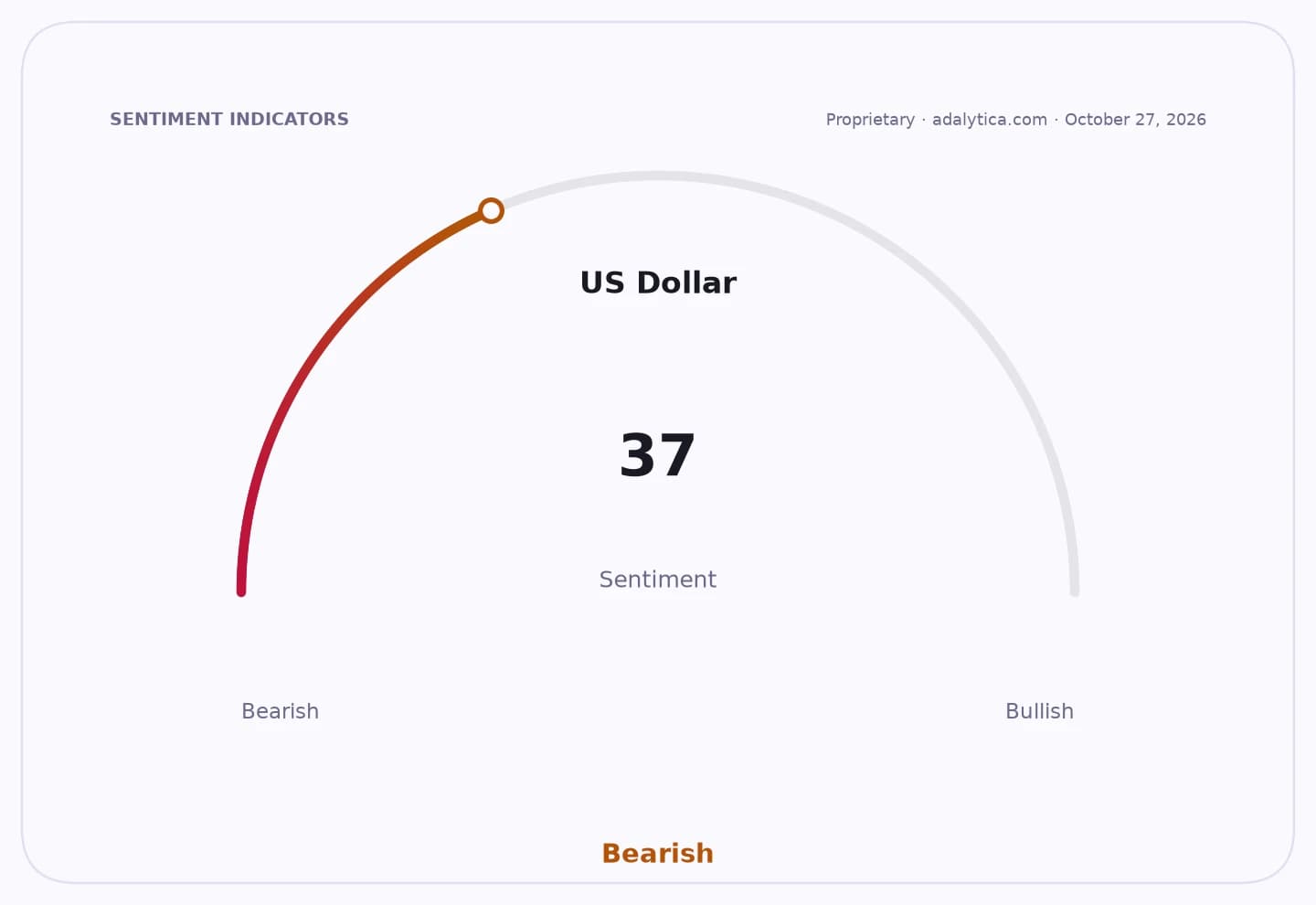
Indian-tracking ETF INDA is trading at $47.72, below its 200-day moving average of $49.17 and just under its 50-day average of $47.87, a sign that investors remain cautious on the country’s external outlook even as the recent bounce lifts it off earlier lows. In Adalytica’s China growth-target gauge, sentiment sits at 32, still neutral, while the US dollar signals show fear sentiment at 30 with extreme-greed awareness, pointing to a market still trying to price cross-currents in trade, policy and capital flows.
For India, the narrative is straightforward: stay in BRICS, but use it as a negotiating tool rather than a loyalty test. The next test is whether Delhi can keep the forum focused on reform and economic resilience while avoiding becoming a passive platform for China’s ambitions or a casualty of US pressure.
| Entity | Gains | Losses |
|---|---|---|
| India | ▲Diplomatic leverage; room to maneuver | ▼Less influence if it walks away |
| China | ▲More room to shape BRICS if India exits | ▼More pushback if India stays active |
| US | ▲Clearer bilateral pressure point | ▼Less leverage over multilateral agenda |
| BRICS smaller members | ▲Broader coalition; reform platform | ▼Risk of bloc rivalry dominating agenda |