Rising food inflation is becoming the hardest part of India’s price story, because it is eroding household purchasing power precisely where most families spend the most.
India food inflation raises household borrowing

The immediate problem is not abstract macro theory but staples: flour, sugar, pulses and edible oils have all become materially more expensive over the past 12 years in the source material, with atta rising to 58 rupees a kilo from 21 rupees in 2014, sugar to 65 rupees from 40 rupees, pulses to 115 rupees from 70 rupees and mustard oil to 160 rupees from 102 rupees. Diesel has more than doubled to 105 rupees from 56 rupees, lifting freight and distribution costs across the food chain. That is why inflation bites harder for lower-income households, which spend a bigger share of income on daily necessities and have little room to defer purchases.
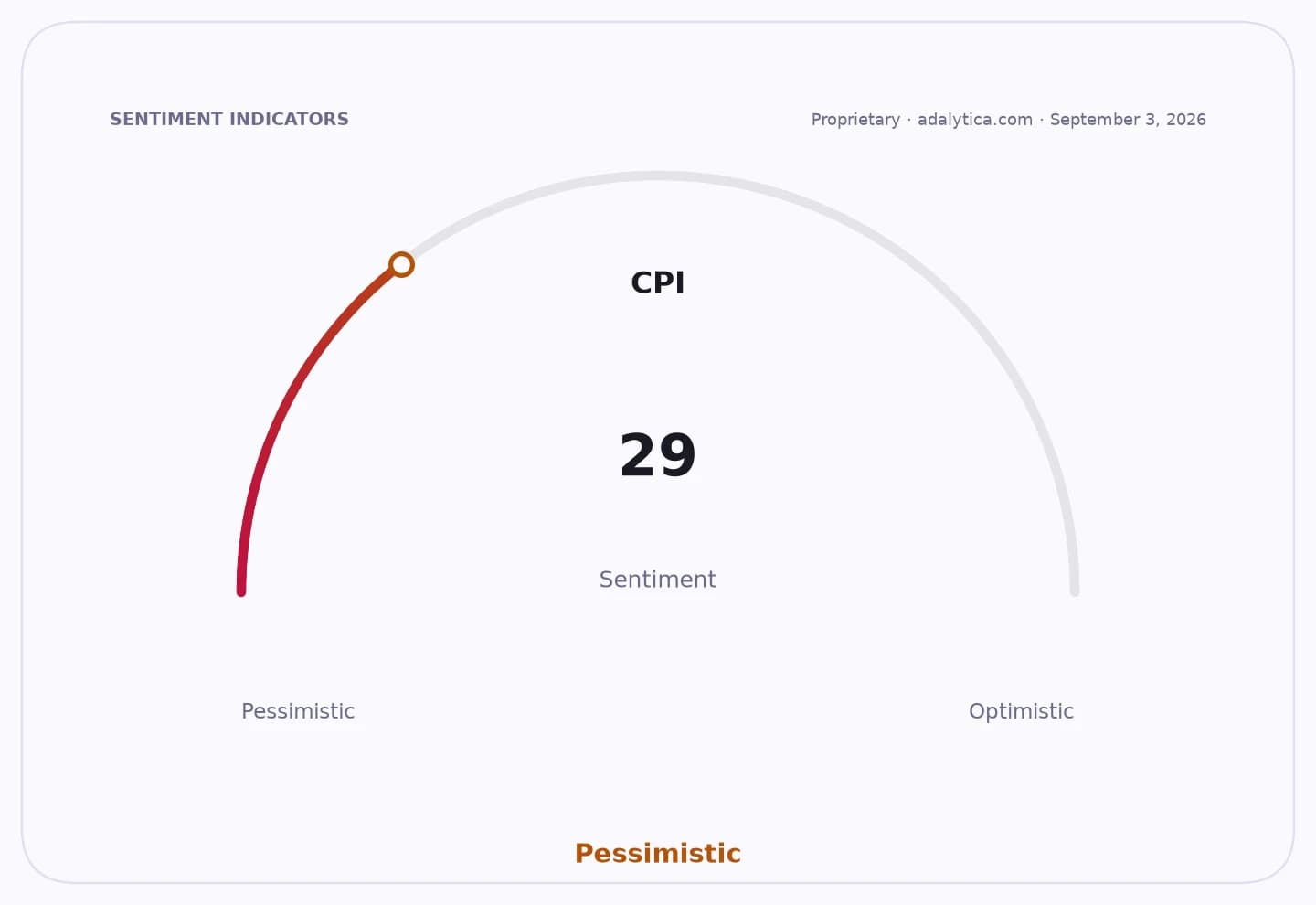
Sentiment IndicatorsⓘProprietary · adalytica.com · September 9, 2026
This is a snapshot — live sentiment, awareness and momentum for 130+ markets update continuously in the dashboard.Open AlphaPulse

The economic consequence is a forced trade-off between consumption and debt. The data cited in the piece says household borrowing in India has risen from 69.9 lakh crore rupees in 2019-20 to 107 lakh crore rupees in 2024-25, with 58% of that debt taken for food, health care and education rather than productive investment. That matters because inflation is no longer just a price-level issue; it is feeding a balance-sheet problem. More debt for essentials leaves less room for discretionary spending, weakens demand quality and deepens inequality.
For policymakers, the narrative is clear: India cannot rely on broad anti-inflation rhetoric alone when food carries such a large weight in consumption. The article argues for a supply-side response — greater self-sufficiency in imported agricultural goods, better state procurement, pricing support for farmers and investment in region-specific crop research. That is economically significant because food inflation in India is often structural, not just cyclical. Import dependence on pulses and edible oils exposes domestic prices to global shortages, higher dollar, euro and pound costs, and higher transport bills tied to diesel. When the rupee weakens, imported inflation becomes a direct tax on consumers.

Investors should care because persistent food inflation can keep pressure on real incomes, spending patterns and policy choices. It supports a defensive bias toward staples, discount retail and companies with pricing power, but it also raises the risk that policymakers try to cap prices in ways that squeeze farm incomes or distort procurement. The market backdrop is consistent with that tension: the U.S. CPI remains elevated at 333.979 on the latest data point, while Treasury yields have climbed to around 4.8%, reminding investors that inflation remains a global valuation risk even where growth is slowing. In India, any lasting improvement in food inflation would help protect consumption, limit further household leverage and give the central bank more room to avoid tightening too aggressively.
The bull case is that better procurement, higher domestic output and less import dependence can reduce the most volatile part of inflation without choking demand. The bear case is that supply reforms take time, weather and global commodity prices remain outside New Delhi’s control, and households keep borrowing to bridge the gap. For investors, the key test is whether policy shifts from price suppression to supply expansion — because only the latter can slow inflation without weakening the growth engine that depends on India’s consumers.
| Entity | Gains | Losses |
|---|---|---|
| Lower-income households | ▲Relief from food prices | ▼Less pressure to borrow |
| Farmers and producers | ▲Better procurement support | ▼Delayed payments / price controls |
| Import-dependent consumers | ▲Lower exposure to FX-driven inflation | ▼Higher staple costs |
| Retailers and consumer lenders | ▲Stronger demand if inflation eases | ▼Margin pressure if costs stay high |