India has cut poverty at a pace few large economies have matched, with World Bank estimates showing about 496 million people moving above the $4.20-a-day line between 2011 and 2023, a shift driven by a broad expansion of food support, cash transfers, housing, health insurance and rural jobs under Narendra Modi’s government.
India poverty falls as welfare boosts consumption base
The scale matters because it points to a structural change in India’s consumption base, labour market and fiscal policy mix. A country where a large share of households were once trapped below the lower-middle-income poverty line is now seeing a meaningful drop in deprivation, creating the conditions for stronger domestic demand, better financial inclusion and a larger market for formal credit, consumer goods and services.
Sentiment Indicators
The World Bank said India’s poverty rate at the lower-middle-income threshold fell to 16.1% in 2023-24 from 57.7% in 2011-12, while extreme poverty declined to 2.6% from 27.1%. It also estimated that 24.82 crore people exited multidimensional poverty between 2013-14 and 2022-23, underscoring gains not only in income but also in access to food, housing, sanitation, health care, electricity, banking and water.
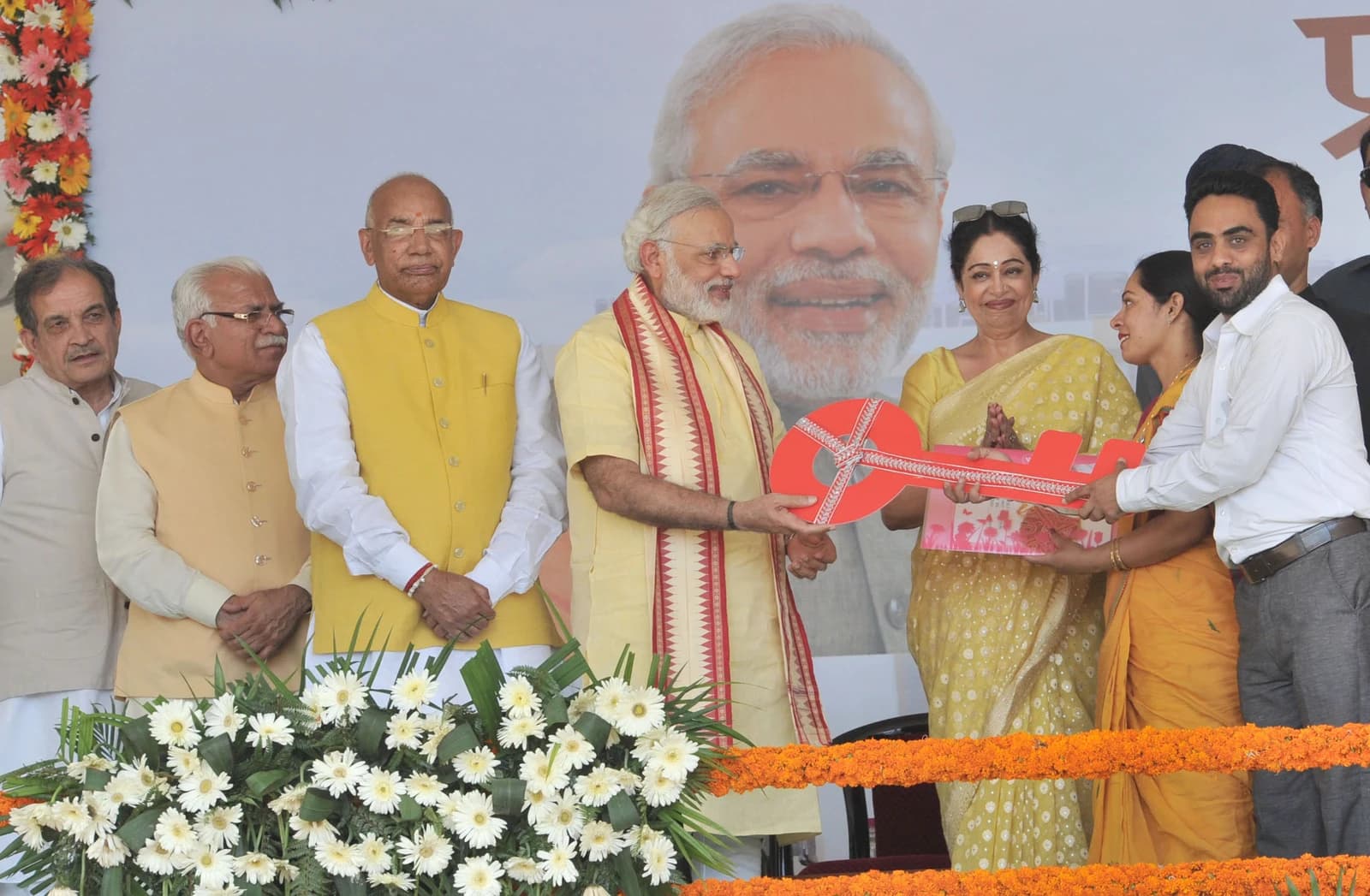
The reduction has been underpinned by a policy architecture that combines direct welfare with market-enabling infrastructure. Free grain under the Pradhan Mantri Garib Kalyan Anna Yojana reaches more than 810 million people, while the Pradhan Mantri Awas Yojana has expanded housing access. Jan Dhan accounts and direct benefit transfers have reduced leakages in subsidy delivery, and schemes such as Ayushman Bharat, PM-Kisan, Ujjwala, Jal Jeevan Mission and the rural jobs programme have provided a floor for household spending and resilience.
For investors, the implication is not just social progress but a larger, more reliable domestic demand engine. Rising formalization and wider access to bank accounts support deposits, payments and small-ticket lending, while better household balance sheets can lift consumption of staples, packaged food, two-wheelers, affordable housing and low-cost financial products. The beneficiaries include lenders, consumer firms and companies tied to rural distribution and infrastructure.
But the story is not only one of success. Economists have long argued that India’s official poverty benchmark is too low to capture the depth of deprivation, and state-level gaps remain wide. That means the headline decline in poverty should be read alongside the risk that millions remain vulnerable to inflation, joblessness and poor services even if they have moved above an income line.
The next test for policymakers is whether India can convert poverty reduction into durable upward mobility. That will depend on job creation, productivity growth and whether the government keeps improving the quality of social spending rather than only expanding coverage. For markets, the key question is whether the country’s welfare-led inclusion can evolve into a stronger, more profitable consumption cycle.
| Entity | Gains | Losses |
|---|---|---|
| Indian households | ▲Higher incomes and access | ▼Less extreme deprivation |
| Modi government | ▲Welfare-policy credibility | ▼Pressure to raise poverty standards |
| Banks and lenders | ▲More formal accounts and credit demand | ▼Less cash-based exclusion |
| Consumer companies | ▲Broader rural demand base | ▼Slower growth from poor households |