India’s rare stretch of political stability under Prime Minister Narendra Modi has helped turn a long-promised economic story into a tangible investment cycle, drawing in global manufacturers, capital and strategic attention even as the country races against a demographic clock.
India Stability Attracts Manufacturing Investment

That is the central message in a Telegraph report cited by ANI: a more predictable policy environment has enabled legal reform, welfare delivery, tax simplification and a rapid build-out of roads, rail and airports, making India easier to do business in at the very moment global companies are looking to diversify away from China. The result is visible in headline investments from Apple, Foxconn, Micron Technology and Air India’s record 470-jet order, all of which underscore how India is increasingly being treated as both a production base and a consumer market.
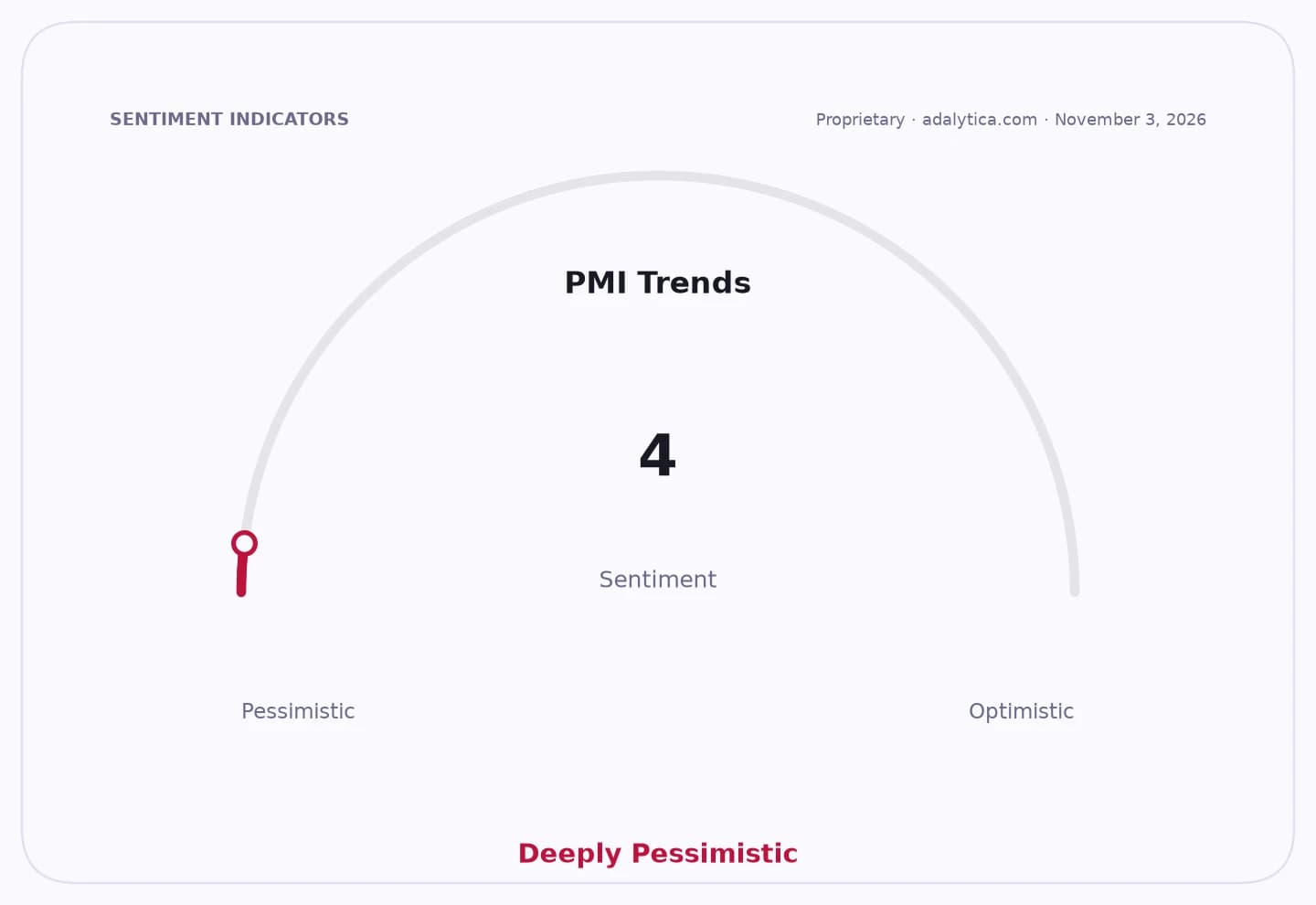
Sentiment Indicators
The economic significance goes beyond symbolism. India is now the world’s fastest-growing major economy and is on track to become the third-largest by 2029, according to the report’s framing. Its nominal GDP of about $3.7 trillion needs only to overtake Germany and Japan to reach that milestone. A larger prize is the push to become a developed economy by 2047, but that would require annual growth of at least 7.6% for 25 years, a pace the Reserve Bank of India says has been achieved only rarely since the 1991 reforms. That gap between ambition and capability is where the investment case and the policy risk coexist.
For investors, the appeal is straightforward. Political continuity lowers execution risk on multi-year manufacturing, infrastructure and digital-payment projects. Modi’s second-term agenda has included production-linked incentives for sectors such as mobile phones, pharmaceuticals and autos, a lower corporate tax rate, a nationwide goods-and-services tax and privatization steps including the sale of Air India. Those moves have made India more investable for global industry and helped lift domestic champions that benefit from formalization and rising consumption.
The market narrative is also being reinforced by capital-market positioning around India. The country’s infrastructure push is not abstract: projects in Mumbai and the Delhi-Mumbai corridor are designed to cut travel times, ease bottlenecks and support denser urban growth. That matters for productivity, logistics costs and earnings growth across sectors from construction and cement to financial services and consumer goods. It also fits the “friend-shoring” theme as Western companies seek a second manufacturing hub and governments want a counterweight to China.
But the bullish case has clear limits. India still struggles to generate enough jobs for a young population, education outcomes remain weak and income inequality is stark, with the top 1% capturing 22% of income and the top 10% 57%. Former central banker Raghuram Rajan’s warning that India could squander its moment by underinvesting in human capital is a reminder that infrastructure and digitization cannot by themselves solve the employment problem. The services-heavy economy also makes it harder to absorb the labor force at scale without a stronger manufacturing push.
The broader narrative, then, is not simply that Modi has stabilized politics. It is that stability has become a macro asset: it is allowing India to convert scale, digital infrastructure and geopolitical relevance into tangible capital inflows and industrial commitments. Yet the same report makes clear that the country’s rise is not inevitable. Investors are betting on a long runway of growth, but the real test will be whether India can turn political continuity into enough jobs, productivity and broad-based income gains before the demographic dividend starts to fade.
| Entity | Gains | Losses |
|---|---|---|
| Modi government | ▲Policy credibility | ▼Reform delivery risk |
| Global investors | ▲Lower execution risk | ▼Exposure to missed targets |
| Indian manufacturers | ▲Incentives and demand | ▼Labor and infrastructure bottlenecks |
| India’s young workforce | ▲Growth opportunity | ▼Job scarcity if growth lags |