Fitch’s warning that MSCI’s proposal could hurt Indonesia’s credit profile lands at a delicate moment for markets already facing a sharp repricing in risk appetite, with U.S. 10-year Treasury yields near 5% and Indonesian equities under pressure.
Indonesia MSCI Review Raises Credit Profile Concerns
The issue is bigger than an index label. If MSCI follows through with reclassifying Indonesia as a standalone market, the move could force passive and benchmarked money to rethink exposure, weakening demand for local assets and potentially raising borrowing costs just as policymakers are trying to preserve foreign inflows. Fitch’s comments effectively underscore that market-access concerns are no longer just an equity story; they can spill into sovereign funding conditions, the rupiah and broader capital-market confidence.
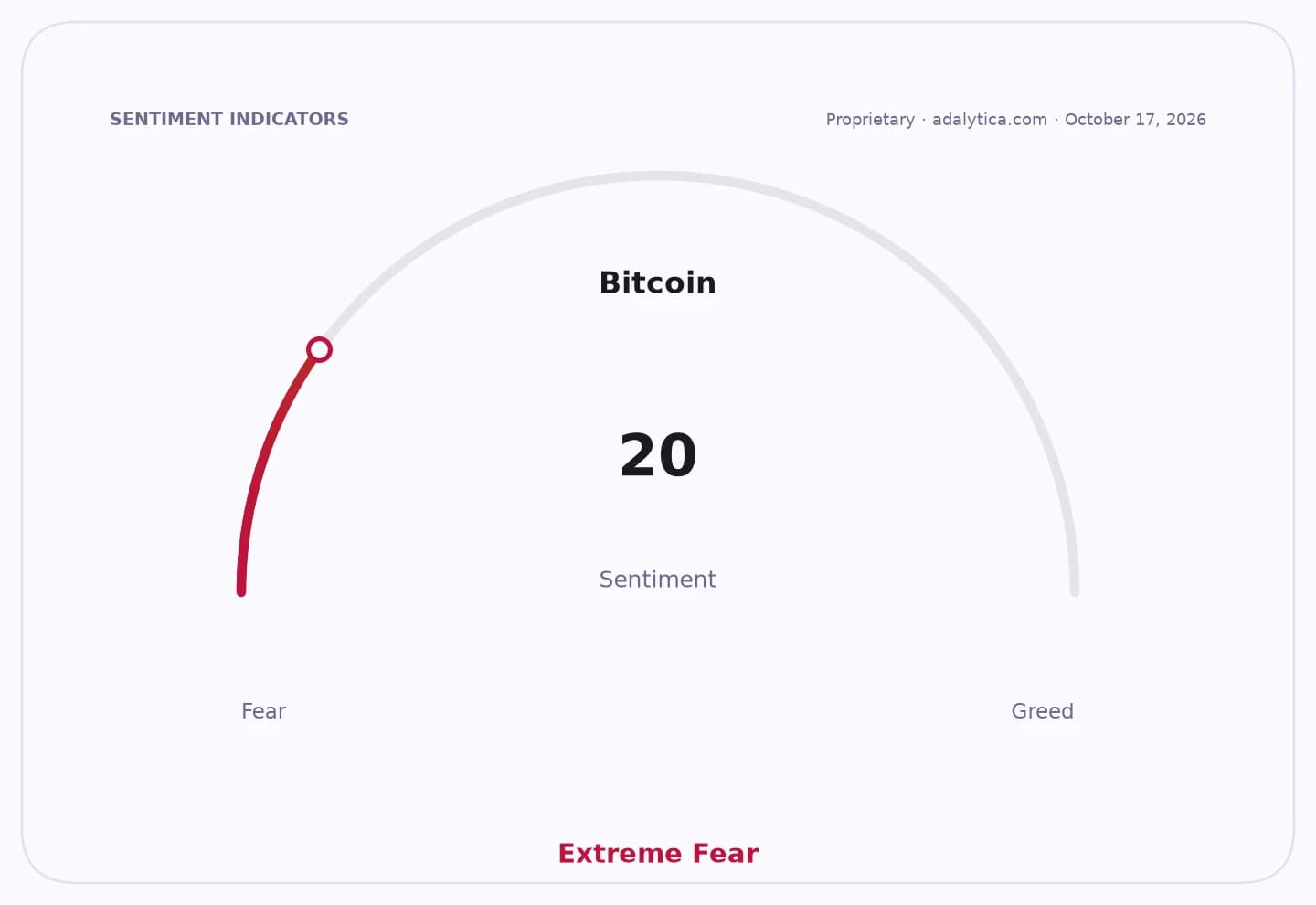
Sentiment IndicatorsⓘProprietary · adalytica.com · October 27, 2026
This is a snapshot — live sentiment, awareness and momentum for 130+ markets update continuously in the dashboard.Open AlphaPulse
That matters because index status can shape the flow of billions of dollars. Emerging-market classification helps keep Indonesia in the orbit of global funds that track MSCI benchmarks, while a standalone designation would risk shrinking that investor pool. For a country still reliant on foreign portfolio money to support its financial markets, even the prospect of exclusion can tighten financial conditions before any formal change is made.
The market reaction has already shown how quickly the issue can spread. Indonesia-tracking ETF EIDO has fallen to 10.32 from 12.69 earlier in the period and remains well below its 200-day moving average, reflecting persistent stress among foreign-facing assets. The Jakarta Composite Index has also weakened, with the IDX fund dropping to 9.19 from 11.42 in late August and trading below both its 50-day and 200-day averages. MSCI’s own stock has climbed above its 50-day and 200-day averages, suggesting investors see the index provider as insulated from the immediate political fallout.
Prabowo Subianto’s pushback, including his claim that Indonesia is “fearless,” shows how politically sensitive the issue has become. But the more consequential response will be operational: whether Jakarta can persuade MSCI to reverse or soften the proposal by addressing concerns over governance, market accessibility and investor treatment. If officials fail, the risk is not only further equity outflows but a broader erosion in the country’s credibility with global asset allocators.
For investors, the immediate question is whether this becomes a temporary volatility spike or the start of a deeper re-rating of Indonesian assets. A resolution would likely restore some confidence in local equities and the rupiah. A downgrade, by contrast, would probably leave emerging-market funds lighter on Indonesia, keep valuations under pressure and push the burden of proof onto policymakers trying to defend the country’s place in global portfolios.
| Entity | Gains | Losses |
|---|---|---|
| MSCI | ▲Methodology credibility | ▼Political pressure |
| Indonesia government | ▲If status is preserved | ▼If capital outflows deepen |
| Foreign EM investors | ▲Clearer market access rules | ▼Exposure to reclassification risk |
| EIDO / IDX holders | ▲A reversal of the proposal | ▼Lower prices, weaker flows |