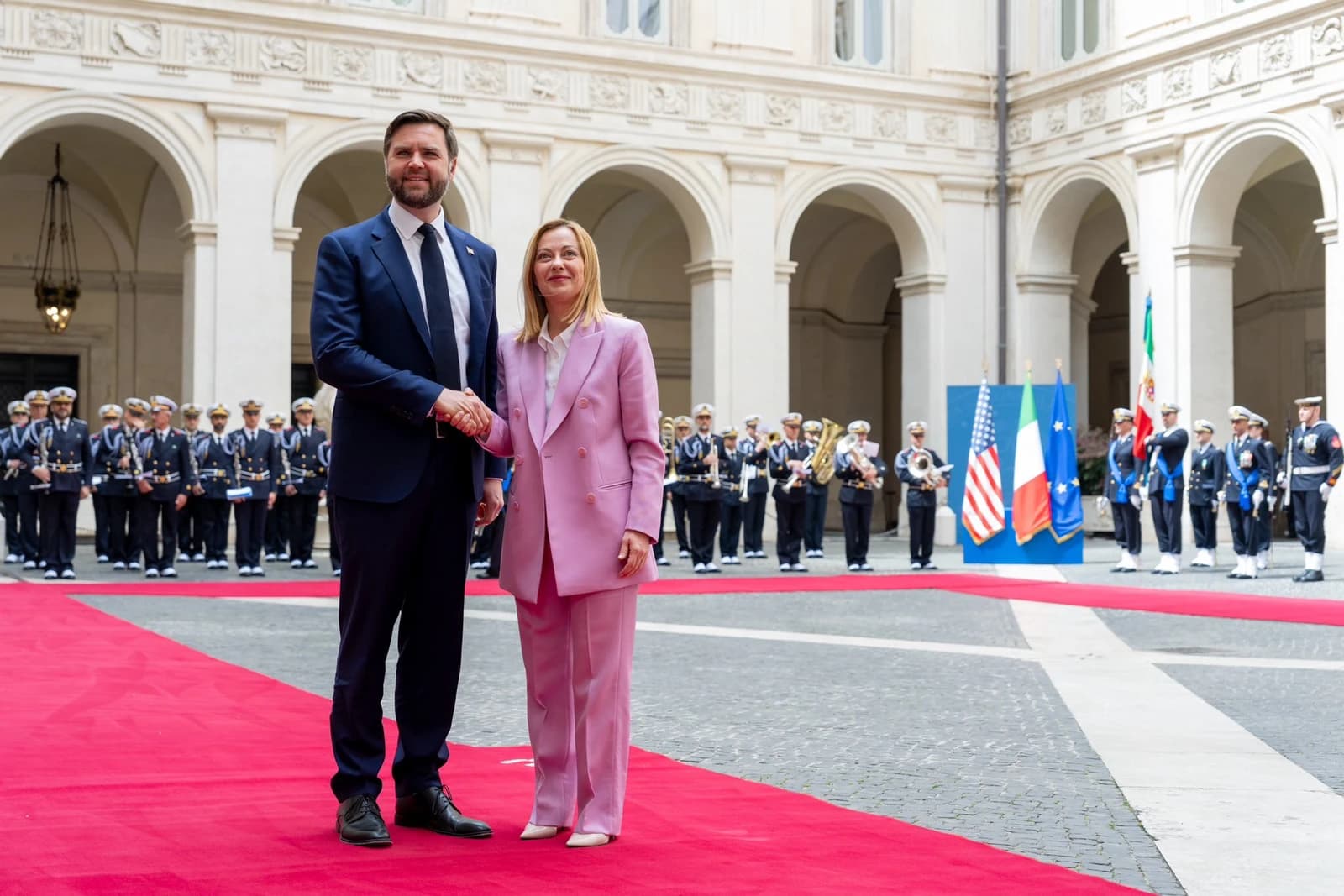
Italy’s Giorgia Meloni is turning a wave of cyber and aviation security scares into a broader case for Europe to spend more on defense, arguing that the continent now needs protection not just against missiles and drones, but against attacks on hospitals, food systems and transport networks.
Italy’s Meloni links cyber scares to defense spending
That matters because it widens the investment case for defense from a traditional military budget debate to a much bigger national-security capex cycle. If cyber resilience, airport security and critical infrastructure protection are all treated as defense priorities, the spending pool expands beyond weapons platforms into software, sensors, communications, air defense and hardened systems — exactly the kind of multi-year demand that can support margins and backlog for major contractors.
Sentiment Indicators

Meloni’s comments came after a day of false bomb alerts on several European flights, including a Wizz Air flight forced into an emergency landing in Venice and a Ryanair route from Lisbon delayed for more than two hours while anti-terror checks were carried out. She said the threats underscore that the targets of modern attacks are “civilian infrastructure, food, hospitals and transport,” and pointed to a recent case in France where hackers allegedly tried to disrupt blood-storage temperatures but a digital security shield protected the reserves.
For investors, that is the key shift: the market is still underestimating how security spending is bleeding into civilian infrastructure and digital defense. Europe’s rearmament is no longer only about tanks and missiles. It is also about the systems that keep airports open, hospitals functioning and supply chains intact. That creates a bigger addressable market for defense primes, cyber specialists and dual-use technology names.
The price action already shows how investors are positioning around that theme. Lockheed Martin has climbed to $610.05 from $488.03 in early January and remains above its 50-day moving average, while its RSI is elevated but not yet extreme, suggesting momentum is still intact. Northrop Grumman, which sits closer to homeland missile defense and advanced systems, has rebounded sharply from a spring selloff to $550.96, also above its 50-day and 200-day averages. RTX, meanwhile, has recovered to $201.29 after a deep October washout, reflecting renewed interest in aerospace and defense exposure as Europe and the U.S. sharpen procurement plans.
The bigger macro story is that governments are being pushed to spend defensively even as fiscal constraints tighten. In Europe, the debate is already intensifying over how to fund defense without crowding out schools, transport and climate investment. Germany is facing pressure over rapidly rising military outlays, while NATO members are being pushed toward higher spending targets. That political backdrop supports a sustained procurement cycle, but it also means the spending will be debated, delayed and often reprioritized — which favors companies with diversified programs, strong backlog and exposure to recurring modernization rather than single-platform risk.
Our thesis is that the market is still pricing defense as a cyclical trade, when it is becoming a secular infrastructure-and-security theme. The winners are the primes with exposure to air defense, command-and-control, missile systems and cyber-enabled protection; the secondary beneficiaries are the suppliers behind them. If Europe’s leaders keep reframing cyberattacks and civil-security incidents as defense problems, then the next leg of upside likely comes from the picks-and-shovels of national resilience, not just headline fighter jets and artillery.
For investors, the takeaway is simple: stay long the defense and security supply chain, especially names tied to homeland protection, integrated air defense and cyber resilience. The spending cycle is broadening, and that is what makes the opportunity asymmetric.
| Entity | Gains | Losses |
|---|---|---|
| Defense primes | ▲Larger budgets, broader procurement | ▼Fiscal scrutiny, contract delays |
| Cybersecurity providers | ▲More critical-infrastructure demand | ▼Budget competition from hardware |
| Airlines/transport operators | ▲Better security infrastructure | ▼Disruption from threats and checks |
| Taxpayers/public budgets | ▲Safer infrastructure | ▼Higher spending pressure |