Kazakhstan is trying to turn Chinese investment from a source of export commodities into a base for higher-value manufacturing, a shift that could reshape the Central Asian economy, broaden its industrial capacity and deepen Beijing’s commercial footprint in a strategically important supplier state.
Kazakhstan Shifts Chinese Investment to Manufacturing
The economic significance is straightforward: a country long dependent on shipping wheat, metals and hydrocarbons wants to move up the value chain into processed goods, machinery and automation. That matters because local processing captures more margins, creates more skilled jobs and reduces the vulnerability that comes from relying on volatile global commodity prices. It also fits a broader policy goal in Kazakhstan of diversifying away from raw-material dependence and building domestic industry that can feed both regional and Chinese supply chains.
Sentiment IndicatorsⓘProprietary · adalytica.com · October 8, 2026
This is a snapshot — live sentiment, awareness and momentum for 130+ markets update continuously in the dashboard.Open AlphaPulse
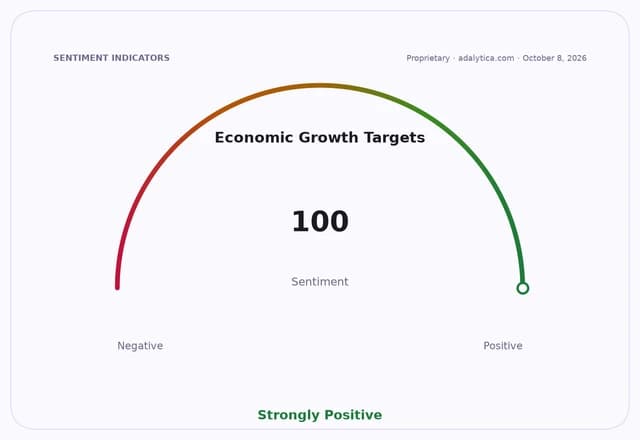
For investors, the story is less about a single project than about where capital is likely to flow next. Chinese financing and industrial know-how can accelerate factory buildouts, logistics links and equipment purchases, benefiting companies tied to automation, heavy machinery, rail, industrial software and construction. The market backdrop points in that direction: China-growth sentiment tracked by Adalytica is at an extreme-greed reading, suggesting policymakers and investors are leaning hard into support for industrial expansion, while the U.S. dollar signal has softened over the past month, a combination that can ease financing conditions for cross-border trade and capital spending.
That context helps explain why the theme resonates beyond Kazakhstan. Beijing has been pushing more outward industrial capacity, and Central Asia offers proximity, transport corridors and a political appetite for development money. For Kazakhstan, the attraction is obvious: Chinese capital can help build processing plants, robotics lines and logistics hubs faster than domestic savings alone would allow. For China, the payoff is access to resources, new markets for equipment and a deeper role in regional supply chains extending west from Xinjiang.
The risk for Kazakhstan is that higher-value production could still leave it dependent on imported technology, financing and maintenance, limiting how much of the value chain stays local. There is also the political challenge of balancing industrial deepening with concerns about overreliance on Chinese capital. But the direction of travel is clear: Kazakhstan is no longer presenting itself only as a commodity exporter. It wants Chinese money to help it become a manufacturing platform.
For investors, that means watching whether the investment pipeline shifts from mines and farms to processing plants, rail freight, industrial automation and export-oriented assembly. If that happens, the story changes from commodity exposure to a longer-cycle industrialization trade, with winners in infrastructure and equipment and losers among pure commodity exporters stuck on the lower end of the value chain.
| Entity | Gains | Losses |
|---|---|---|
| Kazakhstan industrial sector | ▲Higher-value output | ▼Commodity dependence |
| Chinese investors | ▲New manufacturing footholds | ▼Higher execution risk |
| Equipment and automation suppliers | ▲Capital-spending demand | ▼Pure raw-material exporters |
| Commodity-only producers | ▲— | ▼Margin pressure, lower strategic priority |