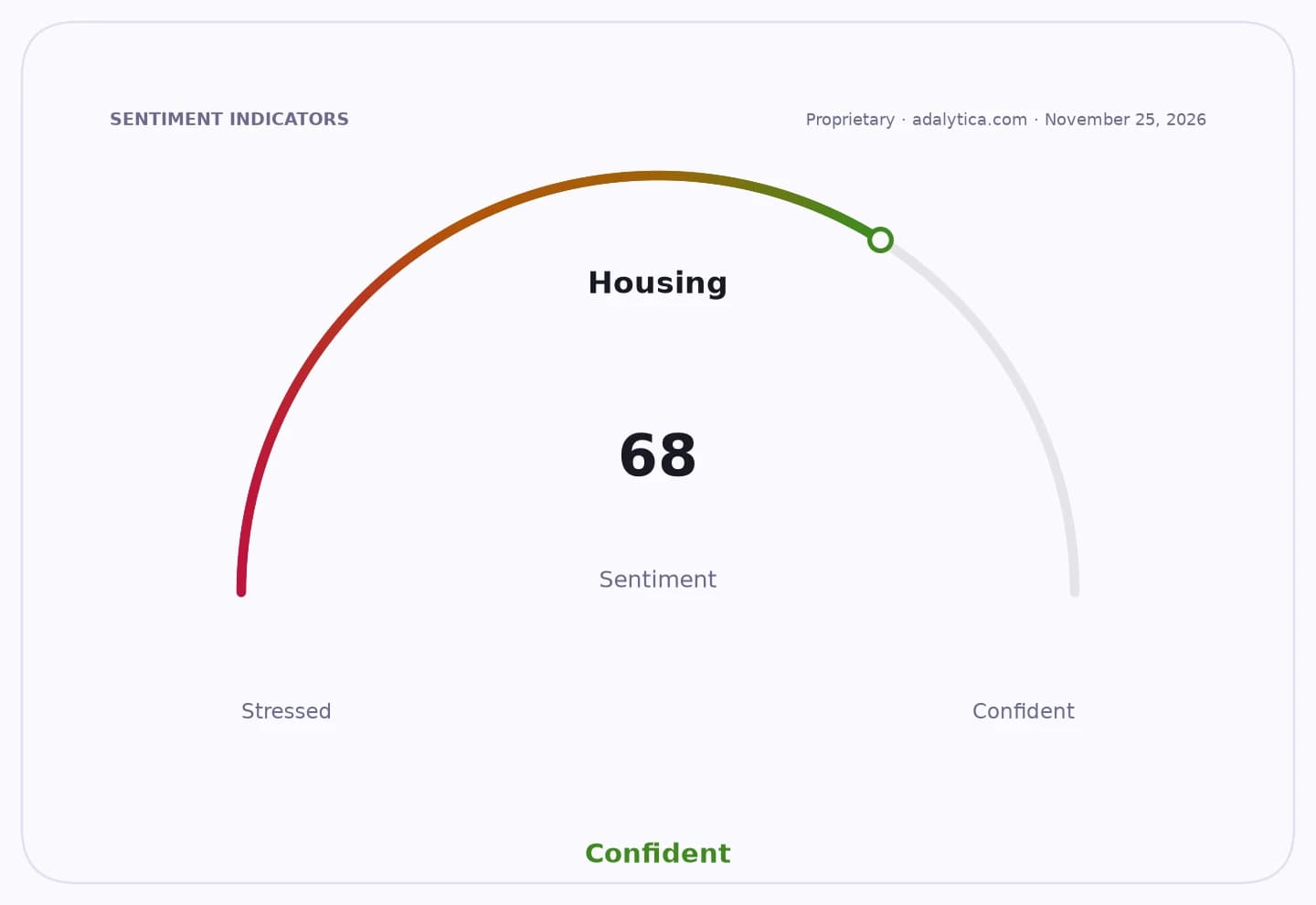
Knight Frank has sharply downgraded its outlook for UK house prices in 2027, trimming its forecast for gains to just 1% as higher borrowing costs, political uncertainty and geopolitical instability continue to weigh on demand.
Knight Frank cuts UK house price forecast for 2027
That matters because housing is one of the clearest gauges of household confidence, credit conditions and the health of the broader economy. When price growth slows this much, it usually means buyers are stretching less, sellers have less pricing power and transaction volumes stay subdued longer than hoped. For investors, that has implications far beyond estate agents: mortgage lenders, homebuilders, rental platforms and anything exposed to consumer sentiment all feel the strain.
Sentiment Indicators
The property consultancy had previously expected prices to rise 3% in 2027, but now sees a far more muted recovery. Its five-year house price forecast through 2031 has also been cut to 14.2% from 20.4%, underscoring how persistent the drag from rates may be. Knight Frank said five-year swap rates climbed from 3.5% before the Middle East conflict to 4.75% in mid-November, a move that fed directly into mortgage costs and affordability.
Tom Bill, Knight Frank’s head of UK residential research, said “a more uncertain political backdrop, higher borrowing costs and ongoing geopolitical instability” were weighing on buyer demand and market confidence. The firm expects Greater London to lag the wider UK market as affordability remains tight, while prime central London looks especially vulnerable. It now sees prime central London prices falling 3% next year, and its five-year growth forecast for that market has been slashed to 6.5% from 16.8%.
There is one bright spot: rents. Knight Frank expects UK rents to rise 18.1% over the next five years, with London rents up 19.2%. That is a reminder that when ownership becomes more expensive, demand often spills into the rental market. For long-term investors, that can support landlords and rental platforms even as price growth in the sales market slows.
The downgrade also fits a broader pattern across the housing industry. Connells recently said UK house prices would rise only 1.5% next year, with a bigger recovery coming later as borrowing costs ease in 2028. It also said high mortgage rates delayed a rebound in home moves this year, leaving 100,000 fewer transactions than expected. In other words, the market is not frozen — it is waiting.
For investors, the key question is not whether housing remains under pressure in the near term; it clearly does. The better question is which businesses can compound through the slowdown. Homebuilders with strong balance sheets, rental-focused platforms and companies tied to housing turnover all deserve a close look, but patience matters. Housing markets move slowly, and the real opportunity tends to come when pessimism is highest and rates eventually ease. For now, Knight Frank’s cut is another sign that UK homebuyers are still paying for the era of expensive money.
| Entity | Gains | Losses |
|---|---|---|
| Renters | ▲Higher rental supply demand | ▼Homebuyers facing affordability squeeze |
| UK landlords | ▲Stronger rent growth | ▼Sellers in slower sales market |
| Prime central London buyers | ▲More negotiating power | ▼Prime central London owners |
| Mortgage lenders/homebuilders | ▲Eventual refinancing and demand rebound | ▼Near-term transaction slowdown |